




A conversation between: Jim Biddulph & Nathan Ward
Our day-to-day lives may continue to be dominated by digital technology, along with our growing concerns about its impact, but one UK designer is using his creative prowess to remind us that humble paper still has a place in our 3D and tactile world.
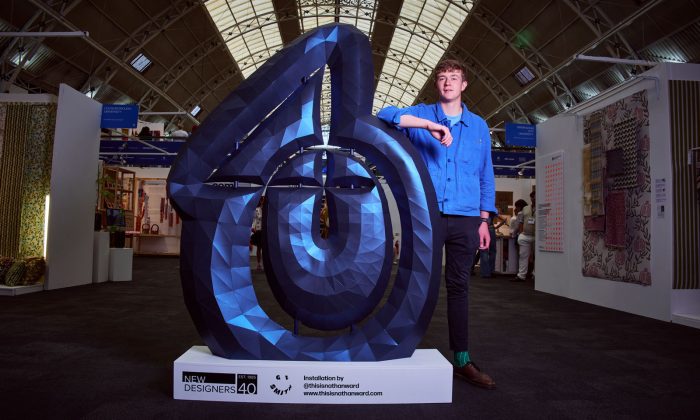
Nathan Ward studied BA Illustration Animation Kingston School of Art as recently as 2020, but his imaginative and highly skilled manipulation of the increasingly overlooked material has gained him numerous clients, including Hobbs London, The National Trust, and Fortnum and Mason. Rather appropriately, his latest client celebrates young creatives, with a commission that uses a metallic blue paper and takes centre stage at this year’s New Designers in Islington Business Design Centre.
I got to have a chat with him about all things paper and how he’s approached the new work shortly before its installation.
JB: As demonstrated by the centrepiece you’ve created for New Designers this year, your work fills a niche that captures the imagination and oozes with a playful charm. Do you think you were destined to work this way from the get-go? Have you found the perfect career for an inquisitive and playful mind!?
NW: I’ve always been making and very much consider myself first and foremost a maker. The BA Illustration Animation course at Kingston was open enough that it allowed me to realise that physical paper outcomes to communicate ideas. I love taking ideas from sketches and making them physical. I would build and capture paper sets to create photographic illustrations, which for me displays a sense of captured tactility. Stop motion animation and live action puppeteering felt to me like an extension of this process, and I started to experiment with making my paper creations move, inspired by the likes of Wes Anderson and Nick Park. As a young person, I would love to make simple Lego stop-motion movies or construct paper craft kits of historical forts, so I suppose I just never stopped playing and now design these as a professional! There was never a plan B in my decision to pursue art as a career, and I’ve had to carry a lot of self-belief, which I think has contributed to my successes in the paper field. My artworks increasingly live in their own right as physical installations for events and in public spaces, where I consider spaces like shop windows as canvases for storytelling and expression.
JB: This is one of numerous projects you already have under your belt, and I’d love to understand how you set up your studio and have continued to develop it.
NW: Whilst studying at Kingston University, I got to meet lots of great designers. The tutors on my course would invite guest speakers from industry to share insights. Vanessa Fletcher from paper company G F Smith came to Kingston School of Art to give a talk about their amazing paper collection and got speaking with me and then two fellow students, Euphemia Franklin and Tilda Rawls. The possibility of creating a small group exhibition was raised, and we ended up creating the first student-led exhibition in what was the G F Smith show space in central London.
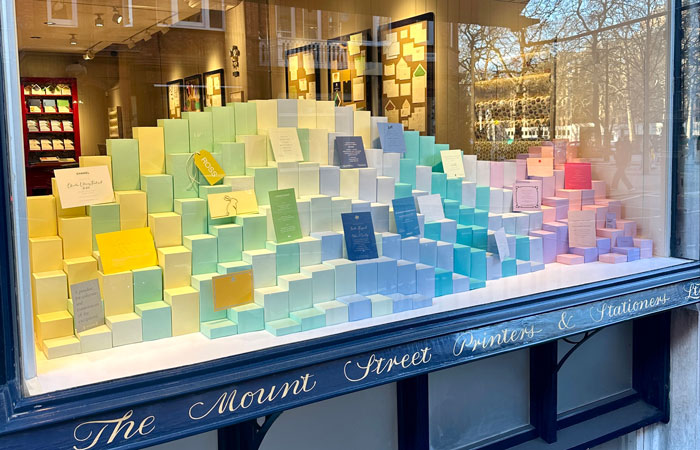
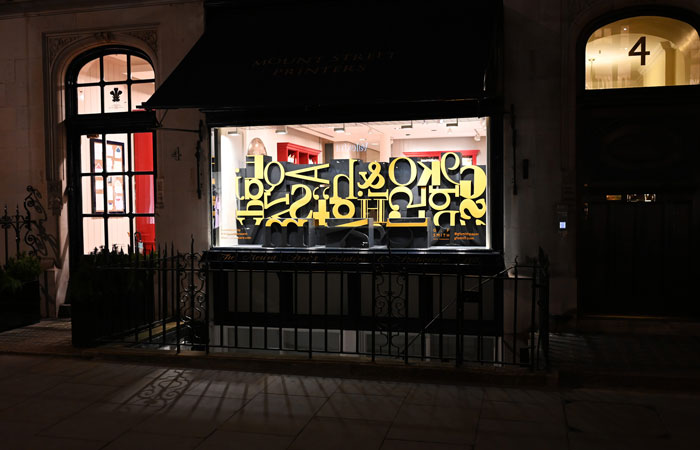
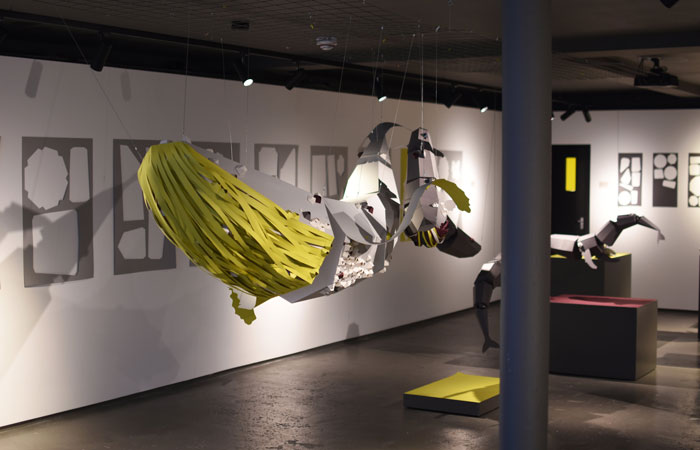
With Tilda and Euphemia, I created a giant articulated paper whale as the centrepiece for the exhibition. It was called Underwater: Paper and Movement, and the idea for the whale was inspired by the underground gallery space. The exhibition came just weeks before the COVID-19 lockdown, so we were lucky to be able to go ahead with the show! My course tutors were encouraging of the self-sought live brief, and I was able to hold the show as part of one of my university modules. We invited industry and tutors to the show and made lots of connections across the week-long exhibition. It was at the show that I was first introduced by G F Smith to one of my long-standing clients, Mount St Printers, we’ve since created lots of exciting window projects together, and from there, much of my network has grown.
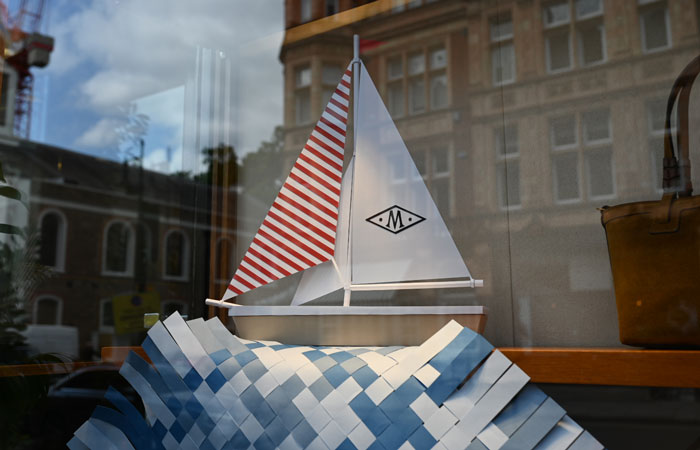
JB: As demonstrated by the ND commission, you work almost exclusively with paper, and it certainly adds to the charm of the outcomes. I imagine it also comes with its challenges, with some of these incredibly intricate and detailed works, many of which transform the flat surface into 3D forms.
NW: I’ve not exhibited at New Designers before, but it was always an ambition to, so I’m very excited to have been commissioned to create the ND 40th Anniversary artwork!
For me, the beauty of paper comes with the way you work it; it’s incredibly versatile, and the possibilities are endless! I used to worry about pigeonholing myself by only using paper, but there’s so much you can solve with it. It’s very accessible, and I think that’s part of the charm. It’s something we’re all familiar with, so when you see it elevated through design, the results can be hugely exciting. We’ve all tried making a paper aeroplane and know how hard that can be, so seeing paper transformed is hugely engaging!
JB: It really is an overlooked and underrated material, with so many great qualities. It must be super helpful to have teamed up with G F Smith in recent projects too?
NW: Yes, there’s also the sustainability aspect; paper is a circular material, and the way I work with it fills a space where formed plastics would’ve been used. It’s a great material for forward-thinking brands looking for sustainable art.
As someone who loves working with paper, I’d always been familiar with the G F Smith brand for as long as I can remember. As a company, I believe G F Smith really understands the importance of supporting future generations of artists and designers as they’ll be shaping what’s to come. Over the years, my relationship with G F Smith has continued to grow and we’ve worked on lots of creative projects together, pushing the boundaries of what paper can achieve!
JB: In an increasingly digitally dominated world, the identifiably handmade nature of your work is no doubt an intrinsic part of its appeal. Is it a non-negotiable for you, or does digital feature in your practice?
NW: It’s no secret that with the development of AI, my peers and a lot of artist-illustrators are worried about what this means. I have sought to shield my practice from the effects of this by moving into a physical 3D space with my paper sculptures. I am certain I have lost out on some editorial projects to digital means in recent years.
At the same time, technology is an intrinsic part of my practice and very much allows me to meet the demands of commercial work. My studio is equipped with a professional cutter plotter and laser cutting technologies.
I favour my cutter plotter for most projects, which cuts with a blade rather than a laser, preventing any burn marks.
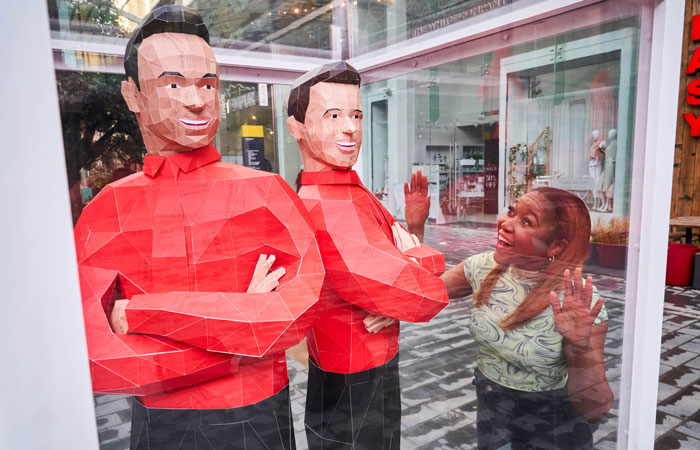
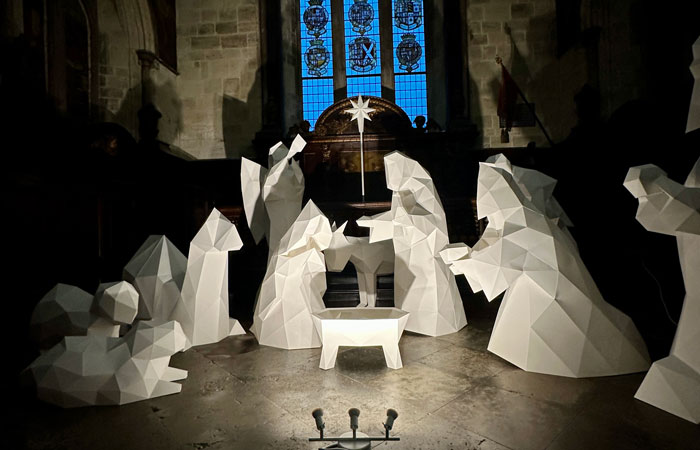
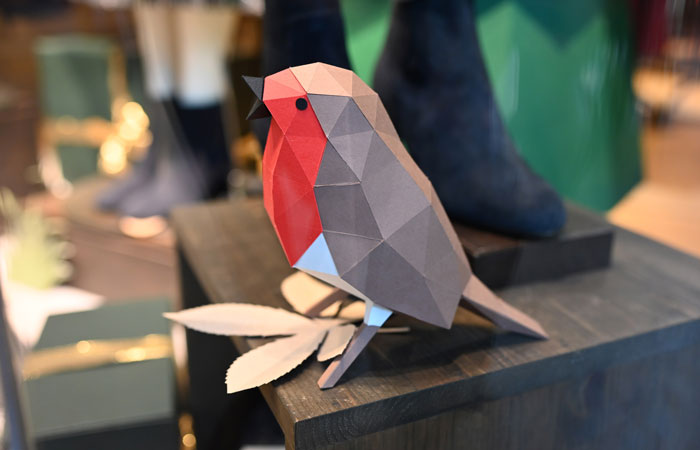
I also use 3D software to create many of my designs, modelling them in 3D digital space like a sculptor would sculpt with clay. This method of working has allowed me to create a niche in the paper world and create shapes in paper that others are unable to. A good example of this is when I was commissioned to make the famous TV duo of Ant & Dec out of paper for clients Santander and Mastercard.
JB: You’ve increasingly worked at a larger, even architectural scale. What are the challenges and joys of working in this more expansive way?
NW: As my work has increased in scale, so needs the space to make it! I now occupy two studios at ASC Kingston and my cutting equipment has had to expand in speed and size.
As a rule, with my low-poly work, if the smallest piece fits onto the cutting bed, I can probably make it. The biggest thing to consider at my studio is the doors and getting things I’ve made out. Sometimes, like the ND 40th anniversary artwork, I’ve had to segment sections of the design and finalise construction onsite.
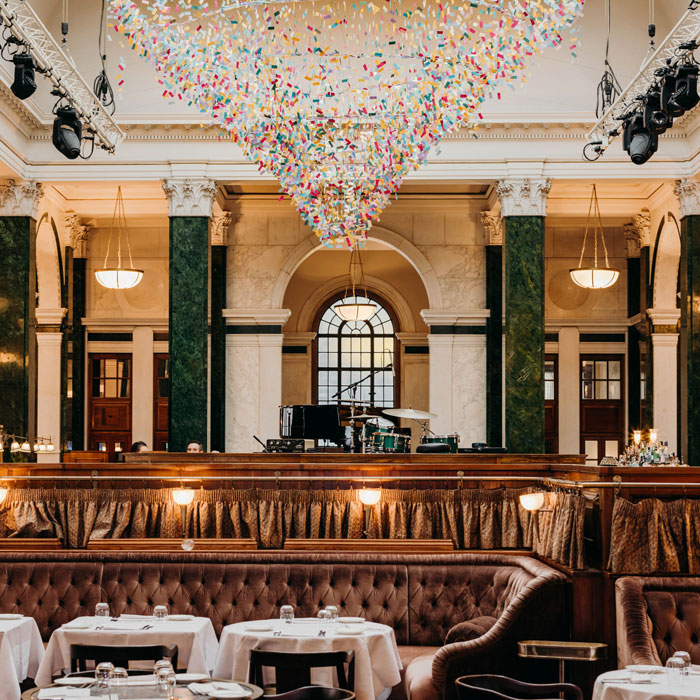
I was challenged to think big (literally) at university by my tutors and experiment with scale. One large-scale project has very much led to another. I often say yes, and problem-solve later with these kinds of large-scale projects. I’m often pushing new ground when I take on a project, and no one has done it before! There’s always a lot to consider, especially health and safety-wise wise when suspending artworks high above people’s heads. You may think ‘oh it’s just paper’, but when you multiply all the individual pieces and the cable needed to hang them, the weight can be considerable. On projects like that for The Ned’s Fifth Birthday Confetti Installation, it was also important to fire retardant each piece of paper – a time-consuming process!