






An Ambitious Expo 2025 in Osaka
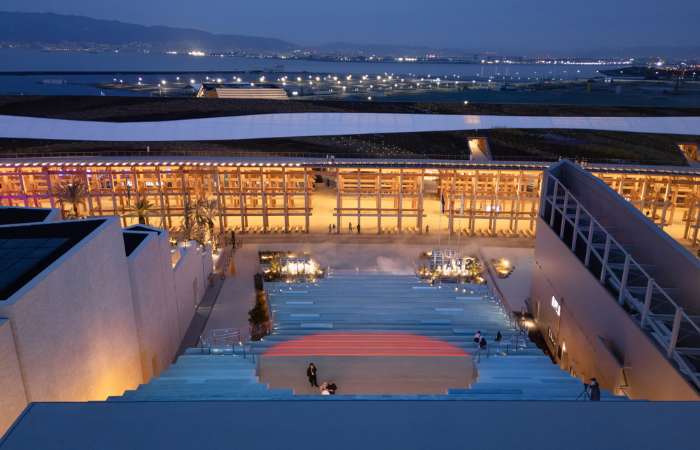
As Expo 2025 Osaka draws to a close after a six-month stint on Yumeshima Island, and a full month since my visit, it’s still hard to fathom the sheer scale, ambition, and contrasts that the event has to offer.
Architecture meets exhibition design throughout, with 188 pavilions – 152 of them international showings – themselves steeped in contrast, and on occasion, contradiction, from what they show on the inside to the outside. Everything is enormous, not least the queues, and some diehard fans of the event (way more than you’d imagine) leave smothered head-to-toe in official merchandise – even in 40 degree heat!
For context, the Expo is technically a World Expo, the first of which being the infamous Great Exhibition, which took place in London in 1851. In 1928, the mega-event was taken under the stewardship of the Bureau International des Expositions, Paris. From that first inception onwards, World Expos are intended to be “Large-scale platforms for education and progress that serve as a bridge between governments, companies, international organisations, and citizens.”
Nations gather to share ideas, while visitors from countless nations alike flock to join the conversation about how design and creativity may solve the biggest challenges of the time. In the modern era, the multifaceted behemoth rotates on a five-year basis, with a new host city chosen for each new showing. Although this year it returns to Osaka, which hosted it in 1970, an event that still holds legendary status in the World Expo Hall of Fame (if such a thing were to exist).
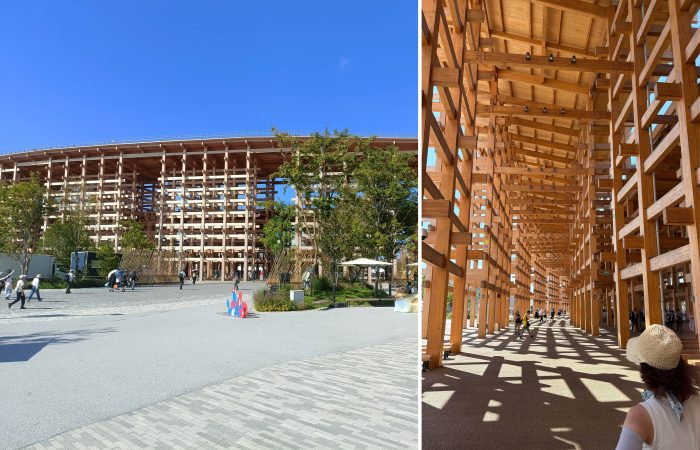
The organisers certainly pulled out all the stops this time around, though, notably with the commission of the Grand Ring. Designed by Sou Fujimoto and constructed from Japanese cedar and cypress, along with imported scots pine, the circular structure uses modern CLT connected by Nuki joints, which are traditionally used on shrines and temples. At 675m in diameter, the sheer size of the timber frame boggled the mind, but also served as a usefully shaded pathway to traverse the perimeter of the show.
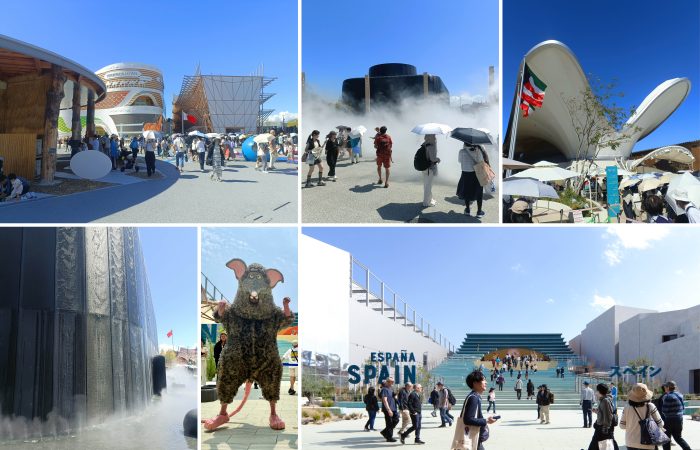
Once you’d chosen a building to beeline towards, the next step was navigating the countless umbrellas – intended for the dazzling sun, not the rain – while doing your best not to be distracted by some other looming and eye-catching piece of architecture or performance. Whether that was the open wings of the Kuwait pavilion, crashing cascades of water, clouds of water vapour, a building that looked like a lavish birthday cake, or people dancing around dressed as rats as seen at the Spanish space, there was a sensory feast to draw one’s attention in every direction.
The sheer volume and density of the queues were astounding. In places, hundreds zig-zag their way into a dense, motionless wall of bodies, sometimes so far away from any entrance that you begin to question whether myriad Situationist pranks have popped up across the site with mass, unwitting take-up. As a member of the press, fully equipped with a bright yellow ‘Media’ armband (first time for everything), there were a few perks. Although clearly very few of the security guards shepherding the throngs of willing but waiting punters had ever seen, or knew what the armband was supposed to do before.
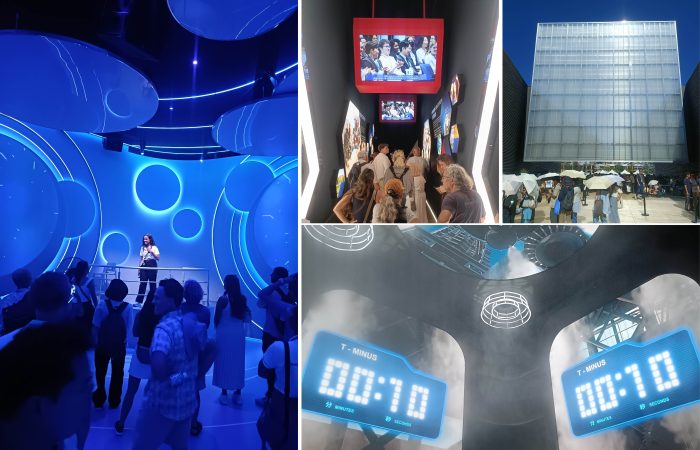
One of the few occurrences when it meant avoiding the multiple-hours-long queues was at the USA pavilion, which was somewhat of a relief on multiple levels. ‘America the Beautiful’ was designed using modular construction methods, along with dark timber, to create two triangular forms that acted as a funnel toward a central glass cuboid. Inspired by America’s famous canyons and traditional Japanese footbridges, the architecture had a fairly minimal and austere aesthetic. But that didn’t deter the crowds.
Once inside, they were herded into a winding corridor where multiple screens played an initial video introduction from President Trump, followed by an array of overly hammy talking heads from individuals who had travelled to the country to participate in various educational programs. That was one of five immersive AV-based exhibitions, which visitors were guided around by entirely superfluous, microphoned hype men and women, as well as an even more annoying AI character with the unbearably cutesy name of Spark. The circus-like event culminated with Spark and co. leading visitors into a NASA simulation, where they were blasted by the roaring flames of a rocket’s takeoff, and reminded that, if anyone is going to win the space race (again), it will undoubtedly be the USA.
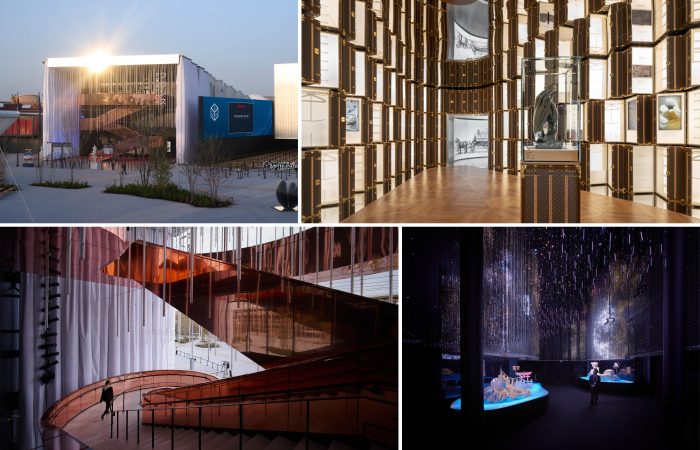
Neighbours France were as subtle in living up to their stereotypes, but that did make for a sophisticated and elegant piece of architecture. From the front, visitors were dazzled by a curved copper staircase that poked through a curtain-like veil made from clear vertical tubes. The concept was inspired by a Japanese legend, the ‘Red Thread’, which “refers to the joining of two beings by an invisible, indestructible magic thread attached to their little fingers.” Titled A Hymn to Love, the sweeping staircase created a sense a theatre and symbolically created a physical coming-together of people.
While the exhibits within included an ode to nature, with pools of water and a 1,000-year-old Olive tree, along with their own twinkling immersive AV space and sculptures by Rodin. Oh, and installations from French fashion super brands Dior and Louis Vuitton. Did you know France is known for its love of fashion…and love?
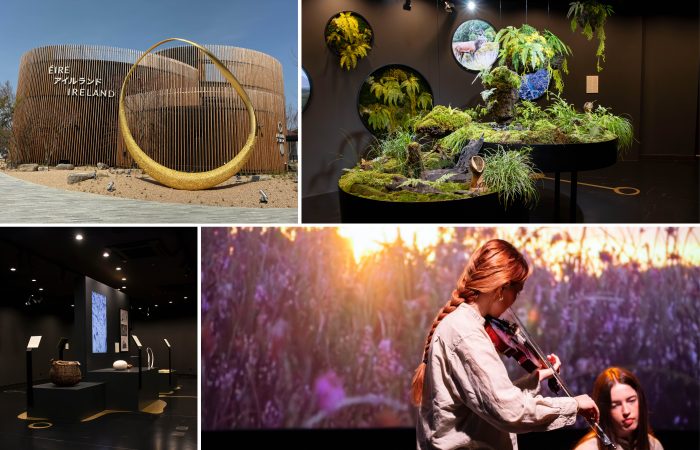
One nation that successfully blended architectural and cultural sensibilities with a degree of sensitivity and sophistication was Ireland, with its pavilion Creativity Connects People. Inspired by an abstracted triskele (three interlocking spirals), the building itself was designed by Government of Ireland architects from the Office of Public Works (OPW). Made up of three elliptical areas and a central interlocking space, the pavilion was clad in Irish-grown Douglas Fir and understated but elegant in comparison to many of its neighbours. As the title suggests, the team was also keen to celebrate Ireland’s rich and long history of creative accomplishments and its artistic influences across the globe.
Visitors were welcomed by a verdant micro-habitat designed to draw attention to the country’s unique natural landscape, with its lakes and bogs, and to offer guests a moment of quiet reflection in nature. The second space was a celebration of Irish design, both old and new, with beautifully crafted objects and literature on display, not least the iconic harp. This visual reminder of Ireland’s continued love of and influence upon music acted as a signpost to the final space, which played host to live performances set against a video backdrop by artists Marianne Keating and Caoimhín Ó Raghallaigh.
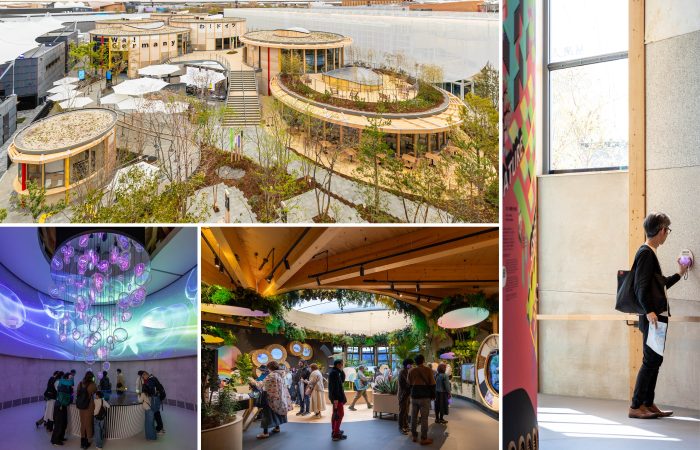
Perhaps the most impactful pavilion, though, was Wa! Germany (that I managed to see at least). To any non-Japanese speakers, the name may seem a little underwhelming. But ‘wa’ has many connotations in Japan, all of them positive: circle, harmony, and wow, for instance. The buildings themselves were circular in form, with six large, converging timber buildings forming the main exhibition spaces. The circular theme continued within, with a selection of presentations, interactive displays, and wrap-around screens, which invited guests to delve into and consider the circular economy – specifically the “impact architecture and urban planning can have on sustainability and circularity.”
Aside from LED screens, soft furnishings, and numerous plants, the main material palette within the architecture consisted of wood and mycelium panels, all of which were designed with disassembly and reuse in mind. While highlighting that, “The building sector generated approximately 115 million tons of CO2 equivalents in 2021,” the exhibition design meant that you never felt preached to or shamed. Instead, the interactive screens felt illuminating; more like an educational game, with plenty of insights into the types of materials and building methods we could be deploying in the near (and improved) future.
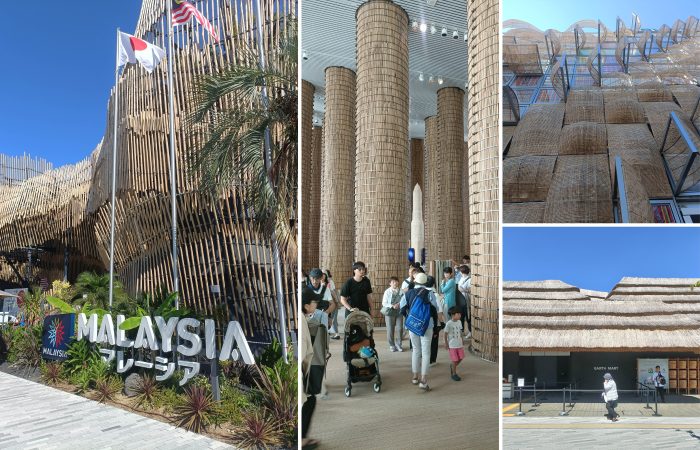
Other standout creative applications of materiality within architectural structures came from those deploying natural materials on a generous scale. Perhaps unsurprisingly, most of these examples were created by nations from the tropics, such as Malaysia, the Philippines, and the UAE. Staying true to the plants found in their regions, including bamboo, date trees, and rattan, along with the crafts that shape them, such buildings were a reminder that vernacular materials need not be lost in the modern world, including in the built environment.
That said, if anyone had the energy left to still be in attendance as the sun began to set, they were given a truly enchanting light show by the organisers. A timely reminder that the future is sure to involve plenty of sparks, distraction, and show-stopping architecture and events. As well as it being time to leave the mish-mashed metropolis that was the Expo 2025 Osaka.