






Building Collective Memory: Unknown Works Designs Paper-Led Retrospective for Beatriz González at the Barbican
Using paper as its primary material, architects Unknown Works have designed the UK’s first major retrospective exhibition for Colombian artist, curator, art historian and educator Beatriz González at the Barbican. González was born in 1932 and sadly passed away at the beginning of this year, aged 93.
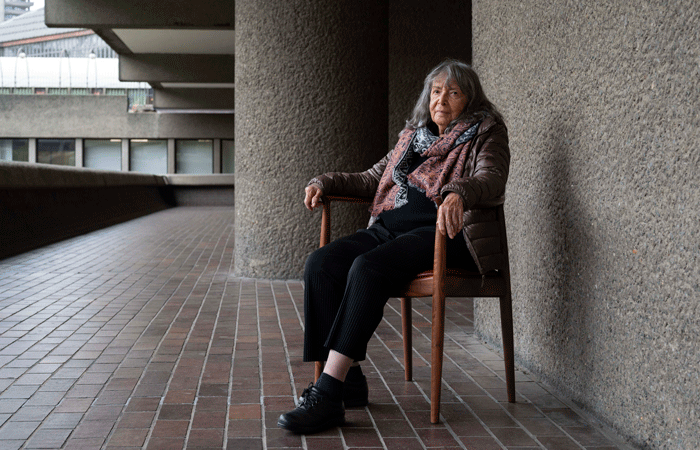
Beatriz González at Barbican Centre. Photo Louise Yeowart
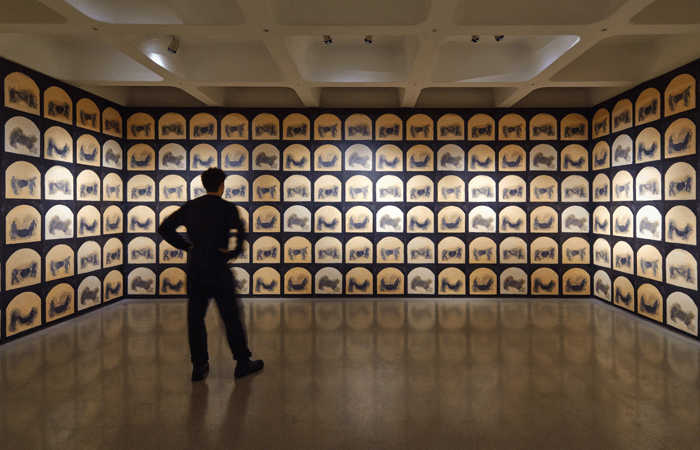
The exhibition is the largest-ever European show for this ground breaking artist, bringing together 150 artworks created over six decades, many of which have never been shown before in the UK. It includes paintings, sculptural assemblages and monumental public installations. The exhibition runs from 25 February to 10 May and forms a highlight of the Barbican’s Spring 2026 season.
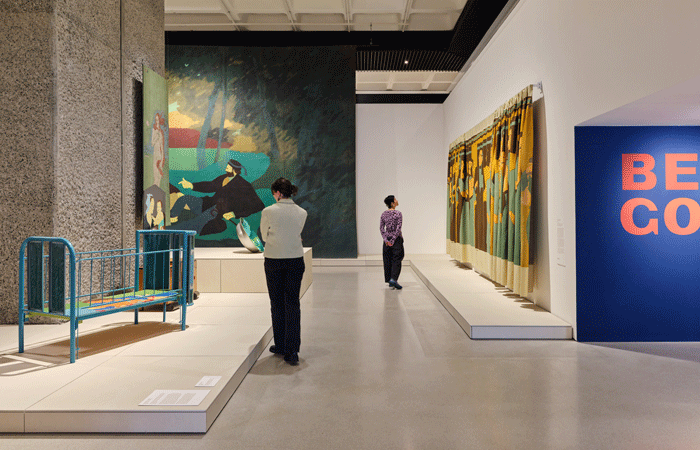
“A stack of newspapers is like a brick. Together, they build the walls of our collective memory” (Beatriz González)
Unknown Works won an invited competition to work with the Barbican’s curatorial team on the design of the show. They created a spatial and material narrative based on ‘paper-tecture’, responding to the artist’s close working relationship with print media and its materiality. González’s work drew inspiration from found images she collected throughout her life, ranging from tattered reproductions of paintings from Western art history to newspaper clippings reporting on violent conflict and loss. She reworked and transformed these sources in a distinctive graphic style, using a bold colour palette, which also informed the choice of wall colours in the show.
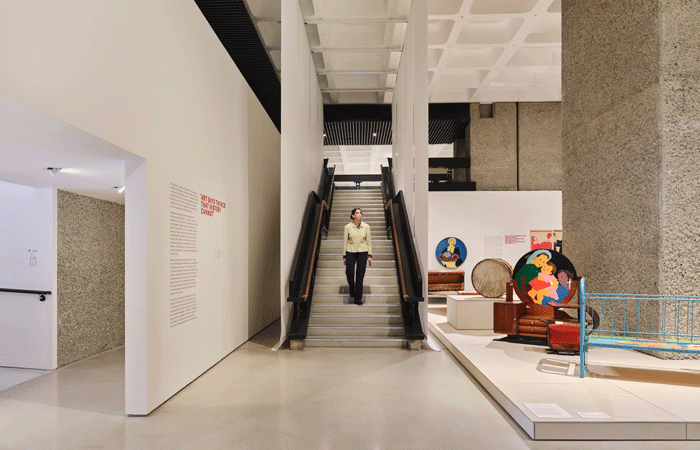
Extensive experimentation was undertaken by Unknown Works for the project, exploring the possibilities of fabricating and constructing an exhibition using paper and paper-based materials across surfaces, walls, screens and furniture, pushing the boundaries of what paper can achieve, in honour of González’s fearless creative practice.
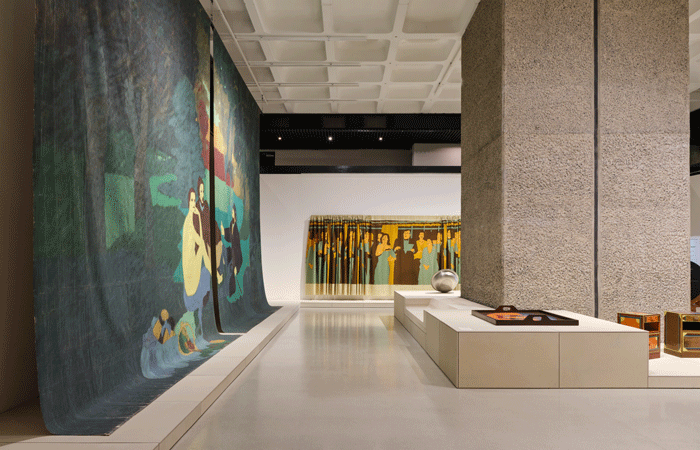
A panel product made of 100% paper called Honext – both recycled and recyclable – was experimented with in a number of different ways throughout the exhibition. First, in sheet form, with individual panels abutted next to each other to form an undulating display landscape. Then, the product was layered to form solid blocks that were carved using a CNC (Computer Numerical Control) machining process to make four monolithic benches that allow visitors to reflect on the monumental scale and impact of González’s works.
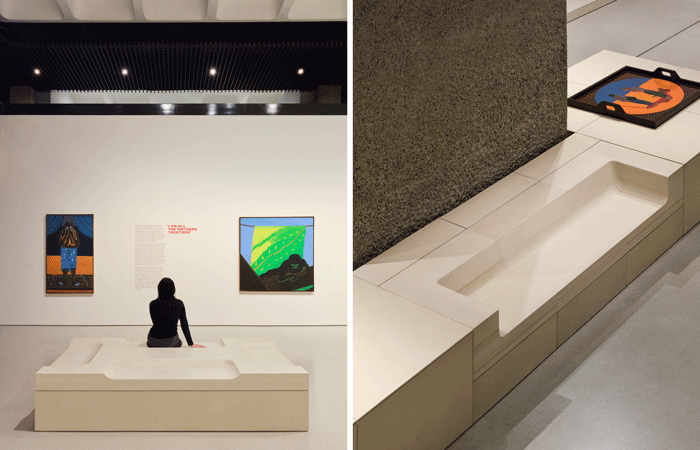
Shallow scallops have been machined into the top surface of each bench, revealing the contours of each paper layer. The benches sit throughout the gallery as both freestanding elements and integrated into the display landscape.
All paper surfaces are roughly sanded and sealed with a fire retardant varnish that catches the light and adds protection to the delicate surface. This shows off the inherent fibres of the paper and adds texture and depth.
“The use of paper directly echoes González’s fascination with politics, culture and people” Theo Games Petrohilos, Founding Director of Unknown Works explained, “as seen in her vast reference archive of print media, news cuttings and ephemera. Beatriz González was very much an experimenter, producing work in a range of formats, scales, media and materials. Unknown Works endeavoured to embed the artist’s process and passion throughout the materiality and design for this exhibition. We have greatly enjoyed our explorations into her distinctly challenging, sharp yet playful approach.”
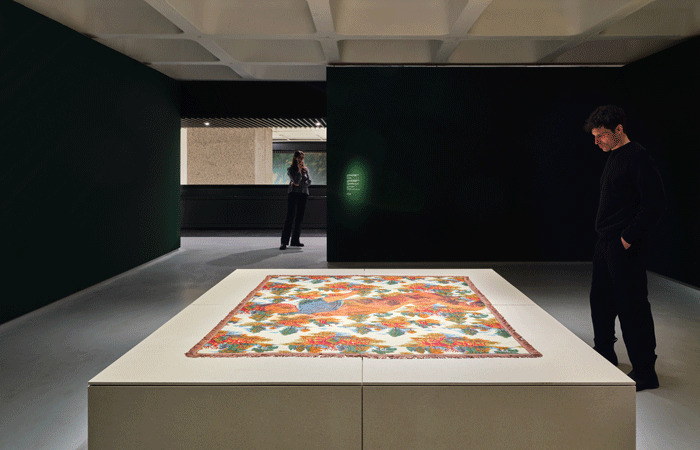
The show is located in the Barbican’s main, 2-storey, 1,500 sq m third floor gallery, made up of a central, double-height area and a galleried upper floor. Each level sees a different approach to exhibiting and framing work, from low level plinths to hold sculptures in open spaces to more conventional gallery spaces for hung works.
Creating an intimate and ethereal threshold between the upper and lower spaces, visitors are first greeted by a staircase flanked by massive, suspended sheets of paper, hanging from the Barbican’s distinctive coffered concrete ceiling soffit. This echoes newspaper print production and the large-scale printworks González herself explored.
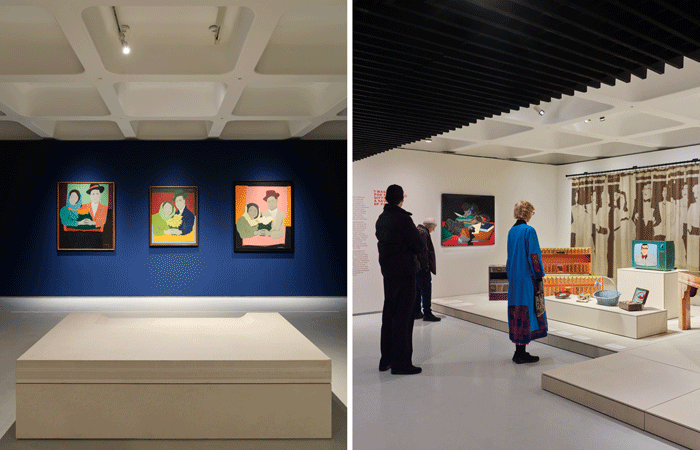
The exhibition starts formally at the upper level, where the more cellular gallery spaces play host to paintings, prints, textiles and smaller objects. González’s collection of newspaper cuttings and reference materials, housed in vitrines made of paper, line the upper mezzanine walkways so that visitors can view the collection in the context of the work it inspired.
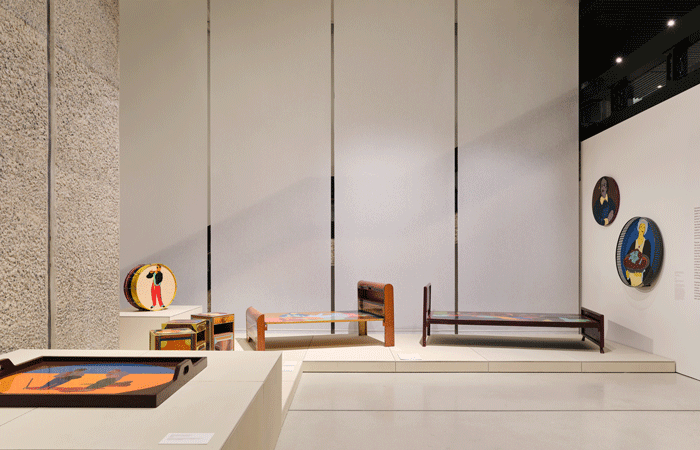
Sustainable thinking is at the heart of Unknown Works’ design process. For example, material grids were optimised with fixed panel dimensions to maximise future re-use potential. Two thirds of the paper panels used were sourced from suppliers’ waste stock, whilst four hundred paper panels will go on to have a future life in Unknown Works’ Rainforest Research Station, a project in the Cornish rainforest that likewise celebrates materiality and innovation. Metal framing – fixed with minimal fixings – has been ear-marked for use on future exhibitions in the gallery. The project has also undergone a full carbon counting process both by the design and fabrication team.
Credits:
Photography: Henry Woide | Lead Designer: Unknown Works | Contractor: Raskl Graphics: Roland Brauchli | Barbican curatorial team – Curator: Lotte Johnson / Assistant Curator: Diego Chocano / Exhibition Organiser: Rita Duarte | Production Manager: Maarten van den Bos | Technical Supervisor: Nick Davies
Exhibition:
Beatriz González
Barbican Art Gallery
25 February – 10 May 2026 / Press Preview: Monday 23 February 2026, 10am–1pm
This exhibition is generously supported by the Beatriz González Exhibition Circle: Lonti Ebers (Lead Support), Estrellita and Daniel Brodsky, the Erica Roberts Art Foundation and Flavia Nespatti.
This exhibition is co-produced by Pinacoteca de São Paulo, Barbican, London and Astrup Fearnley Museet, Oslo.
Official paint partner: Little Greene