




Designing with Empathy: How ‘The New Habitat’ Report Reframes Work and Hospitality Design
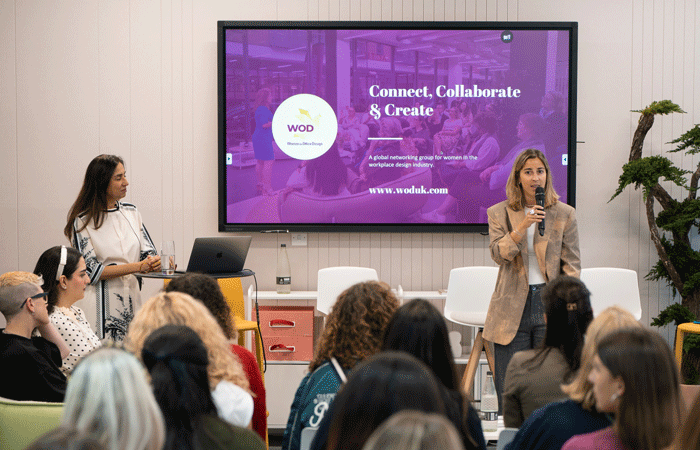
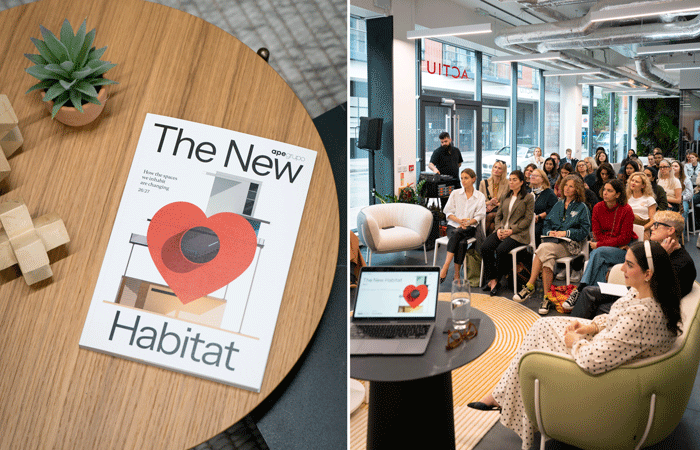
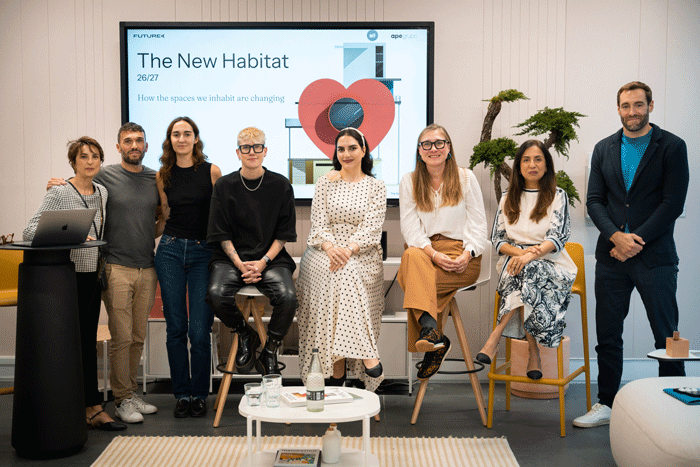
On September 4th, the Actiu showroom in Clerkenwell became a hub for insight and international exchange as Women in Office Design (WOD), in collaboration with Futurea and Ape Grupo, launched The New Habitat 26/27 trend report in the UK for the first time. The event, titled “Designing with Empathy: Trends Shaping the New Work-Hospitality Experience,” explored how flexibility, inclusion, and emotional wellbeing are reshaping the spaces where we work, stay, and live.
The evening began with a welcome from Ape Grupo, who shared the brand’s vision to move beyond product manufacturing into strategic design partnerships. “We’re driven by curiosity and collaboration,” he said. “With The New Habitat, we’re not offering fixed answers, we’re inviting global dialogue.”
Lucía Marín, trend forecaster at Futurea, then took the stage to present the report’s key findings. Framing the research as a tool for designers, not a traditional trend digest, she explained:
“This is not just about how spaces are changing, but how our behaviours, values, and emotional needs are evolving, and how design must evolve with them.”
Redefining the Built Environment
The New Habitat 26/27 is built on interviews, case studies, and survey data from over 350 design professionals, identifying five top priorities in today’s design practice: wellbeing, functionality, business viability, sustainability, and emotional experience.
The report is structured around four typologies, home, workplace, hospitality, and retail, each shaped by a defining trend:
- Home: Living Solo
An increasing number of people are choosing to live alone, a shift driven by lifestyle choices, ageing populations, and changing relationship models. Designers are responding with emotionally supportive, multi-functional homes that accommodate independence and foster resilience. - Workplace: The Workshop Lab
Offices are being reimagined as hybrid, collaborative labs, spaces that encourage experimentation, support both focus and socialisation, and serve as cultural anchors for teams working in increasingly fluid ways. - Hospitality: Real Inclusion
From age-inclusive amenities to cognitive accessibility, hospitality design is embracing genuine inclusivity. Travellers with diverse needs are no longer an edge case, they’re shaping the mainstream expectations of what hospitality can and should be. - Retail: Dreamscape Retail
Retail is evolving from transactional to experiential. Today’s physical stores act as immersive environments that offer emotional value, encourage exploration, and serve as hubs for community and brand storytelling.
Lucía concluded:
“Spaces today are not just functional, they’re emotional. They’re reflections of how we live, connect, and take care of ourselves and others.”
Panel Discussion: Global Perspectives, Shared Priorities
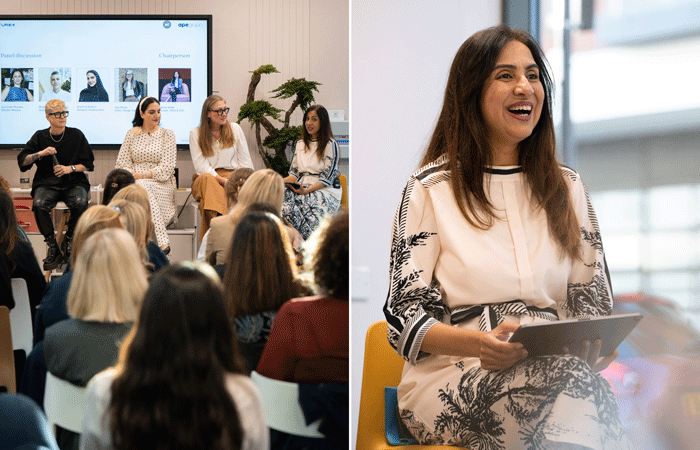
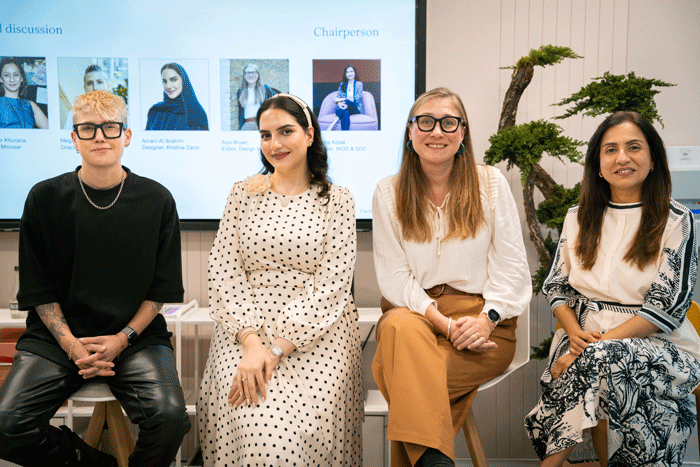
Following the presentation, Harsha Kotak, founder of Women in Office Design, moderated a panel discussion exploring how empathy, adaptability, and inclusion are actively shaping design decisions across sectors. The panel featured:
- Megan Dobstaff, Design Director, Gensler
- Amani Al Ibrahim, Design Director, Kristina Zanic Consultants
- Alys Bryan, Editorial Director, Design Insider
Originally scheduled panellist Gurvinder Khurana (M Moser) was unable to attend, with Megan kindly stepping in to respond on behalf of the workplace sector, although Gurvinder’s contribution was provided to us through her prepared insights.
Making Empathy Actionable
Harsha opened the panel with a timely question: How do designers translate empathy and wellbeing from abstract ideas into real design decisions?
Megan Dobstaff, Design Director at Gensler, reflected on how dramatically the conversation has shifted in recent years:
“Back when we started, design was very much led by interiors and architecture. But then COVID happened, the great equaliser. People no longer just had to show up to a place because someone told them to. And that’s when it really hit us , we had to take it back to the people. Why are they coming in? What are they feeling? What’s going to support them through the day?”
She spoke about how empathy has become embedded into Gensler’s process, particularly through engagement and research:
“It’s all about speaking to people. Interviewing individuals and different user groups, whether that’s mental, physical, or emotional needs, and then using that feedback to inform how we design. It’s not just a post-occupancy survey anymore. It’s built in from day one.”
This human-first approach, she explained, doesn’t mean sacrificing rigour:
“I always say every design choice needs at least three research-based reasons behind it. Why are you choosing this material? Why is that light placed there? You can’t just make things warm and fuzzy anymore, they have to function, and the function has to be rooted in how people live and work today.”
Amani Al Ibrahim, Design Director at Kristina Zanic Consultants, brought in a hospitality lens, emphasising that emotional experience is central to how people remember and connect with a space:
“Guest experience is everything, especially in hospitality. It’s what keeps people coming back. So we focus on creating spaces that are emotionally connected, not just visually impressive.”
She described how their design process begins long before concept stage:
“We always start with cultural context and local storytelling. We ask: who are we designing for? What does this place mean to them? We build a distinct narrative that drives materiality, colour, spatial flow — everything. That’s what gives a space emotional value. That’s how you make someone feel seen.”
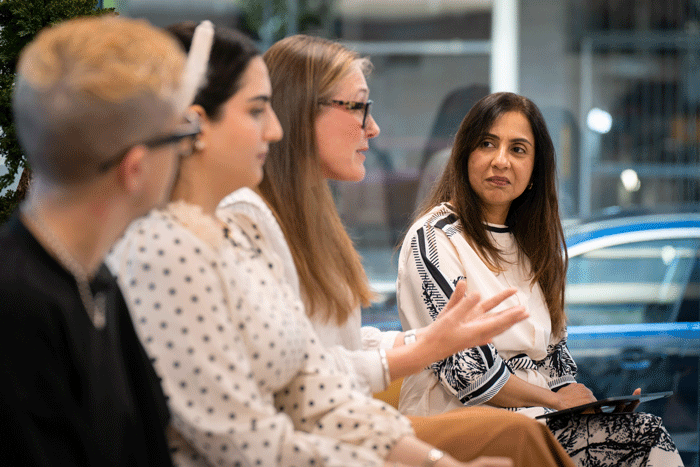
With a team spanning five offices and 25 nationalities, Amani shared that empathy also begins within their studio:
“Designing with empathy starts in-house. Our team is so diverse, culturally, generationally, in experience — and that drives us to challenge our own assumptions. To think differently. To listen more. That’s a strength.”
She summarised the shift happening across sectors:
“Whether it’s a workplace, hotel, or restaurant, people want to feel cared for. That’s what they remember. That’s what builds loyalty. It’s design that’s personal, not just polished.”
Had Gurvinder Khurana of M Moser been able to attend, she would have brought in a strong case for behaviour-based, neuro-aesthetic design. As she puts it:
“Empathy is the ability to understand and share another person’s feelings, thoughts and experiences. This is the essence of human-focused and behaviour-based design.”
She would have described how M Moser uses data to shape performance-supporting spaces:
“We take our neuro-aesthetic toolkit and layer the right quantities of personalisation, control, materiality, light, colour, sound, smell and movement, so people can choose what they need in the moment.”
And she would have highlighted the growing influence of hospitality in workplace environments:
“Concierge-style entrances, ambient lighting, the smell of coffee, this is about a holistic response to sensory design. We’re creating places people want to be in together.”
Designing for Neurodiversity and Multigenerational Needs
Gurvinder also provided a written response to the second panel question, addressing how the needs of neurodiverse and multigenerational users are influencing design:
“The EMEA business currently spans four generations, and that’s reflected in our own team too. Inclusion isn’t just something we apply to design. We live and breathe it.”
She explained that M Moser’s workplace strategy team, often including behavioural psychologists, plays a vital role in ensuring diversity of perspective at the earliest stages of design.
“We believe in mirroring the diversity of our clients’ organisations, because inclusion starts with understanding. And that begins at the brief.”
To illustrate this, she used her own evolving needs as a practical case study:
“I’m not a boomer, but these days I need both a laptop and a large screen. Research shows eyesight starts to deteriorate from around 40, and with screen time only increasing, this is accelerating. We also become more sensitive to sound.”
In a recent HQ project, Gurvinder’s team layered and positioned spaces to create both clarity and calm in open-plan environments:
“We’ve placed high-vibrancy areas thoughtfully alongside working zones and introduced acoustic interventions, both overhead and within the floor, to manage how sound travels through connected open spaces.”
Wellness and regeneration were carefully considered:
“Even when wellness spaces are located close to social zones, we create distinct experiences through colour, materiality, shape, and texture. Tactile and ergonomic finishes reduce stress and support recovery between more intense tasks.”
Gurvinder also highlighted the emotional side of inclusion:
“Even when people are doing heads-down work, they still want to be seen and included. So we consider placement carefully. Inclusion isn’t just about access, it’s about emotional belonging.”
She concluded with a reflection on how client briefs are evolving:
“It’s no longer about a wow moment for the sake of wow. Clients are focusing on creating destinations for support, connection, and community, spaces where people can do their best work and feel part of something bigger.”
Flexibility Means More Than Moving Furniture
The panel turned their attention to the evolving role of flexibility in both workplace and hospitality design, and how the term needs to go beyond its traditional association with furniture and layouts.
Megan Dobstaff opened with a call to redefine the concept:
“Flexibility is still so often misunderstood. We’re still talking about modular desks, which are great, but true flexibility starts with the bones of a building, with raised access floors, demountable walls, plug-and-play systems, services that can be easily relocated. That’s where we’re really seeing innovation in some of the HQs we’re designing.”
She also noted that flexibility should be data-driven, not just design-led:
“We monitor space usage. In some of our projects, clients are sitting on entire floors that are barely touched. That data helps us design spaces that are fit for purpose, not just packed with features.”
Alys Bryan, Editorial Director at Design Insider, urged the audience to think about flexibility not only in physical terms, but as a way of thinking, something that shapes the culture of a business just as much as its space.
“The report invites us to think about flexibility outside of modularity, to think about flexible thinking and flexible cultures, and how we as designers can help shape those.”
She pointed to the role designers play in helping clients build more adaptive, people-first cultures:
“In workplace design, there’s already such incredible expertise. Designers know how to work with clients to support them in creating environments that reinforce positive culture, and that’s what attracts and retains talent.”
Alys also drew comparisons with hospitality, particularly the increasing attention being paid to staff wellbeing and operational spaces.
“In hospitality, I think we’re seeing a lot more flexibility in culture. There’s real respect now for the needs of team members, particularly back-of-house. And just like in the workplace, when team wellbeing is properly addressed, they deliver better service. You can feel it. And when it’s missing, that’s just as obvious.”
Sustainability Without Sacrifice
On sustainability, Amani dispelled the myth that luxury and eco-consciousness are in conflict:
“Sustainability is not a compromise, it’s a design driver. We see it as an opportunity for deeper storytelling and more authentic connection with place.”
She shared how projects like the St. Regis Red Sea achieved LEED Platinum while maintaining high-end expectations.
Megan explained how Gensler is embedding sustainability into every layer of practice:
“We’ve committed to being carbon neutral by 2030, and we’re not waiting for clients to tell us to do it. If they don’t fund lifecycle assessments, we do it anyway.”
She encouraged designers to take ownership:
“We have the influence. If something doesn’t exist, let’s invent it. That’s what design leadership looks like today.”
Inclusion: An Ongoing Commitment
When asked whether the design industry is progressing fast enough on inclusion, Alys Bryan offered a hopeful but grounded response, focused on the value of skill sharing and community dialogue.
“I want this to be a celebratory answer, because there’s a lot to celebrate. The generosity in the design community right now is incredible. The talks, the panels, the collaborations, it all helps us learn faster. And that’s what we need.”
She highlighted how this spirit of openness is accelerating progress:
“Inclusion isn’t about getting it perfect. It’s about being willing to share what you’ve learned, so someone else doesn’t have to start from scratch. And we’re seeing that generosity across sectors, people offering knowledge, sharing case studies, and lifting each other up.”
Megan Dobstaff reflected on how inclusion must be treated as an evolving process, not an end goal:
“Inclusion isn’t a fixed outcome. It’s something we keep applying, testing, and improving. And it has to be embedded, from the very beginning of the project, not something we think about after layout is done or products are selected. It’s about the entire mindset going in.”
She added that inclusive design means listening first:
“We’re not experts in everyone’s lived experience, so we talk to people, we bring in experts, we ask questions. It’s about designing with, not just for.”
Amani Al Ibrahim brought in a hospitality perspective, arguing that inclusion is far more than just accessibility compliance:
“In hospitality, true inclusion is sensory, cultural, and emotional. It’s about whether a space feels welcoming, whether it reflects empathy from the first moment someone enters.”
She concluded with a nod to the power of team diversity:
“The more diverse our design teams are, the better our work becomes. Different viewpoints lead to richer, more responsive spaces, and ultimately, a better experience for everyone.”
Audience Reflections: Finding Balance
During the Q&A, audience members raised important questions around contradictions in sustainable practice, such as removing carpets to reduce carbon but harming acoustic quality or user comfort.
One participant asked whether AI might help reconcile conflicting design goals. The panel responded with cautious optimism.
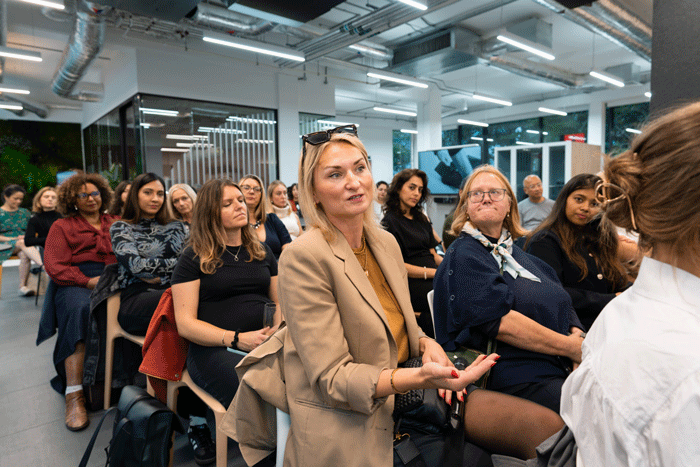
“AI can support decisions, but it doesn’t have empathy,” one speaker noted. “That’s where we come in, to bring in care, nuance, and understanding.”
Harsha shared a helpful framework:
“Try designing for the three P’s: People, Planet, and Performance. If you can find balance across those, you’re already on the right path.”
Final Thought: Designing with Feeling
Throughout the evening, one message echoed across disciplines and geographies: design must start with people, and end with feeling.
From adaptable offices to inclusive hotels and emotionally resonant stores, The New Habitat sets a bold yet grounded agenda: design should empower, include, and connect.
As Lucía closed her presentation:
“We’re not just designing spaces anymore. We’re designing systems of living.”
The New Habitat 26/27 was developed by Futurea, sponsored by Ape Grupo, and supported by collaborators across Europe, including Women in Office Design.
To download the report or learn more about WOD’s global chapters, visit www.woduk.com