







From the Barbican to the Caribbean: Tim Peck on Architecture, Responsibility, and Resort Design
This exclusive Design Insider interview features Tim Peck, Chairman of OBMI, whose career spans more than four decades and has played a defining role in shaping the firm’s global reputation in resort, destination, and master-planning design.
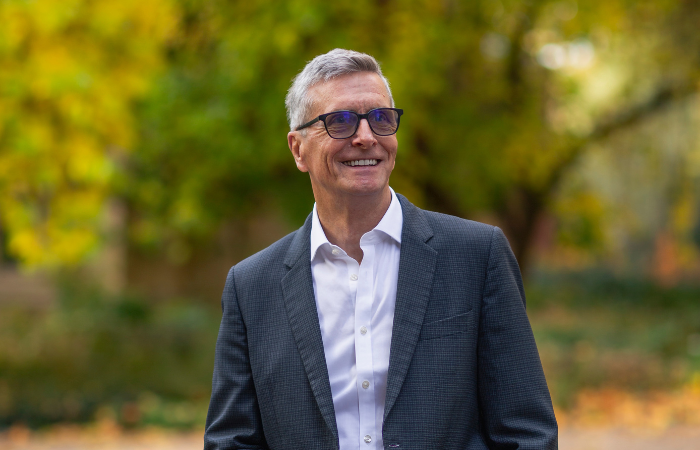
The conversation traces Tim’s formative years in 1970s London at Chamberlin, Powell & Bon, including work on the Barbican, and explores how those experiences instilled a lasting belief in architecture as both a craft and a civic act. From what was intended to be a one-year placement in the British Virgin Islands to a lifelong commitment to OBMI, Tim reflects on the values that have anchored his career: deep respect for climate and culture, a place-led design philosophy, and long-term stewardship.
Topics covered within the conversation include OBMI’s balance of culture, environment, and economics; leadership and legacy within a nearly century-old practice; the evolution of luxury hospitality; and the firm’s work across the Caribbean, the Middle East, Africa, and Europe. Looking ahead, Tim shares his perspective on sustainability, regenerative development, and the responsibility of architects to design with a long view, offering thoughtful insight into how OBMI continues to create sensitive, context-driven destinations around the world.
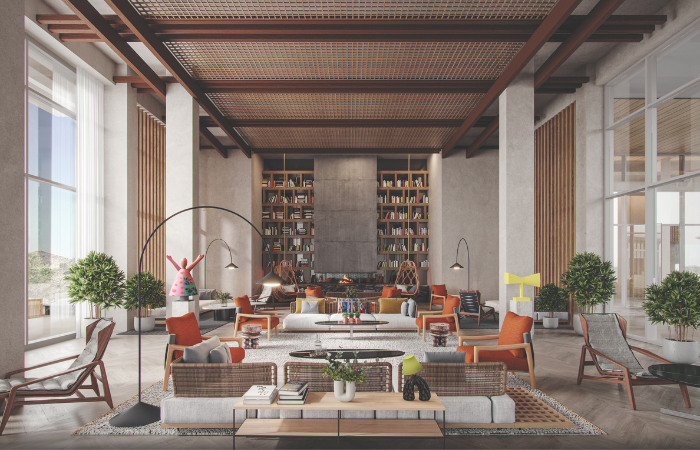
Angsana Real de La Quinta Benahavís Marbella
You began your career in London in the 1970s with Chamberlin, Powell & Bon, working on projects such as the Barbican. How did those early experiences shape your view of architecture and its social role?
Those years gave me an early understanding of architecture at various levels, micro and macro . Working with Christophe Bon you were very much aware of the attention to detail of even the smallest design element, and how architecture is truly a craft, even with a project as large as the Barbican. Bit also, at Chamberlin, Powell & Bon, you couldn’t escape the idea that buildings are a critical part of a social fabric. The Barbican, in particular, demanded that you think about how people live together, how they move through space, and how the built environment can quietly support daily life.
What stayed with me from that time was the sense that architecture must been seen on various levels, as the minutiae of the craft and as a civic act. Even in private work, you are contributing to a wider cultural landscape. That idea has guided me throughout my career.
You originally joined OBMI expecting to spend only a year in the British Virgin Islands. What made you stay, and what has anchored you to the firm for more than four decades?
I stayed because the work felt honest and the palette was spectacular. In the Caribbean, you cannot design without paying attention and deep respect to climate, to craft, to culture, and to the land itself. OBMI had a way of working that was grounded in those relationships, and it matched the way I wanted to practise.
Over the years, what has kept me here is the consistency of those values. OBMI has always been a firm that listens first. We design from the place outward, not the other way around. That ethos has shaped every stage of my career.
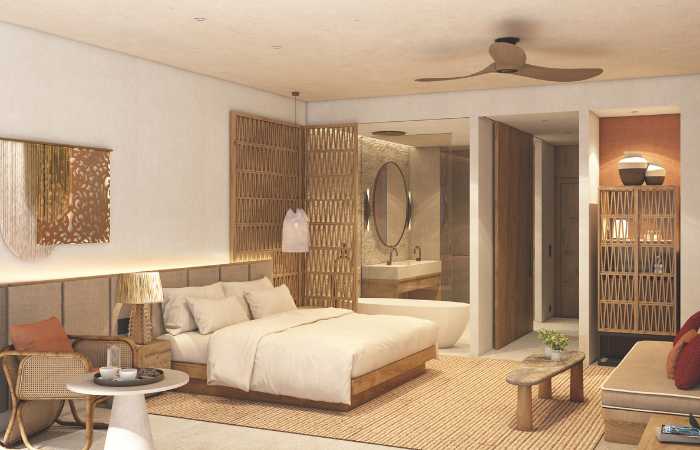
Angsana Real de La Quinta Benahavís Marbella
OBMI often speaks about balancing culture, environment, and economics. How does that framework influence decision-making in your practice?
For us, it is a practical tool rather than a slogan. Culture reminds us to understand how people live and what matters to them. Environment forces us to work with climate and landscape in ways that are resilient and respectful. Economics ensures that the project can sustain itself over time.
When one of those dimensions is ignored, the project weakens. When they are in balance, the architecture feels rooted and purposeful. It’s a framework that helps us make responsible decisions wherever we work.
OBMI has grown into a global studio working across destination resort design, private islands, and master planning. How do you describe the essence of the firm today?
At its centre, OBMI is a practice shaped by its geography. We were born and for much of our lives have lived on islands, and that has influenced how we think. We truly understand the impact of development on communities and context, we design carefully, with a deep level of responsibility and sensitivity, we conserve resources, and we work with the land as a partner rather than a backdrop.
What sets us apart today is that we carry that sensibility into every region we work in. Whether we’re designing a remote island retreat or a large-scale destination, we begin by listening to place and by understanding the responsibilities that come with it.

St Regis Bermuda
You worked closely with earlier leaders such as Bill Bissell and Baudilio Ruiz. How have those relationships shaped your approach to stewardship and OBMI’s long-term legacy?
Working with Bill and Baudilio had a profound impact on how I understand leadership. Bill was in many respects my mentor, taking our Caribbean firm on the first steps of our global adventures. Baudi was the explorer, taking all that we had learnt in our Caribbean development across the globe. They both believed the firm existed to serve something larger than themselves, the people, the places, and the ideas that shaped OBMI. Their leadership was grounded in empathy, generosity and care, not hierarchy.
That perspective has shaped how I see my role. Stewardship, to me, is about strengthening the practice for the next generation. It means creating an environment where young designers can grow, where curiosity is encouraged, and where the values that have guided OBMI for nearly a century remain clear and alive.
We spend a great deal of time thinking about continuity, documenting our processes, expanding our research culture, and ensuring each studio has the autonomy and mentorship it needs. Our legacy is not just a portfolio; it’s a way of thinking. My priority has been to preserve that ethos while giving the next generation the space to move it forward in their own way.
You’ve described architecture as a “vehicle for connection.” How does that idea manifest in sensitive or culturally distinct destinations?
Connection to me is stepping away from ego and listening deeply to culture context and community. It is about using what we learn by our listening to allow people to feel the essence of a place. In sensitive landscapes, that often means stepping back, working with topography, embracing local building knowledge, and designing in ways that minimise disturbance and truly resonate with context.
In culturally rich contexts, it means listening to the stories and values that shape daily life. The goal is not to imitate, but to interpret with care. When architecture supports the land and honours culture, guests feel a deeper bond with the destination.
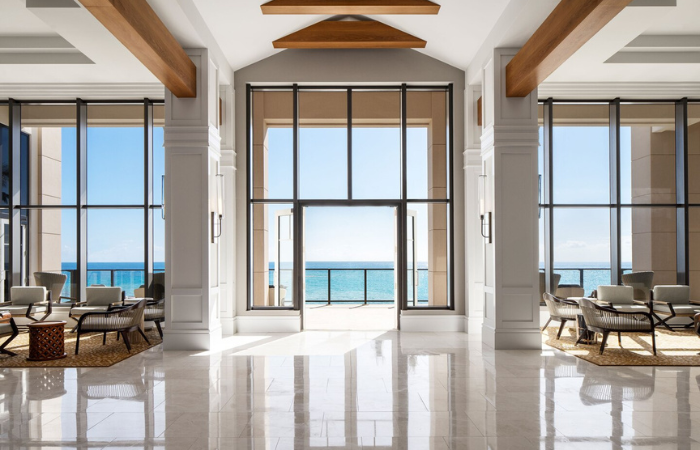
St Regis Bermuda
With OBMI active across the Caribbean, the Middle East and North Africa, where do you see the most compelling opportunities for resort design today?
Different regions are moving at different rhythms. The Middle East is entering a fascinating period of experimentation, with projects that ask designers to think in new ways about ecology, art, and guest experience.
The Caribbean continues to evolve, with a focus on low-impact development, wellness, and a growing interest in branded residences.
In parts of Africa, we’re seeing a renewed appreciation for cultural depth and for hospitality rooted in community. The strongest opportunities often arise where there is a desire to create destinations that are specific rather than generic. These places are shaped by the identity of their landscape.
Are there any upcoming OBMI projects that reflect the firm’s forward-looking direction?
Two projects illustrate where we are heading as a practice.
In Europe, we are leading the design of Angsana Real de La Quinta Benahavís Marbella, Banyan Tree’s first Angsana resort in Spain. Set within the hills above Marbella, the project brings hospitality, living, and wellness together as part of a wider masterplanned community. The architecture is carefully embedded into the sloping terrain, capturing long views and strengthening the relationship between indoor and outdoor space. Conceived as a long-term lifestyle destination rather than a standalone resort, the design reflects a quiet, place-led approach to contemporary hospitality — one grounded in the character, climate, and daily rhythms of the Andalusian landscape.
We are also working on AlWadi – The Living Canyon in Abha, Saudi Arabia, where OBMI has been appointed lead designer for Ardara under the chairmanship of Prince Turki bin Talal. The development integrates luxury hospitality, cultural and wellness components, along with public realm and waterfront spaces. It has been envisioned as a catalyst, socially, economically, and environmentally, setting a new benchmark for regenerative and context-driven development in the Abha region. It invites us to design with restraint, to honour the region’s natural drama, and to imagine a destination shaped by both ecological care and cultural depth.
Both projects demonstrate the direction we’re committed to: hospitality experiences that are rooted in place, sensitive to landscape, and designed with a long view in mind.
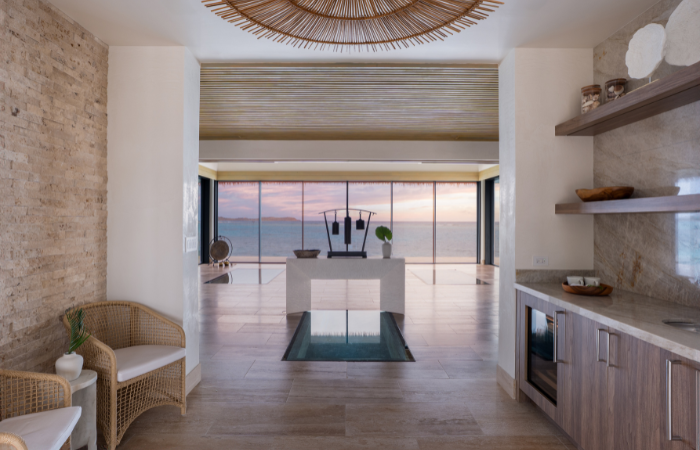
Sundara Spa, BVI
The resort sector is facing rapid change — climate pressures, shifting travel patterns, and new guest behaviours. What do you see as the biggest challenges ahead?
One challenge is understanding that resilience must be built into every decision. Rising sea levels, changing storm patterns, and ecological stress require us to design with far more foresight.
Another is the need for authenticity. Guests are increasingly attuned to the difference between what is genuine and what is simply cosmetic. That demands a deeper engagement with culture, history, and materiality.
These challenges are pushing resort design to become more interdisciplinary — architects now work closely with ecologists, anthropologists, engineers, craftspeople – and even neurologists. I see that as a healthy evolution.
Sustainability has been central to OBMI’s thinking for decades. How is the firm approaching global sustainability imperatives today, especially in coastal and island environments?
Our approach is grounded in context. Islands teach you to design with limits — water is finite, energy is precious, ecosystems are delicate. That awareness was based in necessity and has shaped our process long before sustainability became a mainstream topic.
Today, we are investing more in environmental modelling, coastal resilience strategies, passive cooling, and local materials. We collaborate closely with local communities because cultural continuity is essential to long-term sustainability. A project succeeds when it strengthens both ecology and identity.

Sundara Spa, BVI
You have spent much of your career working in the luxury hospitality sector. How do you define luxury today?
Luxury today is less about accumulation and more about experience. It is the gift of time, space, and attention — the feeling that the world has slowed enough for you to pay attention to it.
Guests are seeking environments that feel sincere and connected to place. They value craftsmanship, quiet moments, and a sense of belonging. Materials that reflect nature, details made by hand, and spaces that encourage contemplation are far more meaningful than displays of opulence. It is about making your guest experience grounded and ensuring that they feel as though their vacation experience has in some why improved or uplifted their quality of life.
How are new generations of travellers influencing OBMI’s design strategies?
They are bringing a greater level of thoughtfulness. Younger travellers care about impact across the environment, culture, and social issues. They want to understand where things come from, how they’re made, and who benefits.
This is shifting our focus toward sensory design, local craft, restorative landscapes, and hospitality experiences that encourage reflection rather than spectacle. The aim is to create places that feel grounded, personal, and enduring.
Looking to the decade ahead, what excites you most about the future of OBMI and of resort architecture more broadly?
What excites me is the sense of responsibility emerging within the field. There is a growing understanding that designers must think in terms of generations, not seasons.
At OBMI, we are building on our heritage while expanding our research and our global networks. The next decade will challenge us to design more lightly, to collaborate more broadly, and to imagine destinations that enrich both people and place.
I’m encouraged by the younger designers entering the profession. They are inquisitive, principled, and eager to work in ways that respect culture and ecology. That gives me great optimism for the future.