





Redefining Leadership, Opportunity and Inclusion in Commercial Design
Design Insider spoke with four designers whose perspectives are shaped by both practice and personal experience: Tatiana Sheveleva, Owner at CHAPI Design; Kate Mooney, Founder and Principal at OCCA; Ana Moisin, Founder and Creative Director at Anamo Design Studio; and Rachel Trippier, Studio Director at f.r.a.
Together, they share candid reflections on mentorship and sponsorship, flexible working and progression frameworks, the growing importance of strategic and data-led skills, and how inclusive thinking can be embedded not only in studio culture, but in the spaces we create.
Our intention is to discuss the realities of commercial interior design today, highlighting where contribution becomes tangible, where change is still needed, and what the sector can commit to now to create lasting progress.
When we spoke with Ana Moisin, Founder and Creative Director at Anamo Design Studio, she walked us through what, in her experience, “giving” looks like within the commercial design industry, and why it can be a practical lever for accelerating gender equality.
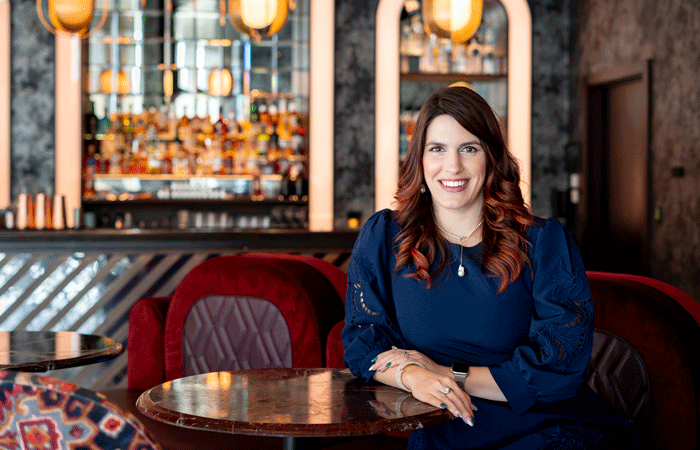
Ana Moisin, Founder and Creative Director at Anamo Design Studio
Ana shared: “Within the commercial interior design industry, ‘giving’ takes the form of deliberate investment in people and progression. In my experience, it begins inside the studio environment. At Anamo Design Studio, giving means opening the full spectrum of practice to emerging designers, from concept and storytelling through technical detailing, procurement, and site delivery. Rather than confining junior designers to narrow roles, we ensure they understand both the creative and commercial realities of our industry. This transparent approach builds confidence and competence early. Giving also requires time and visibility from leadership.”
That idea of “giving” as something active and actionable was echoed by Kate Mooney, Founder and Principal at OCCA. Kate explained: “‘Giving’ in our industry should be practical. It’s about giving time, access and real responsibility. Over the years I’ve realised that the most powerful thing I can give another woman in this sector is not simple design advice, it’s opportunity. A seat at the table. Exposure to clients. Ownership of a budget. Space to make decisions and learn.”
Tatiana Sheveleva, Owner at CHAPI Design, reinforced the same message by widening the lens beyond individual support and onto the habits that shape studio culture. In her view, progress accelerates when contribution becomes embedded in how teams operate day-to-day, who gets mentored, who gets credited, and who is actively brought into the room. Tatiana said: “‘Giving’ in commercial design means mentoring, sharing open-source assets, crediting all contributors and hiring inclusively. When senior women sponsor and network for emerging talent, they break the ‘old boys’ club,’ expand the talent pool and prove that gender balanced teams produce stronger work – thereby fast-tracking gender equality through a cycle of mutual contribution.”
Leadership remains a key focus of gender equity discussions. When we spoke with Rachel, she set out the tangible actions design practices can take to create stronger pathways for women, and why progress depends on more than intention alone.

Rachel Trippier, Studio Director at f.r.a.
Rachel Trippier, Studio Director at f.r.a. shared: “Creating stronger pathways for women in design comes down to three things: flexibility, clarity and respect. Giving people flexible ways of working means ambition doesn’t have to be compromised by life outside the studio. Providing a clear pathway to success, through transparent progression, mentorship and opportunities to lead visible projects helps build confidence and capability. And above all, creating a culture of respect, where contributions are genuinely valued and people have a platform to thrive, is what allows women to step into leadership naturally. When these elements come together, it’s not just about supporting women; it’s about building a stronger, more inclusive design sector for everyone.”
That focus on practical change and who holds responsibility for delivering it was echoed by Tatiana. Tatiana explained: “First, men have a pivotal role to play in creating a workplace where women can thrive as leaders. It is not enough to simply refrain from bias; men must actively champion gender equity by mentoring female colleagues, advocating for their ideas, and ensuring that promotion pathways are transparent and merit-based.” She added: “When men use their influence to dismantle structural barriers… they help pave a clear road for women to assume leadership positions.”
Ana Moisin reinforced the same message by grounding it in the mechanics of practice: what gets measured, rewarded, and made visible. In her view, stronger pathways are built through structural commitment, clearer definitions of leadership, transparent pay and progression frameworks, and flexibility that reflects the realities of commercial project delivery. She also points to representation as a catalyst: when women are visibly leading major projects, negotiating with stakeholders, speaking on industry platforms and being credited for their work, leadership stops feeling like an exception and starts to look like the standard.
Mentorship and sponsorship are often cited as catalysts for change. When we spoke with Tatiana, she reflected on this through the lens of her personal experience, describing the specific moments where guidance became advocacy, and how that support reshaped her confidence, visibility, and long-term trajectory.

Tatiana Sheveleva, Owner at CHAPI Design; Kate Mooney
Tatiana shared: “Mentorship and sponsorship are often cited as catalysts for change, and my own career has been a testament to their power. When I entered the design field, I was fortunate enough to cross paths with a visionary, creative woman who instantly recognized the potential and imagination I brought to my work. Beyond offering guidance, she became a sponsor, championing my ideas in boardrooms, assigning me high-visibility projects, and, perhaps most importantly, instilling a deep sense of confidence that I could succeed on my own terms. That early act of kindness left an indelible mark on me, and the lessons she taught continue to shape the leader I am today.”
That emphasis on mentorship meeting people at the point where confidence is still forming was echoed by Ana. Ana explained: “Mentorship has the power to influence a career at the moments when confidence is most fragile. During the pandemic, I mentored several interior design students who all happened to be young women navigating their education in isolation.” She added: “Beyond technical advice, I focused on helping them understand how the industry truly operates… how to present ideas with conviction, and how to navigate commercial realities.” For Ana, mentorship also runs both ways: “Mentorship creates a two-way exchange; guiding emerging designers sharpens your own clarity and sense of responsibility.”
Kate reinforced the same message by linking mentorship directly to commercial fluency and long-term resilience. Drawing on her own early exposure to contract furnishings and the realities of business, she now sees knowledge-sharing as part of leadership, not only building design skill, but accelerating readiness for senior responsibility. Kate noted that mentoring, at its most effective, includes bringing emerging talent into the spaces where decisions are made: commercial reviews, client negotiations, and strategic conversations, the experiences that quietly shape who becomes confident, capable, and ready to lead.
The theme highlights empowerment in leadership, STEM, and economic sectors. As commercial interior design becomes increasingly data-driven and technologically integrated, we asked our interviewees how the industry can encourage more women to engage with the technical and strategic sides of the profession not as a separate discipline, but as an increasingly essential part of design leadership.
Ana shared: “Commercial interior design today sits at the intersection of creativity, data, technology, and business strategy. Encouraging more women to engage with the technical and strategic dimensions of the profession begins with broadening how we define a ‘designer.’ Every individual brings a different strength, some are conceptually driven, others naturally analytical or systems-oriented. Recognising and valuing that diversity of capability creates space for more women to see themselves within the technical side of practice. Rather than expecting every designer to excel equally across all disciplines, studios can build multidisciplinary teams that include specialists in technology, data analysis, sustainability metrics, and commercial strategy, some of whom may not be traditional designers at all.”
Rachel mentioned that “Giving equal opportunities to see projects through from concept to completion is essential for encouraging engagement with the technical and strategic sides of design. By cross-training team members across different stages, from initial discovery and concept development to implementation, fit-out coordination and collaboration with fabrication partners and main contractors, they gain hands-on experience that builds both technical confidence and strategic insight. Experiencing the full lifecycle of a project allows designers to understand how decisions at each stage impact outcomes, strengthening problem-solving and leadership skills.”
That reframing of technical confidence as integral and as something that should sit comfortably alongside creativity was echoed by Kate. Kate explained: “We must reframe what ‘technical’ means. Commercial interior design today is technica,l it is dependent on CAD, digital visualisation, AI modelling etc and it is deeply data-led and reliant on supply chains, lifecycle costing, ERP systems, etc. These are not separate from creativity; they strengthen it. The mistake is presenting the technical side of our work as dry or secondary, it is fundamental!”
Tatiana reinforced the same message by setting out the scale of the shift already underway and what organisations can do to ensure women are supported into strategic and analytical leadership as the profession changes. Tatiana said: “As commercial interior design pivots toward data-driven decision making, immersive virtual reality simulations, and AI-powered space planning, the profession is shedding its purely aesthetic reputation and demanding deep technical expertise.” She added: “To channel more women into these strategic and analytical arenas, organisations must create ecosystems that blend mentorship, education and inclusive culture.” Outlining the levers she believes matter most, she continued: “First, early outreach… Second, corporate sponsorship of certifications… Third, visible role models matter… Fourth, redesign the workplace itself… Finally, embed unbiased hiring algorithms and transparent promotion criteria that reward data centric achievements.”

Kate Mooney, Founder and Principal at OCCA
In hospitality and workplace design, we shape environments that influence behaviour, wellbeing, and culture. To explore how designers can actively “give back” through their work and in doing so create more inclusive and equitable spaces, we spoke with our interviewees about what generosity looks like when it is embedded into the everyday function of a building, not added on as an afterthought.
Kate shared: “Design has influence. We shape how people live, work, rest & play. Giving back through our work means thinking beyond the Instagram moment. In hospitality and workplace projects, that might mean designing spaces that genuinely support wellbeing including light, acoustics, accessibility, flow. It means understanding who uses the space at 6am and at midnight, not just during the photoshoot.” Kate added: “It also means considering operational teams. Housekeeping routes, staff facilities, back-of-house ergonomics. Inclusion isn’t just guest-facing; it’s operational.” For her, the benchmark is whether the space works for everyone it touches: “When we align narrative, operations and culture, the environment respects every user staff, guest and investors alike. True generosity is in creating systems that function beautifully for all, not just those who experience the first reveal.”
That idea that inclusive design begins by rejecting the “default user” was echoed by Ana. Ana explained: “The environments we create influence how people gather, collaborate, rest, and feel seen. To ‘give back’ through our work means designing with genuine awareness of diverse users across gender, age, culture, neurodiversity, and physical ability, rather than defaulting to a single assumed norm.” She continued: “In practice, this can translate into thoughtful spatial planning that considers safety and comfort, inclusive amenities, equitable access, and flexibility in how spaces are used.”
Tatiana reinforced the same message by articulating how inclusion can be designed into every layer from universal access and sensory comfort, to material choices and social impact beyond the brief. Tatiana said: “Designers can start with universal design principles that go beyond mere compliance,” pointing to accessibility, lighting, acoustic zoning, and tactile wayfinding, before extending the idea of “giving back” into community impact: “Interior designers can leverage their expertise pro bono for nonprofits, schools, or shelters, creating safe, dignified environments for underserved populations.” Reflecting on her own practice, Tatiana shared: “During five years, we have volunteered our services to create 18 libraries across Kenya, turning modest spaces into vibrant hubs of learning and inspiration.”
Looking ahead to 2030, our interviewees agreed that meaningful progress will be measured less by slogans and more by what becomes standard practice: who leads major commissions, who holds commercial authority, how credit is given, and whether flexibility is designed into studio culture rather than treated as an exception.
Rachel shared: “Looking ahead to 2030, it will be amazing to see even more pathways into leadership; flexible policies that support different life stages and structures that allow ambition to thrive without compromise.” She also underlined that leadership should reflect the full scope of the role: “People don’t have to be purely creative to lead, developing technical, strategic and solid project management skills is equally valuable.”
Ana positioned progress as representation and decision-making power at the top table: “Meaningful progress would mean that women… are no longer described as emerging leaders, but simply as leaders.” For Ana, that looks like “balanced representation at board level… equal pay transparently achieved, and female voices shaping not only creative direction but commercial strategy and investment decisions.” She added that the route there is accountability now: “clear succession planning, transparent pay structures, and active sponsorship of women into senior roles.”
Kate echoed the need to stop qualifying leadership by gender, arguing: “By 2030, I would like to see fewer conversations about ‘female leaders’ and more conversations about excellent leaders full stop.” She defined progress in unmistakably commercial terms: “more women confidently leading major hospitality projects, negotiating contracts & fees, owning equity in practices, and shaping procurement strategy globally.”
Tatiana widened the discussion to culture as well as structure, highlighting visibility and recognition as catalysts. She described a shift where women’s contributions are explicitly credited “She led the project… She secured the client” alongside practical commitments: flexible policies that support caregiving, stronger mentorship and sponsorship, and workplaces where women can contribute with authority. Tatiana concluded: “Deliberate acknowledgment, structural flexibility and an unwavering culture of respect will turn aspiration into everyday experience.”