








Going Beyond: SpaceInvader Pushes the Boundaries of Sustainable Re-Use at the Renold Building, Manchester
SpaceInvader has completed the refurbishment of The Renold Building in Manchester for client Bruntwood SciTech. Over the course of the project, SpaceInvader sought to push the boundaries of the possible in terms of sustainable re-use and material innovation and design, from the use of cardboard lightshades and re-purposed clusters of tube lighting to benches made from demolition aggregate and tables constructed out of former library countertops, featuring criss-cross metal legs made from old scaffolding.
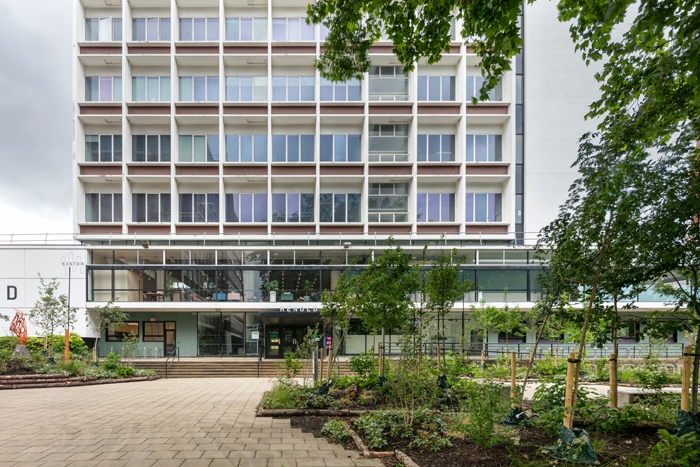
The building is a brutalist and modernist architectural icon
The Renold Building is an iconic landmark of brutalist and modernist architecture, formerly part of The University of Manchester’s North Campus. Now, it enters a new chapter as part of Sister, Manchester’s new innovation district. The refurbished building celebrates the building’s legacy as an educational hub through the hosting of the next wave of science and technology innovators. It provides a range of coworking, office and meeting facilities to accommodate and support collaboration between researchers, entrepreneurs, businesses and partner organisations, with a special focus on those developing new ideas and solutions aimed at tackling some of the world’s biggest challenges.
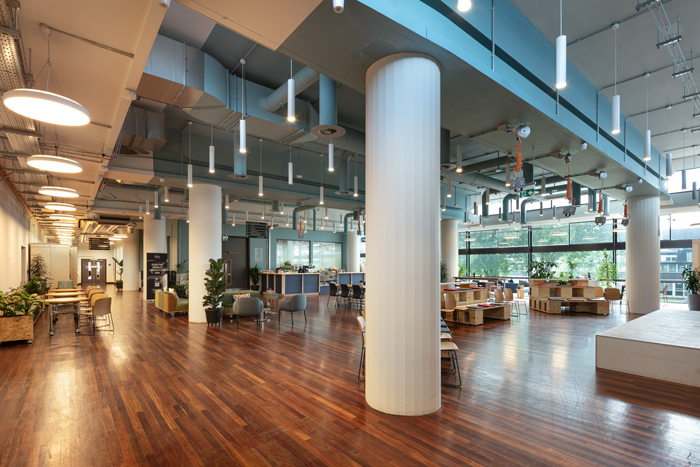
Upper Ground Floor cafe, lounge and events space
For SpaceInvader, the project represents a further example of the sustainable re-imagining of old building stock and the creation of innovative, low-energy new-build interiors, for which the consultancy is increasingly known. The Manchester-based studio previously won the Positive Impact Award at the MIX North Awards, as well as the BCO Commercial Workplace Award, for Eden, New Bailey in Salford, one of the UK’s most environmentally-friendly buildings and winner of the BCO’s inaugural ESG Award in 2025. In 2023, SpaceInvader also won the BCO Corporate Workplace Award and the Sustainable Design Fit-Out Award for Stopford House – another brutalist building, this time in Stockport, made fit for contemporary use with minimal environmental impact.
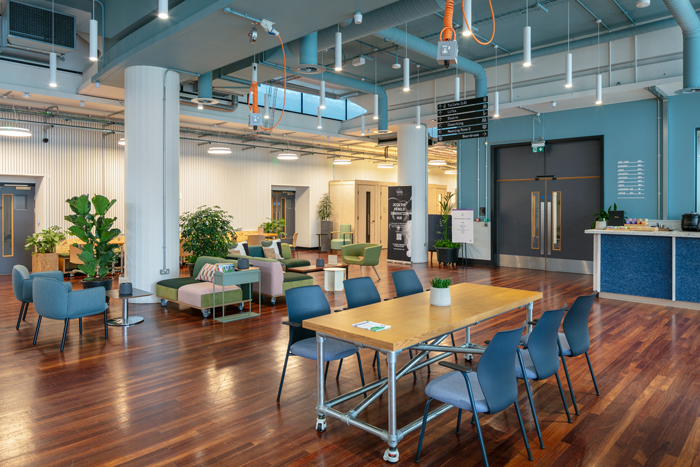
Furniture includes tables made from recycled library countertops with repurposed scaffolding bases
The ‘Sister’ Vision
The refurbishment and repurposing of The Renold Building is the first stage of the Sister development – which has been undertaken as a partnership between The University of Manchester and Bruntwood SciTech – and forms the initial phase of an ambitious plan to transform the University’s former North Campus into a welcoming and accessible new £1.7bn innovation district.
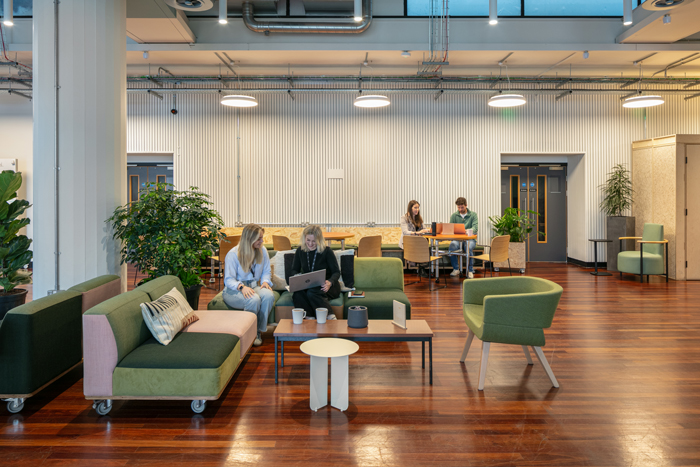
Sofas upholstered with fabric off-cuts by Senator
Sister will specialise in advancing innovation across sectors including digital tech, health innovation, biotechnology, advanced materials and manufacturing and will provide access to state-of-the-art facilities, connecting early-stage high growth potential businesses with investors, while creating a collaborative ecosystem that enables UK and global businesses to benefit from cutting edge innovation. The name represents the close bond between industry and academia and expresses an ethos of collaboration, openness and the use of knowledge to solve problems. Sister is primed to be a catalyst for economic growth and prosperity across the North of England and projected to contribute around £1.5bn GVA per annum to Manchester.
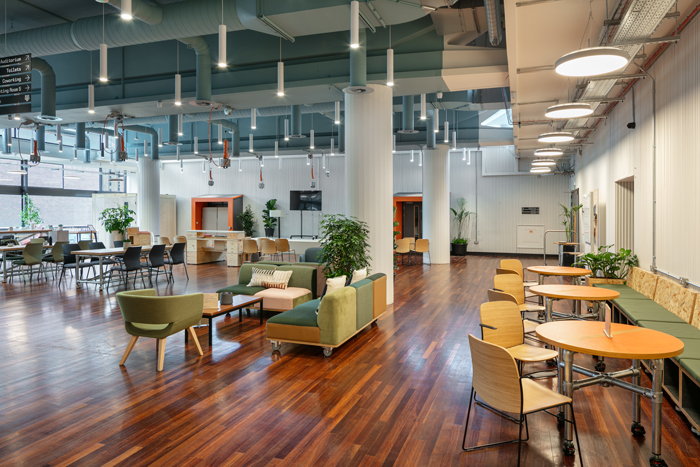
Keeping the original timber flooring meant installing pull-down power sockets into the ceiling
Building History
The Renold Building was originally designed by W.A. Gibbon of Cruickshank & Seward and was constructed as part of a major expansion of the Manchester College of Science and Technology (later UMIST) campus. Completed in 1962, it was the first building in the UK to be dedicated solely to lecture theatres and seminar rooms and is located on Altrincham Street, close to Manchester Piccadilly Station. The building is comprised of a lower and upper ground floor, along with six storeys of what is now office space above, with the lecture theatres retained.
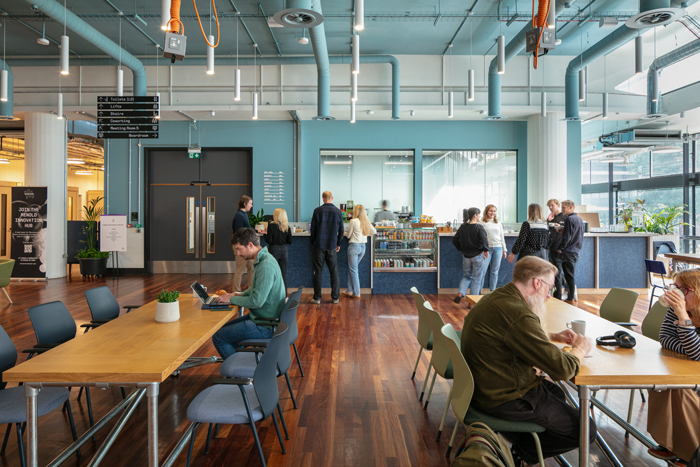
Cafe area in use
Supporting Innovation
The 110,000 sq ft building has been transformed by SpaceInvader into an innovation hub. The Renold Building now provides a range of low and no-cost coworking facilities and smaller office suites to support the growth and scale-up of early stage start-ups and spin-outs. The on-site café and refurbished lecture theatres are also utilised as event spaces for local businesses and community groups.
The building’s first customers have now moved in and include Sustainable Ventures, which helps climate tech start-ups and entrepreneurs scale through investment, workspaces and venture support. They are joined by a number of Manchester University innovation initiatives, including the Turing Innovation Catalyst Manchester, accelerating the growth of AI-start-ups; the Christabel Pankhurst Institute for health technology research and innovation; and the Industrial Biotechnology Innovation Catalyst, a cross-sector collaboration to empower the growth of biotechnology businesses.
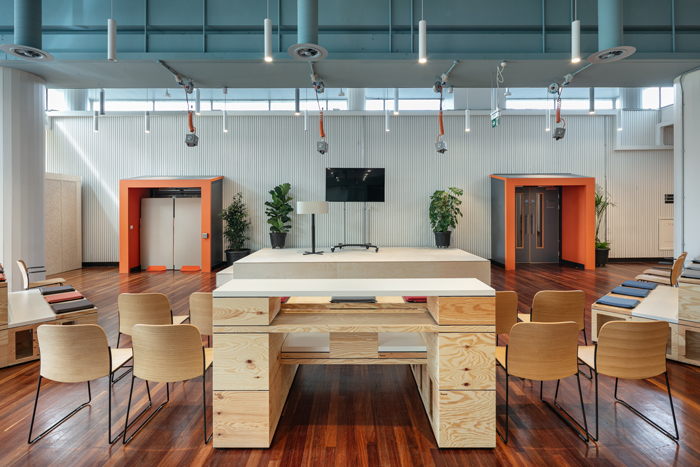
Presentation and event space to rear of same area
SpaceInvader’s Design Vision
SpaceInvader Founder and Director John Williams commented:
“Through a considered, light-touch refurbishment, we sought to honour the heritage of The Renold Building and its new purpose to showcase innovation, while also acting as an exemplar project for sustainability and the circular economy within design. To create a space that resonates with the soul of the city, we have drawn inspiration from Alan Turing and his great invention, the pattern and connectivity associated with molecular engineering, and, whilst so doing, have embraced sci-tech Manchester, as well as Manchester’s arts and design scene. These elements are an intrinsic part of Manchester’s cultural DNA, which reverberate throughout the interior in the form of strong graphics, colour blocking and the embracing of the existing architecture.”
The project began with a period of engagement and research, talking to start-up companies arising out of the university’s faculties and alumni to understand and incorporate their needs into the new scheme. SpaceInvader then shortlisted a series of new products and innovations these companies were undertaking for an exhibition that formed part of the building’s launch event.
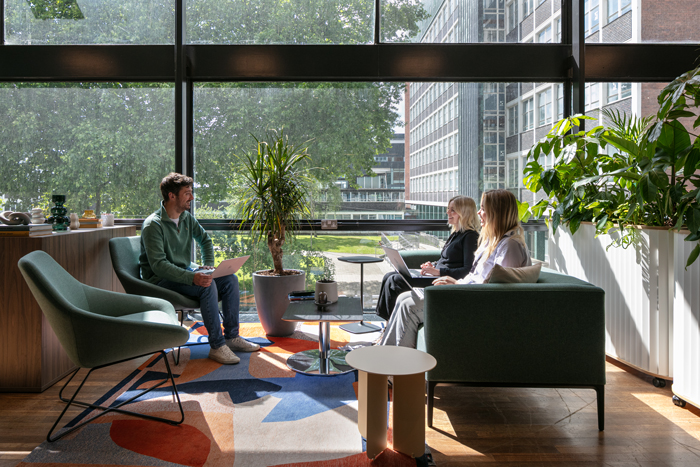
More intimate setting alongside window
Whilst the exterior of the iconic building remains untouched – bar minor changes to the entrance door and the installation of new M&E – SpaceInvader’s remit was then the redesign of the whole building interior, including Cat A works where new customers were coming in; a full interiors scheme for Sister’s own 7th floor marketing suite and the redesign of the lower and upper ground floors to create the co-working areas and community café. As well as references to Alan Turing and Manchester’s art scene, the design team used shapes from the building’s exterior as their inspiration for the interior design, especially the zigzag cladding of the façade, along with block colours and graphic shapes.
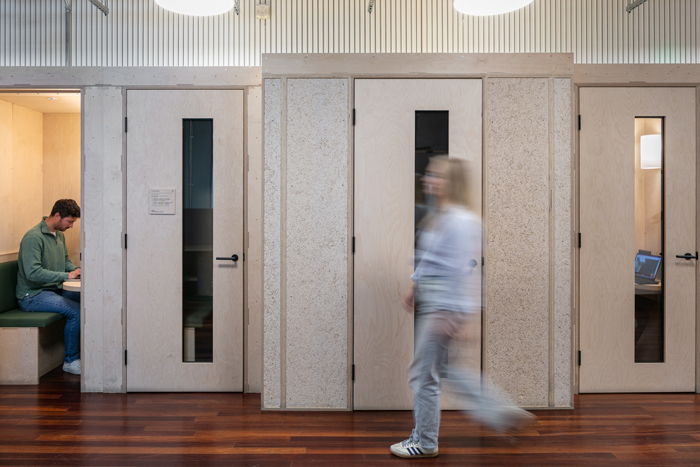
Individual workspaces along corridor
SpaceInvader Associate Regina Cheng commented:
“When we first looked round the space, it was a real treasure trove, full of cubby holes, old signage and piles of newspapers. Everything was the result of years of academic rather than business use, but that meant there was a fascinating process ahead whereby we could re-think every single item left behind to create the most sustainable and cost-effective transformation possible. It was really enjoyable to be able to think and go beyond what is normally possible in a workspace upgrade, with the client completely behind us in our pursuit of minimum waste and maximum re-use.”
Going beyond in this context included designing bespoke new furniture from waste, such as the tables with the scaffold legs, where the design team re-used scaffolding from the project’s joinery contractor and combined this with timber table tops cut from lecturers’ desks. Major features such as the original timber flooring have been retained, which covers 896m2 in total, with pull-down power sockets installed to avoid damaging the original floor.
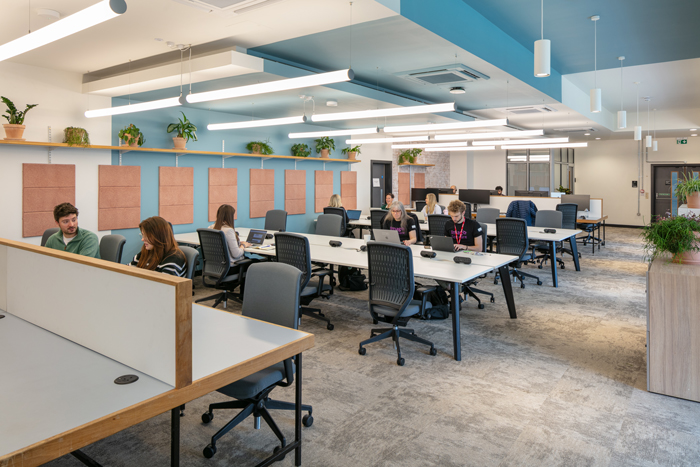
Co-working area
SpaceInvader Branding Associate Jenny Crossland also worked with the Sister team on a series of plaques that tell the sustainable narrative relating to every re-used piece of furniture or interesting material choice, underlining both its story and energy savings to inspire the new generation of innovators in the building. For the new ‘scaffold’ tables, the plaque’s wording reads, for example:
From library counters to dining tables!
This table is built with a creative twist:
- The tabletops started life as the library countertop in the Sackville Street Building.
- The sturdy bases? They’re made from repurposed scaffolding!
- By giving old materials new purpose, we’ve saved 924 kgCO2e when compared to buying new.
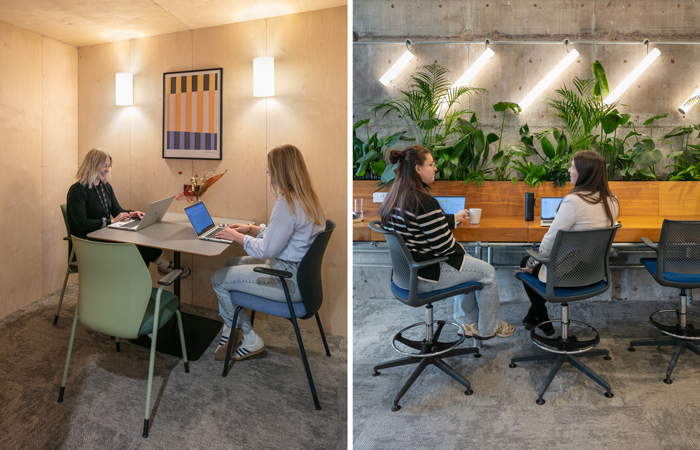
Left: Co-working area meeting room. Right: Exposed concrete wall with hanging light feature
Whilst the cardboard tubing used as lightshades, an idea pioneered at the Eden, New Bailey project, working once again with frequent collaborator Light Forms, has the following plaque:
Light, renewed and reimagined.
- The light feature above is crafted from cardboard tubes, a renewable material that’s fully recyclable at the end of its life.
- By swapping the typical extruded aluminium housing for cardboard, we’ve reduced emissions by an impressive 82% — proof that creative choices can make a brighter, greener impact!
And the pop-up bar counter front?
Sustainability at the counter.
- The counter front has been made with cardboard tubes, a renewable and fully recyclable material.
- The countertop? It’s made from 100% recycled, 100% recyclable plastic from Smile Plastics, with an impressive 96% lower embodied carbon compared to traditional alternatives.
- Smart materials, sustainable design — this counter is built for the future!
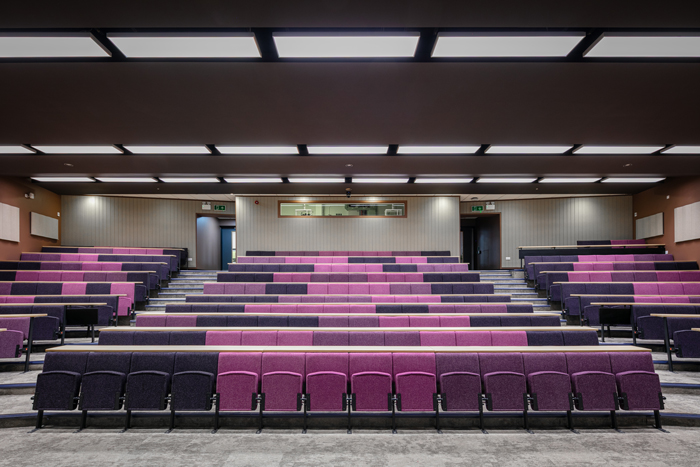
Refurbished lecture theatre for presentation use
SpaceInvader’s 7-Point Sustainability Plan
SpaceInvader’s approach to the building’s new interior design was laid out in a 7-point plan:
1. Regenerative Design: Re-using as much of the building’s existing fabric as possible, minimising material strip out and ensuring what had to be removed was neither replaced nor taken to landfill. SpaceInvader exposed or repaired as many original building features as possible, including timber slats and internal signage, as well as resin flooring infill to the 7th floor Sister Marketing Suite, ensuring a raw aesthetic that shone a light on imperfections and celebrated them.
2.Waste Diversion: Demolition materials were repurposed, including waste from old internal walls used as aggregate for new worktops and the creation of a lower ground floor bench from demolition aggregate.
3. Re-use: The building incorporates repurposed furniture throughout, including reused furniture from across the wider University campus and previous Bruntwood Sci-Tech projects. SpaceInvader also partnered with Senator and their ‘Sustain’ facility to identify and source second-hand furniture from other third-party sources. Sofas in the ground floor spaces, for example, are by Senator with upholstery that uses fabric off-cuts. The design team went to the manufacturer’s factory to see what was available and designed a patchwork of off-cuts for the upholstery.
4. Responsible Materials: Any new specified materials are either bio-based, made from recycled material or are 100% recyclable, carbon negative or carbon neutral. For example, the project’s teapoint splashbacks are made using recovered plastic. All joinery is made from FSC certified OSB board and many of the fabrics are made from off-cuts or recycled natural fibres.
5. Biodiversity and Biophilia: Internally, planting was introduced throughout the building, whilst as many biophilic materials as possible were used on the interior to help create a calming environment. Externally, SpaceInvader was involved in the client’s vision to introduce a new tree and plant nursery outside The Renold Building, with plants grown here able to be repurposed across the wider site as other areas of the district are redeveloped in the future.
6. Future-proofing: All the furniture in the upper ground is intended to be moveable, reconfigurable and flexible to suit a variety of scenarios.
7. Low Carbon Approach: The entire project was monitored for its overall carbon footprint using the ‘Carbonica’ tool and all single use plastics were minimised during the fit-out phase.
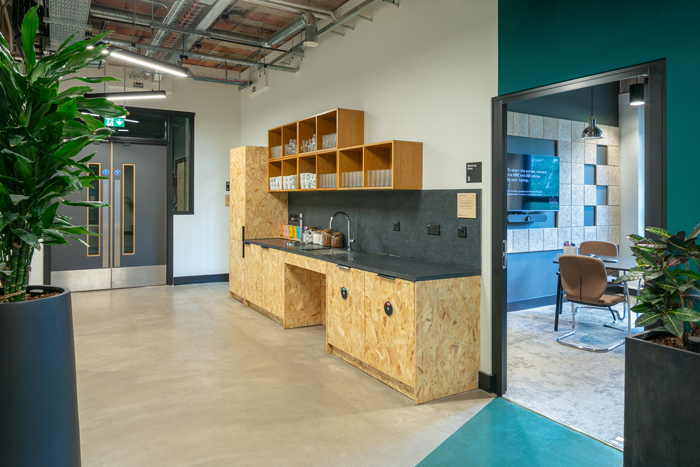
OSB used for teapoints
Liz Bamber, Director of Place for Sister, commented:
‘SpaceInvader really understood the passion and energy of this project and not only got behind the re-use directive, but took it as far as they could push it with their innovative and cost-friendly ideas when it came to re-purposing existing materials from this site and beyond, with some really stunning results. Their work and the uniqueness of the finished project embody exactly what Sister is all about.’
John Williams concluded:
“For more than 40 years, this building was a hive of academic activity, acting as the main teaching hub for lectures for the University of Manchester Institute of Science and Technology – UMIST – and following that, The University of Manchester’s North campus. We are proud to bring this iconic building back to life with a new purpose – one that honours its heritage as the UK’s first purpose-built teaching facility and a centre for science and technology excellence, and which paves the way for the exciting future of this innovation district.”
Photographer: Interiors shots – Midi Photography. Details and 7th floor shots – Pure Agency