







LSE Robeson House – A Home for Global Minds
Robeson House is a landmark, purpose-built student accommodation (PBSA) scheme developed for the London School of Economics and Political Science (LSE).
Situated in South London, adjacent to Burgess Park, the £100 million, 16 storey development is comprised of 676 high-quality cluster flats and studio bedrooms, complemented by a comprehensive range of amenity located across the lower ground, ground, and first floors.
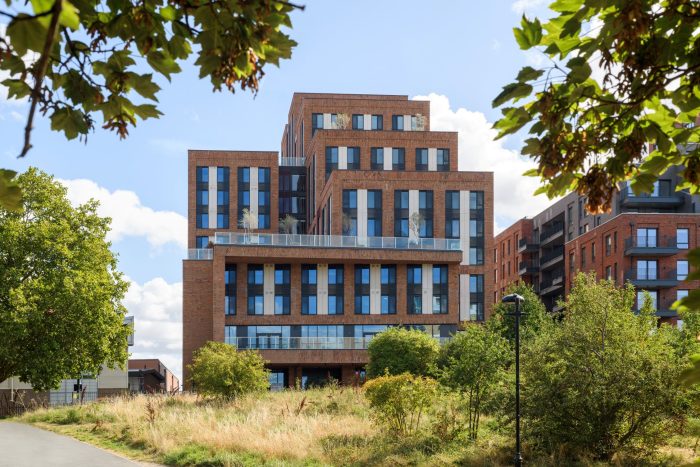
LSE Robeson House
The building’s technical design and delivery architects were Willmore Iles Architects, with the amenity scheme’s interior design and spatial planning by Jasper Sanders + Partners, who were also responsible for the specification for the bedrooms and shared kitchen-lounge areas on the upper floors. Jasper Sanders + Partners were additionally responsible for the building’s brand strategy, including all graphic identities and wayfinding design throughout.
Jasper Sanders + Partners is a Manchester based space innovation studio, dedicated to creating places which inspire and motivate business, through clever, visionary and purposeful design.
Willmore Iles Architects is a Bristol based architectural practice specialising in student living, leisure developments and multi-unit residential schemes across the UK.
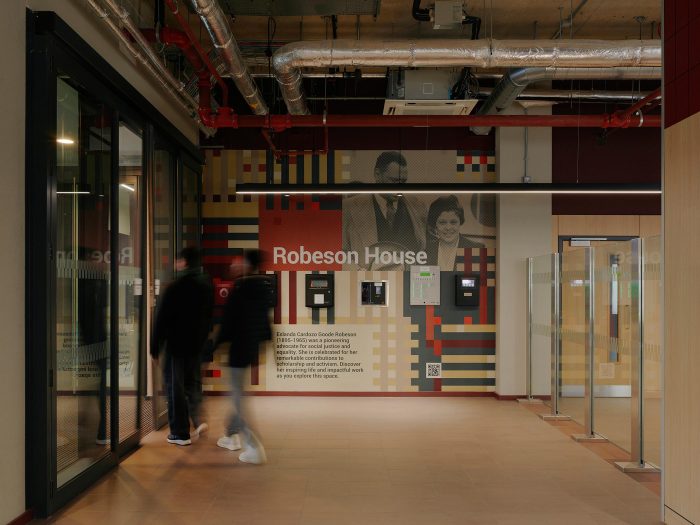
Entrance arrival area
Purpose
Robeson House was designed to meet the needs of a predominantly international postgraduate student community, offering environments that align with the study patterns and wellbeing priorities common in advanced degree programmes. The building integrates multiple layers of amenity beneath extensive student living accommodation, creating a carefully balanced environment that supports study, social life, and everyday living within a robust and secure operational framework.
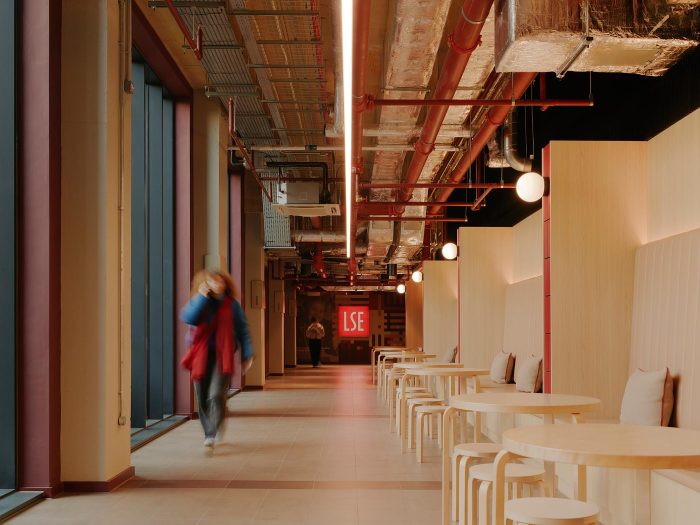
The Street is the central spine accommodating high daily footfall from residents
Naming
The building is named in honour of the American LSE alumna Eslanda Robeson, an anthropologist, civil rights activist, and globally significant intellectual of the 20th century. Robeson’s work, spanning anthropology, internationalism, feminism, and anti-colonial thought, provided a rich foundation for the building’s identity.
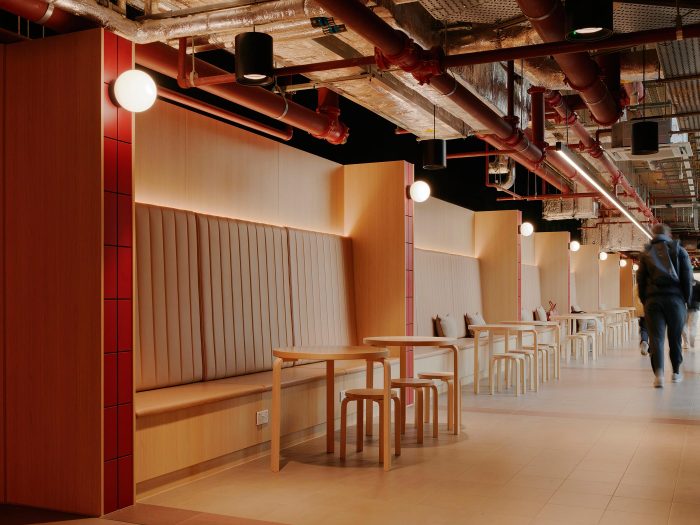
The bench seats are covered in robust vegan leather from Ultra Fabrics
Research into her life and legacy informed the creation of a series of large-scale murals along ‘The Street’, the central spine of the interior, as well as within the first-floor amenity spaces, narrating key moments of her life. These stories were expressed through a contemporary visual language inspired by the layered patterns and bold geometry of London Underground upholstery, rooting the aesthetic firmly in its London context. The compositions blend portraiture with abstraction, colour with form, creating depth and movement that work to anchor the building in LSE’s intellectual heritage, giving residents a meaningful sense of place while embedding cultural narrative into everyday experience.
Architecture
Externally, the building is carefully stepped to address its street-level context, with the massing pulling back as it rises away from Burgess Park to reduce its overall visual impact and scale and provide a series of accessible roof gardens. This considered form mediates between the surrounding urban fabric and the open landscape of the park beyond.
The façade utilises modular, off-site fabricated pre-cast concrete and red-brick sandwich panels, selected to support programme efficiency, build quality, and reduce on-site construction time, and blend materiality with the local vernacular. A projecting first-floor amenity balcony provides a clear architectural marker to the main entrance below, offering shelter to the arrival into the building at the Upper Ground Floor level.
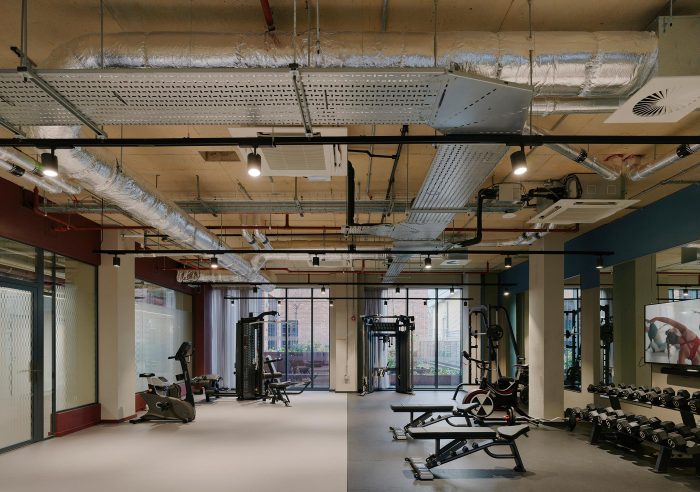
The gym with view out onto courtyard
Spatial Configuration
Once planning permission was granted, the lower ground, ground, and first-floor amenity levels required significant spatial remodelling, with this redesign carried out by Jasper Sanders + Partners.
“The originally consented layouts were largely notional” Jasper Sanders, Founder of Jasper Sanders + Partners, noted, “and did not adequately respond to the realities of managing a building of this scale or the expectations of its resident demographic. The reconfiguration focused on establishing clear zoning, intuitive circulation, and legible destinations, aligning arrival, security, management, welfare, and social spaces into a coherent sequence that works operationally while also delivering a welcoming and calm resident experience.”
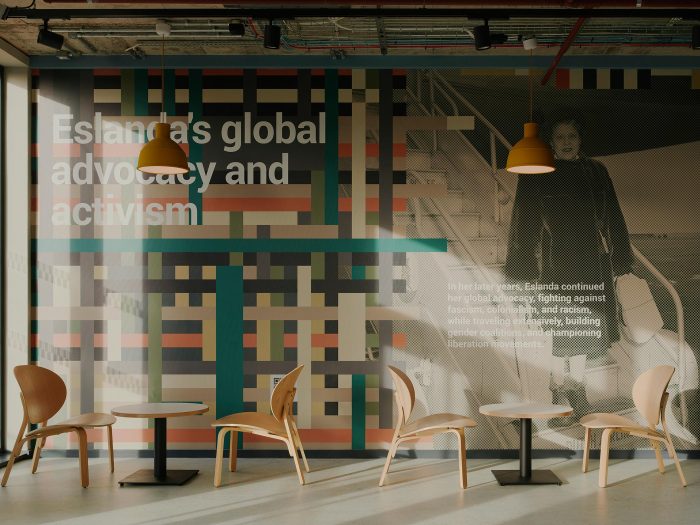
Eslanda Robeson was a globally significant 20th century intellectual figure
Design Approach
The ground floor aesthetic adopts a clear, purposeful design language that reflects LSE’s academic rigour and progressive values while remaining rooted in its South London context. References to the area’s terracotta brick architecture and the graphic clarity of the London Underground inform a palette of tiled surfaces, strong linear compositions, and gridded forms. Subtle red undertones drawn from LSE’s branding are integrated throughout the circulation routes and shared spaces, reinforcing identity and legibility without overpowering the architecture. Together, these elements establish a confident, contemporary character that anchors the building’s public realm.
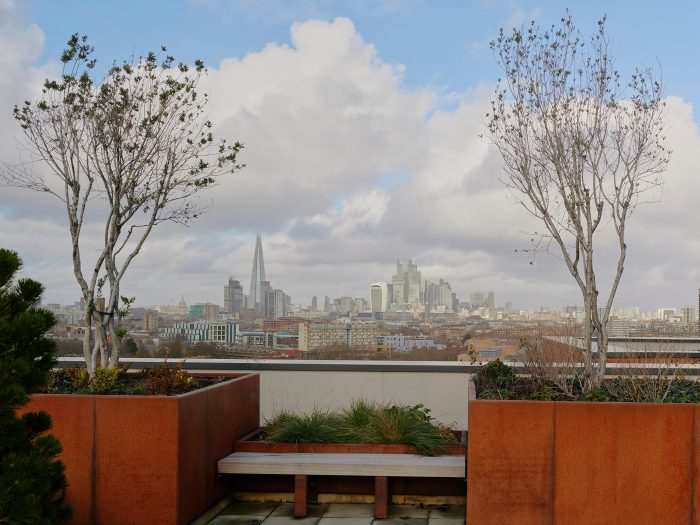
Rooftop Terrace
Colour and materiality are used with precision to support function and orientation rather than to overwhelm. The fitness suite employs cooler blue tones to reinforce clarity and focus, while the communal dining areas use lighter green hues to create a fresh, sociable atmosphere connected to the adjacent outdoor spaces. The cinema adopts a deeper, more immersive palette, distinguishing it clearly from the surrounding activity. Along The Street, these moments of colour punctuate a more restrained architectural backdrop, helping residents intuitively understand how each space is intended to be used. On the first floor, the same approach establishes clear study zones within the open-plan environment, reinforcing continuity throughout the building.
Design Walk-through
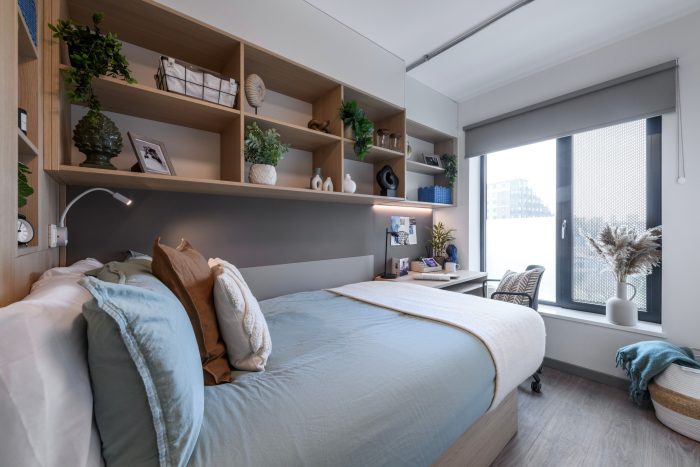
Example of en suite room
At ground level, residents and visitors arrive into a highly active yet controlled environment, centred around a reception concierge and management suite designed to support day-to-day operations, welfare provision, and back-of-house functions. A sculptural painted steel spiral staircase, fabricated off-site, provides a strong visual marker within the space and reinforces vertical connectivity to the first-floor amenities above. Beyond reception, the ground floor opens into an animated internal route known as ‘The Street’ – the central social spine that accommodates high daily footfall as the 676 residents arrive and depart the building.
The Street is conceived of as a single, holistic destination rather than a series of disconnected rooms. Arranged along its length are fitted bench seats, covered in robust vegan leather by Ultra Fabrics. These are made off-site to control quality, programme and reduce waste. They are paired with Alvar Aalto tables and stools by Artek, plus a coffee station, all orientated to overlook pocket courtyards and amenity spaces – including the fitness suite, cinema, private dining rooms, and laundry. Extensive glazing draws daylight deep into the plan, offering framed views to landscaped external areas and creating a strong visual relationship between inside and out. The environment balances movement with moments of pause, encouraging chance encounters while maintaining clarity and ease of navigation within an inherently busy space.
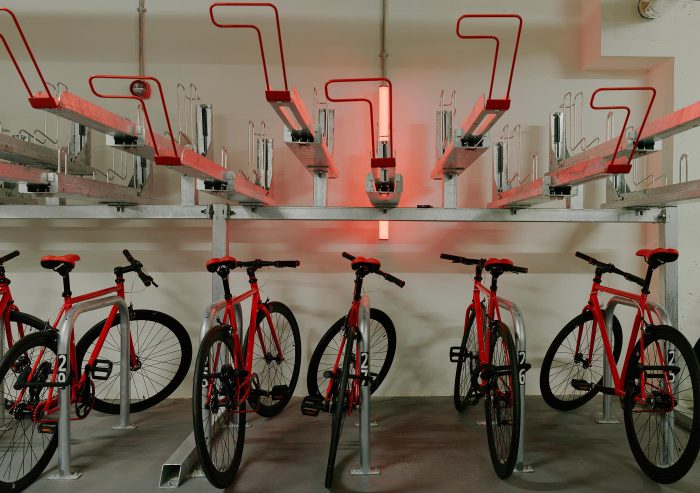
Cycle Hub on lower ground floor
Located on the first floor, the main study amenity provides a flexible and generous environment tailored to the academic rhythms of LSE’s postgraduate community. The layout supports a wide range of study behaviours from quiet, individual work to group discussion and informal collaboration, carefully arranged so that different modes of activity sit comfortably alongside one another. Zoning is subtly defined through furniture typologies, acoustic treatments, and material changes, ensuring the space reads as a single cohesive destination rather than a collection of isolated study rooms.
A centrally positioned coffee station acts as a social anchor, adjacent to bleacher-style tiered seating that provides both informal gathering space and visual focus within the open floorplate. This arrangement encourages interaction while offering views across Burgess Park, strengthening the connection with the wider landscape. Large expanses of glazing flood the interior with daylight, supporting concentration and wellbeing, while access to a generous external terrace provides students with an important breakout space and respite from intensive study.
The cycle hub, also designed by Jasper Sanders + Partners as part of the amenity remit, is located on the lower ground floor and accessed via stair or lift, forms part of a wider green travel strategy for the building. Given the site’s distance from LSE’s main campus further north, the provision actively encourages sustainable and active travel.
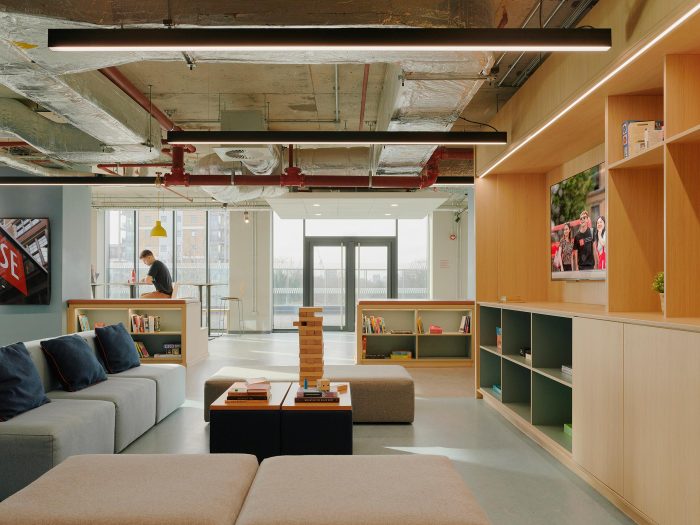
Study Lounge
Sustainability
A core sustainability ethos of the Jasper Sanders + Partners studio is to prioritise operational efficiency, intuitive circulation, and clearly defined destinations. The design therefore creates spaces that are robust, adaptable, and capable of supporting long-term occupation, reducing the need for future intervention and refurbishment, and delivering vibrant highly occupied successful buildings.
Environmental impact was further minimised through a high proportion of off-site manufactured elements, such as the spiral staircase at ground floor and bespoke fitted furniture including the entrance reception desk, integrated bench seating along The Street, wall panelling and column encasements and the tiered seating within the first-floor study amenity. Off-site fabrication allowed for greater control over quality, programme, and waste, while ensuring durability in high-traffic areas.
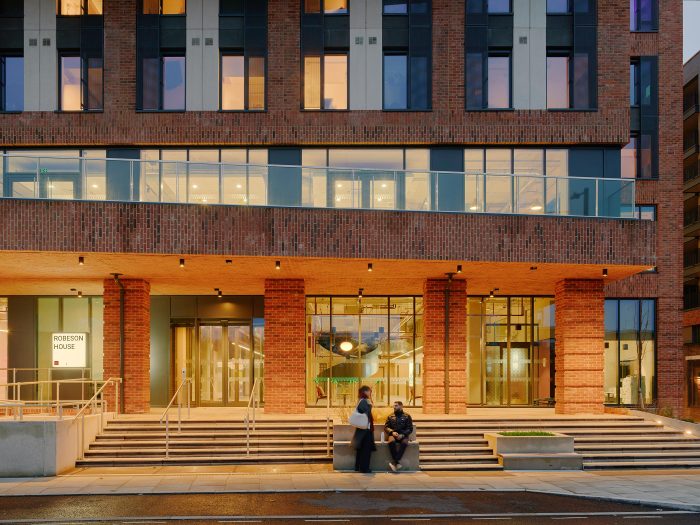
Building Exterior at night
Furniture and finishes were specified for longevity and responsible manufacture. Upholstered elements use robust vegan faux leather by Ultra Fabrics, supporting durability and reduced material replacement over time. Flooring includes Mosa’s Terra collection, selected for its high-performing cradle-to-cradle certification, alongside natural linoleum by Forbo, chosen for its renewable composition and whole-life carbon credentials. Together, these choices reflect a balanced approach to sustainability that prioritises spatial intelligence, durability, and environmental responsibility.
Photography by Gunner Gu
Project Details:
Sector | PBSA
Location | Glengall Road, London, SE15
Completion | 2025
Team:
Client | The London School of Economics and Political Science (LSE)
Contractor | Developer | Equans
Interior Designer | Jasper Sanders + Partners
Technical Design &Delivery Architect | Willmore Iles Architects