







Material District, Utrecht 2026
Last month, Jim Biddulph, headed to MaterialDistrict Utrecht, one of Europe’s leading platforms for material innovation, to see firsthand how thinking around materials is evolving across the built environment. From circular systems and agricultural waste to bacteria-grown surfaces and bio-based alternatives, what he found wasn’t just experimentation, but a growing shift towards application and a more pragmatic, solutions-driven approach to sustainability.
The interest in, and conversation around, the materials that construct, insulate, cover and make up the built environment continues to evolve and spread at a steady pace. Even, or perhaps because, of the hegemony of the digital age, a focus on the physical elements that surround us (as well as the aesthetic) have come to the fore for many designers and architects over the past decade in particular. This is particularly pertinent in the race to decarbonise an industry that remains high on the emissions list, while also producing vast volumes of waste.
There is plenty of evidence of this within the built environment itself, with projects such as Magent Farm, Finchley Road and Cork House doing so in a variety of ways. Propping up such projects is an array of publications, both in print and online, as well as a host of international trade shows that shine the spotlight on materiality.
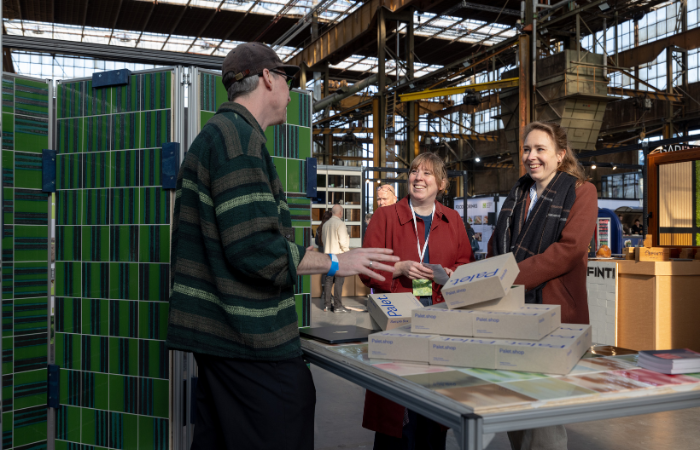
One such recent example of this took place in the Netherlands, with the view of bringing together architects, designers, manufacturers and researchers for three days of material-focused exhibition and knowledge exchange. MaterialDistrict Utrecht returned to the Werkspoorkathedraal from 4–6 March, and is now established as one of Europe’s leading platforms for material innovation. The event continues to evolve from a source of inspiration into a more application-driven forum, with increasing emphasis on how emerging materials can be deployed within the building industry.
As director Jeroen van Oostveen notes, “nowhere else do you see such a broad combination of companies, start-ups, designers, researchers and students gathered together,” highlighting the event’s role as a meeting point for collaboration across the sector.
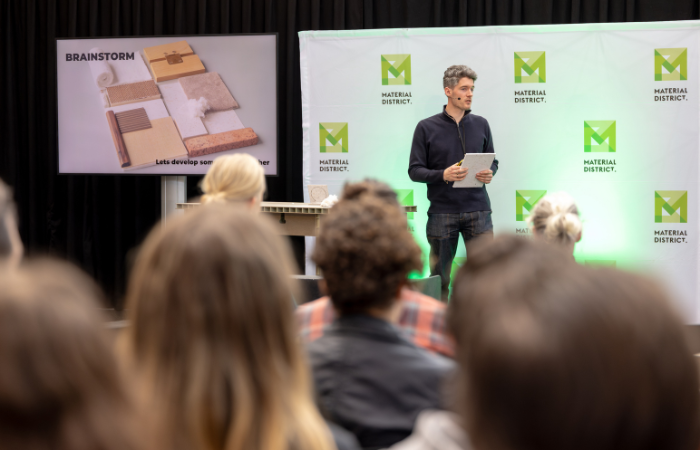
This year’s theme, NextNow, underlined that many solutions for more sustainable construction are already available. The newly introduced NextNow pavilion demonstrated this shift in focus, presenting materials within fully realised spatial settings rather than as isolated samples. Alongside the main exhibition, which featured more than 200 materials, from bio-based composites to products derived from residual streams, a growing programme of talks and partnerships reinforced the event’s relevance to construction.
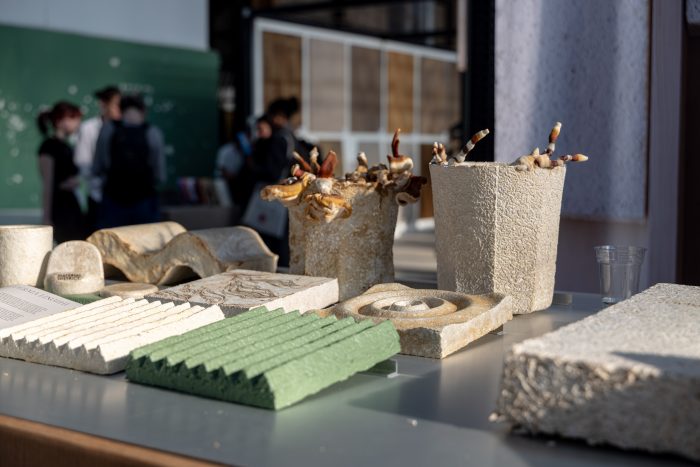
Across the exhibition, innovations ranged from bacteria-grown tiles and mycelium-based acoustic panels to structural components made from agricultural by-products. Here, we pick out some highlights from the extensive offering.
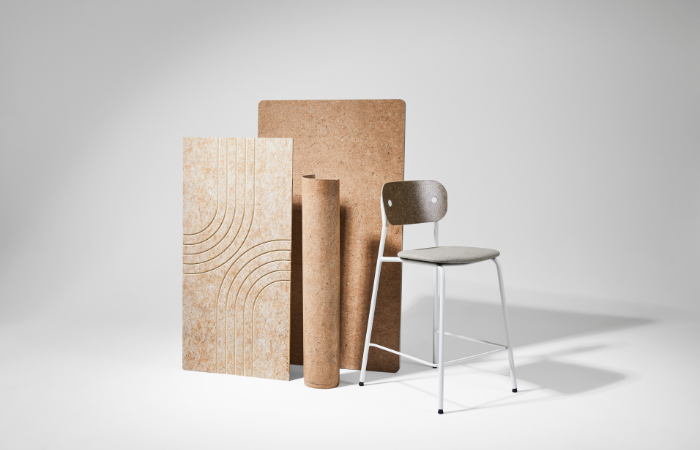
Perhaps it’s to be expected that closing the loop and turning waste streams into valuable assets come to the fore at such a show, but there were certainly plenty of such options to choose from.
Produced by shredding and compressing waste fabrics, Rezign®, developed by Planq, reworks discarded textiles into a distinctive interior surface material. Common end-of-life wearables, such as denim and workwear, are mixed with a biobased binder to produce a versatile building material. The material retains the colour and character of its source, resulting in a textured, visibly recycled finish. Manufactured in Europe using local waste streams, it supports circular design by enabling companies to upcycle their own textiles into furniture and fit-out elements, combining low-impact production with a clear material narrative.
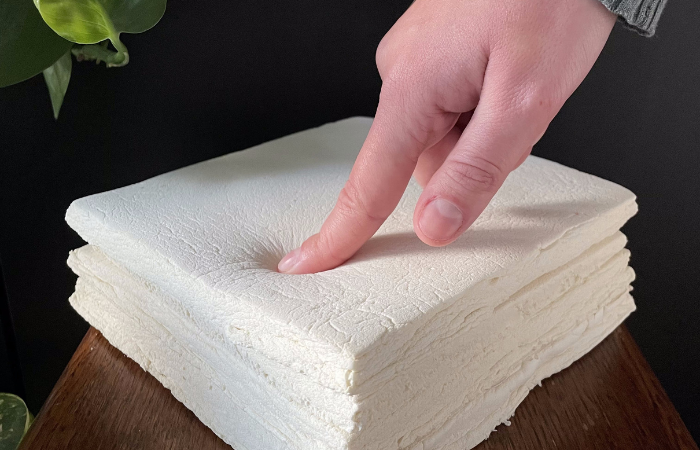
Continuing the textile theme, albeit in the adjacent soft-furnishing sector, SymbioMatter is tackling the ubiquitous application and reliance on fossil-based foams. SymbioFoam, developed by, is a fully biobased flexible foam made from agricultural waste streams, offering an alternative to conventional soft-furnishing fillers.
Combining structural stability with elasticity, it can be used for cushioning, packaging, or as a lightweight board material, while remaining easy to process. Crucially, the material is designed to be home-compostable, breaking down after use without leaving microplastics or toxic residues, positioning it within a new generation of circular, low-impact materials.
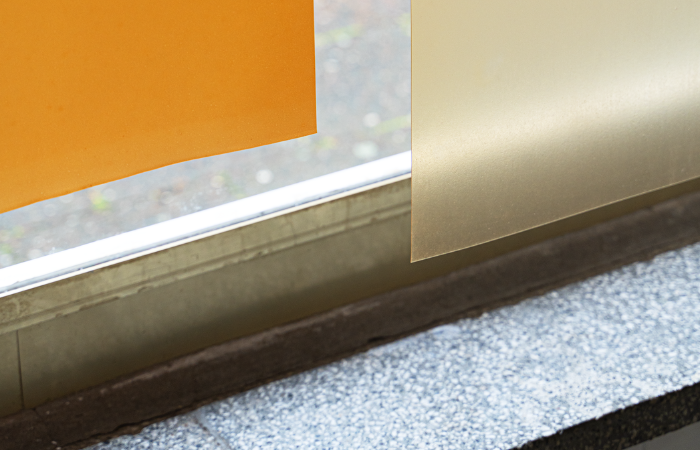
As another highly environmentally impactful industry, it is unsurprising but healthy to see a number of designers and manufacturers turning to agri-waste streams. A Matter of Fruit transforms apple pomace, the leftover pulp from juice and cider production, into versatile plant-based surface materials.
Its Apple Pomace Films translate agricultural waste into translucent sheets that filter light, divide space and introduce a soft, organic material presence to interiors. Available in smooth, textured, opaque or semi-transparent finishes, the films can be printed, sewn, shaped or laser cut, making them suitable for blinds, partitions and lighting elements. Each batch reflects the character of the seasonal harvest, offering a renewable, non-toxic alternative to conventional synthetic textiles.
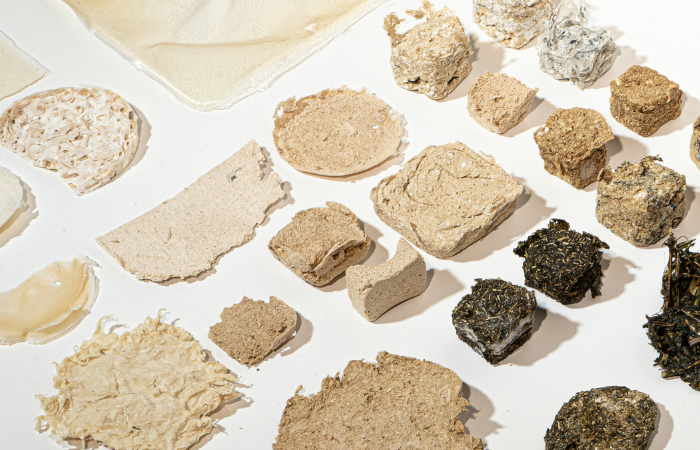
While such events have increasingly looked to bridge the gap between fresh innovation and commercial application, there is still plenty of room for the former, and Tim Couwenberg’s project Between Growth and Structure is one such example. It explores the potential of biodegradable materials derived from algae-based compounds. Combining carboxymethyl cellulose and sodium alginate with natural residues, the material can be processed into both rigid, structural elements and flexible, translucent sheets.
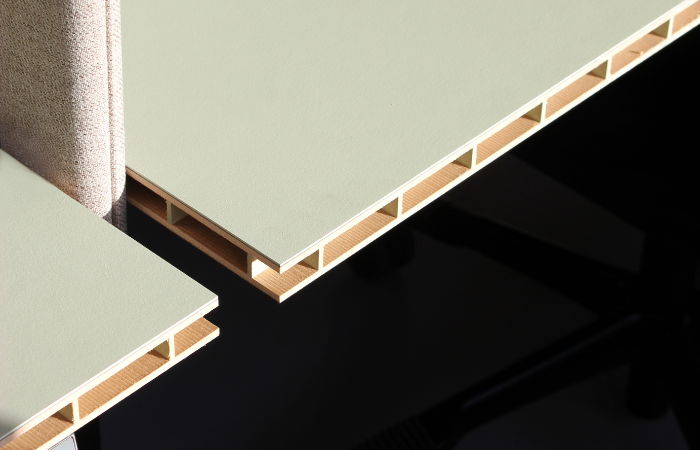
As well as a reduction in waste, there is also a growing interest in reducing the embodied carbon of our buildings, which can be aided by materials that do the same. #GREENGRIDZ, developed by Triboo, is a lightweight furniture panel built around a patented internal grid structure that delivers high strength and rigidity while remaining materially efficient. By reducing raw material use by up to 90% compared to solid panels, and lowering associated CO₂ emissions, it positions itself as a circular alternative for furniture and interior applications. What’s more, the panel is engineered to stay flat and stable over long spans—up to 5.1m—making it suited to desks, tables and large-format joinery.
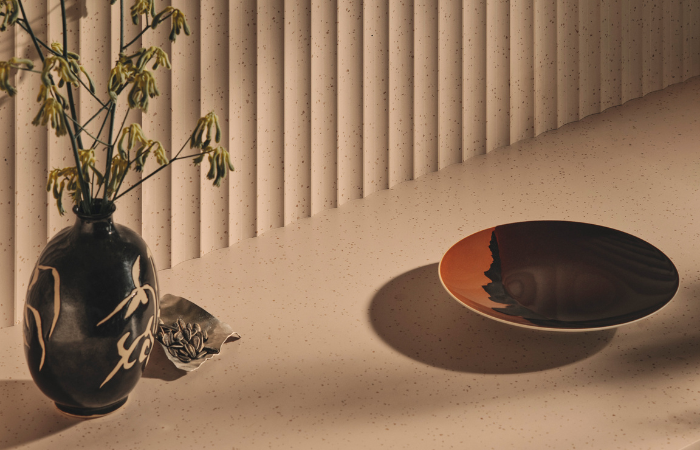
There was also UK representation at the event, with Low Carbon Industrial (LCI) exhibiting for the first time. Launched last year, the company builds off the success of timber terrazzo brand Foresso, “piggybacking” on established processes to create viable circular economies using post-industrial waste, rather than reinventing production.The team showcased one of their latest products, Elenite, a solid surface made from natural waste materials including walnut shell and bamboo fibre.
Co-founder Conor Taylor highlighted the audience’s desire to seek out such circular-centred materials, “We had a great reception to our materials; people really engaged with our design-led and pragmatic approach to the impact of manufacturing and materials. What really stood out was the shift in conversation from sustainability to circularity and how visitors wanted to get into the detail of how and why materials are made.” But perhaps what’s telling is his observation that, “there was a nice recognition of the need for steady improvement rather than perfect solutions,” underlining the fertile ground that such events offer to fledgling and more established brands environmentally conscious materials at their heart.