







Nissen Richards Studio Weaves the Legacy of Clarks into the Design of the Shoemakers Museum
Nissen Richards Studio has created the permanent exhibition and graphic design, wayfinding and shop design for Shoemakers Museum, a brand-new visitor destination opening this month in the heart of Somerset. The practice was also the museum’s interpretation specialist, creating the text for the exhibition’s content, in close collaboration with the curatorial team. The museum has been created to celebrate 200 years of shoemaking by Clarks and is located in Street, the village where the company was first formed.
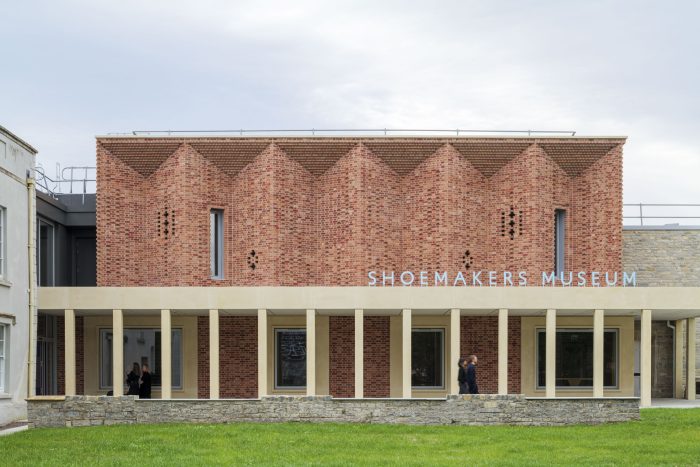
Shoemakers Museum
Background
The ambitious visitor centre project was initiated in 2022 by the Alfred Gillett Trust with the aim of creating a destination attraction whose opening would coincide with the bicentenary of Clarks and tell the fascinating story of the company’s Quaker founding brothers Cyrus and James Clark, as well as highlighting the ongoing relationship between the company, the village and its people. Shoemakers Museum also recounts the rich industrial history of shoemaking itself, displaying for the first time many of the amazing archive artefacts held by the company which illustrate the manufacturing and global retail / marketing story behind the Clarks brand, which helped shape how Britain – and the world – walks.
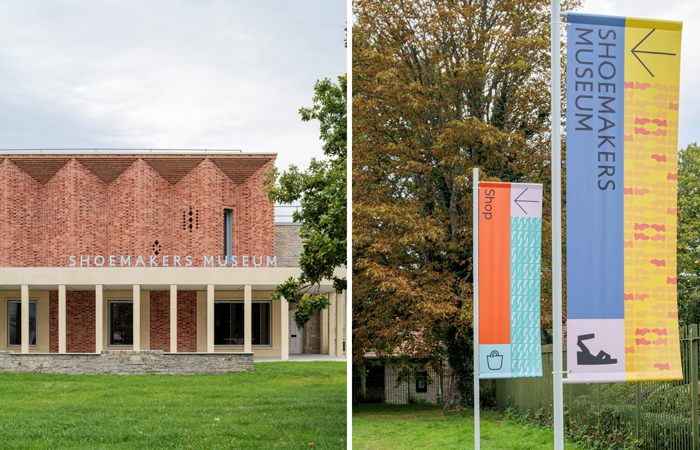
Left: New contemporary extension housing the museum by Purcell Architects. Right: Wayfinding by Nissen Richards Studio
Architecture
Designed by Purcell Architects, the new Shoemakers Museum is rooted in place through locally quarried stone and enriched with playful references to Clarks’ design language – blending history, craftsmanship and innovation – to set a new benchmark for sustainable cultural buildings in the UK. Purcell’s striking double-height contemporary extension houses the permanent exhibition and seamlessly connects to The Grange, a Grade II listed 16th-century manor house long associated with shoemaking. The wider site also includes a 17th-century barn and a beautiful garden with a walled orchard, creating a rich and layered setting that ties the museum to its heritage while offering a vibrant new cultural destination.

Left: Double height entrance space. Right: Welcome desk heel detail
Visitor Experience
Visitors will be able to explore the evolution of Clarks from a homegrown Quaker business into a global fashion brand whose iconic shoes, such as the Desert Boot, have been and are worn by everyone from Jamaican Rude Boys and Ivy League students to American hip hop artists and Britpop icons – as well as legions of children setting off for the new school year. The museum is a celebration of shoemaking and street style, retail rituals and advertising design, working life and cultural identity – all rooted in one extraordinary Somerset village.
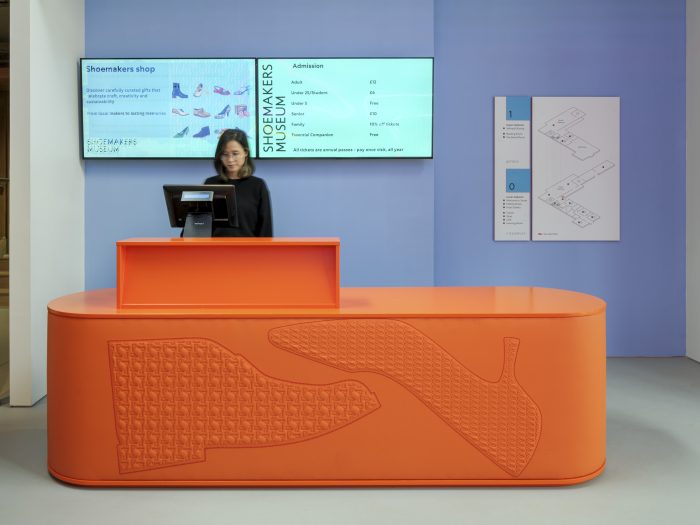
Welcome desk in vegan leather featuring embroidered shoe outlines
Pippa Nissen, Director of Nissen Richards Studio commented:
“We wanted the craft of the story to live within the designs with the very process of shoemaking itself woven into every choice. In the colours, the materials, the forms and the smallest details, you can feel the hand of the maker. Through design, we had the privilege of speaking to shoemakers, and researching into this historically, uncovering the richness of the practice, and letting that knowledge shine through. The shoes became more than objects; they became portals to the people who made them, and to the local stories of Street itself.”
The Clark Family and Street
Street is Somerset’s largest village, within reach of the Somerset levels, offering views over Glastonbury Tor and the Mendip Hills, and home to both the headquarters of Clarks shoes and outlet shopping destination Clarks Village. From the 1825 founding of the shoemaking company onwards, Street’s architecture and its economic and social life have been influenced by the Clark family and their Quaker beliefs and values, as well as by the business they founded. The village’s Crispin Hall (named after the patron saint of shoemakers), Greenbank Pool (Grade II listed) and Millfield House (now part of Millfield School) were all built by family members. Strode Theatre was also built by the Clarks Foundation, whilst much of the housing surrounding the HQ was built for Clarks’ workers.

Shop design by Nissen Richards Studio
Alfred Gillett Trust
Alfred Gillett Trust is the project commissioner and the name of the charitable organisation set up to safeguard and preserve the collection and archives associated with the Clark family and C & J Clark Ltd. It was formed in 2002, taking its name from Alfred Gillett (1814-1904), a local cousin of founders of Cyrus and James Clark. The vision of the Trust is to inspire the world with the family and community stories behind Clarks shoes. The collection it cares for preserves over 100,000 historical objects, amassed by six generations of the Clark family, helping to tell the story of the development of Street as a village with nearly 200 years of shoemaking heritage.
Interpretation
As the interpretation specialists and text writers for the exhibition, Nissen Richards Studio worked with the museum’s curatorial team to craft a family-friendly narrative which would pique the curiosity of visitors and encourage them to look at the craft of shoemaking in a new light. Bringing forth stories of manufacture and innovation, the interpretation approach aimed to spark nostalgia and memories for older visitors, whilst exciting interactives would enliven the experience for younger visitors, allowing them to time themselves, for example, as they test their speed and agility as a factory worker or encouraging them to dress up as a Clarks shop worker and measure each other’s shoe size.
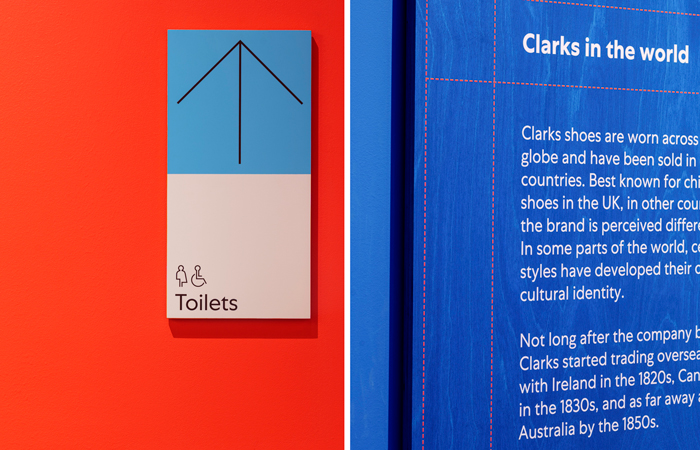
Additional wayfinding. Graphic panels have edging that mimics coloured-thread stitching
Nissen Richards Studio’s Interpretation Specialist Echo Callaghan commented:
“In this exhibition there was no shortage of extraordinary stories to tell, from the Quaker history of the Clark family to the inspiring stories of the inventors who shaped the industry. It felt particularly important that the interpretation approach spoke to the people who worked at the factory in Street, representing their experience and including their voices. Working alongside the archivists, collections manager and curatorial team to bring the narrative of the exhibition to life was a valuable and eye-opening experience and we hope that visitors are infected by the passion and enthusiasm that they hold for this exciting collection.”
Exhibition and Graphic Design
Nissen Richards Studio responded to the brief to create a colourful, highly graphic and vibrant exhibition environment through the imaginative communication of stories and immersive experiences which speak engagingly to many different audiences. As ever, the Nissen Richards Studio team seeks to collaborate with other specialist creatives and this scheme is no different, having seen the team work with both film-maker Nick Street and the London Embroidery Studio to help celebrate the testimony of Clarks’ workers and Street residents and the great art of stitching – a theme which also informed the scheme’s graphic language.
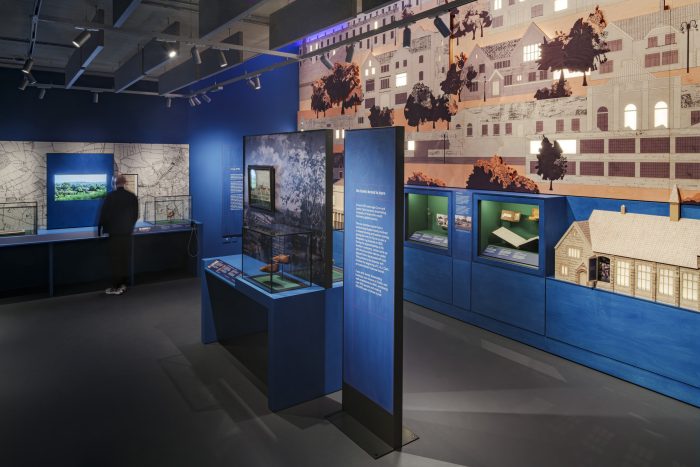
‘Welcome to Street’ is the first gallery in the new, permanent exhibition
As visitors approach the museum, they are met by colourful banner wayfinding in the scheme’s yellow-orange-blue principal colourway, taking people from the boundary to the main museum entrance. As well as introducing the bright colours used within the exhibition design, the wayfinding also introduces a series of shoe silhouette icons which form a major feature of the attraction’s graphic language. The banners additionally introduce the attraction’s chosen typography: fonts from the Centra series, which, according to the Nissen Richards Studio graphics team, is ‘a study in utility and restraint’ and which emphasises texture and readability, whilst being inspired by geometric sans serif designs. Secondary entrances to the museum also provide access to the scheme’s café and learning spaces.
Visitors arrive at Shoemakers Museum into a dramatic double-height space, with their journey starting in the Arrival area before moving through three main exhibition spaces: Welcome to Street / Making Gallery / Buying and Selling. The Arrival area instantly offers visitors two immediate ‘wow’ moments. The first is a wall display featuring neon shoe outlines and the second a bespoke welcome desk clad in vegan leather and featuring embroidered shoe outlines, a high-impact design element which was the product of a creative collaboration between Nissen Richards Studio and The London Embroidery Studio.
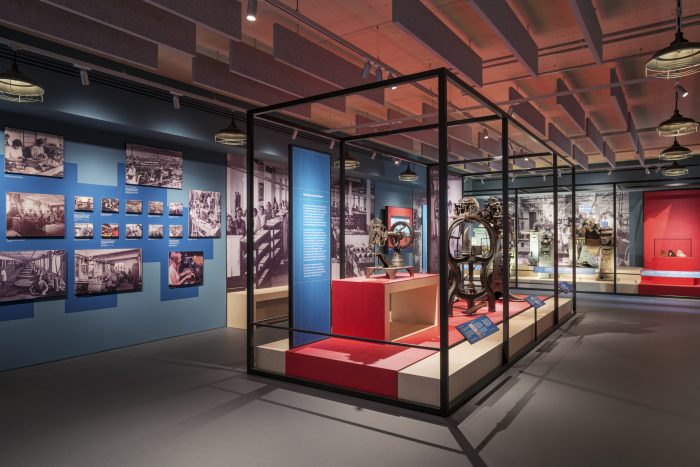
The gallery is organised around two ‘island displays’ and is inspired by an abstracted factory feel
Welcome to Street, the first part of the exhibition, focuses on the village itself, the Clark brothers and the importance of the people of Street to the history of Clarks. A full-wall depiction of Street and its rural context, which takes the form of a 3D-abstracted wall, also spans both the ground and first floors of the exhibition space and shows the village’s schools, factories, Quaker meeting houses, workers’ housing and distribution centres, along with showcases and interpretation. The ancient and iconic Glastonbury Tor sits at the top of the installation. The scene is set at night, time, with a number of buildings lit up to appear inhabited. An interactive element demonstrates how excess energy from the factories was once used to power the town’s streetlights. The section also includes low-level interpretation in the form of section panels and labels, as well as interactive models, with pull-windows revealing informative short narratives.
29 – Filmed footage includes interviews with former employees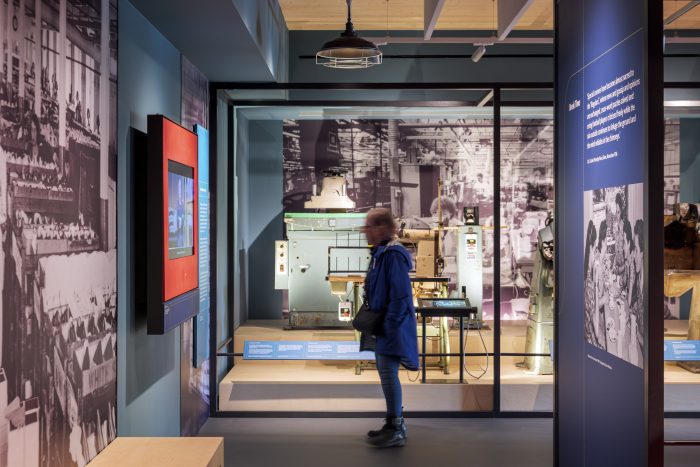
Filmed footage includes interviews with former employees
The second major section is called the Making Gallery and explains the production processes of shoemaking. The design inspiration here was to create an abstracted factory feel within the section’s large and open space, punctuated by a soundscape made up of real factory sounds. Within that is a secondary idea of a conveyor belt, with the sequential arrangement of objects alluding to this. This is an AV-intensive space centred around two ‘island’ displays, with interactive displays all around the perimeter. It tells the story of hundreds of years of evolving shoemaking processes, from hand-sewn shoes to automation and the eventual outsourcing of fabrication to Asia, as well as looking at the innovators and material developments which brought the process forward. The design team worked with film-maker Nick Street to record interviews with former employees who worked on some of the now-historic machinery.
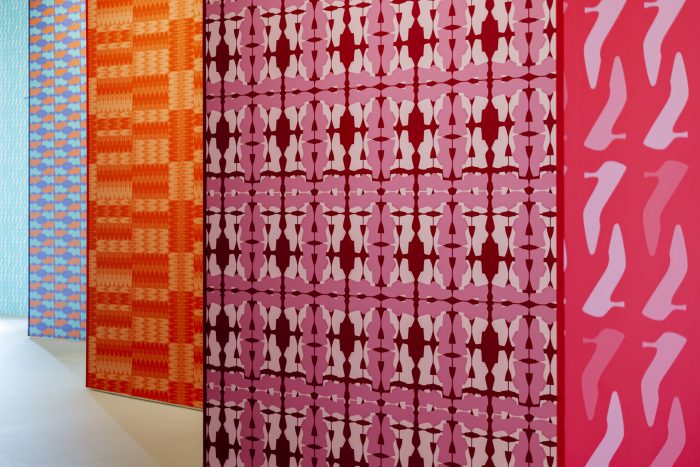
The panels use shoe outlines to create patterns in the exhibition colourways
Special features include a focus on the Bushacre line, which includes one of the brand’s most iconic shoes – the Desert Boot – as well as an interactive dexterity test, which replicates some of the tests original workers at Clarks did to find out what tasks they might be best suited to. Factory materials were the source of material inspiration for this section, with metalwork representing the language of machines and plywood the language of the foot ‘lasts’ traditionally used for forming shoes.
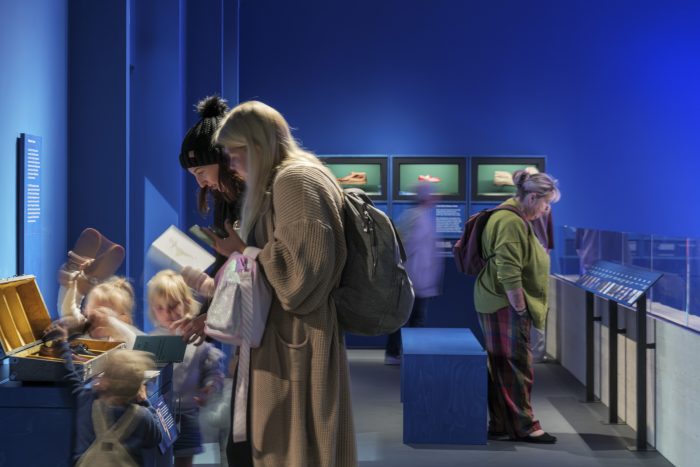
This balcony section examines the brand’s global reach
Visitors then move upstairs to the third section of the display, ‘Selling and Buying’, where the focus is about celebrating the product. The design feel changes with that transition to reflect a more highly-polished, public-facing environment. The space plan was fragmented in this section to create a series of scaled and intimate spaces. First of all, however, visitors meet a balcony section of the Welcome to Street exhibit from the ground floor, with the upper section looking at the story of the Clarks brand in the world, showing its global reach and key markets.
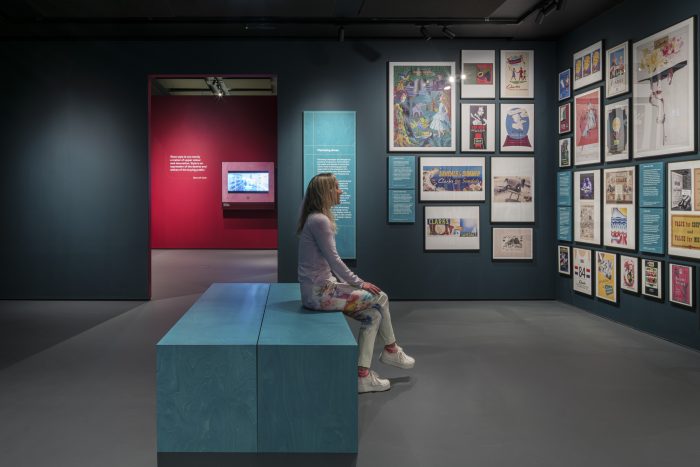
The third section of the exhibition is the ‘Selling and Buying’ gallery
The heart of this gallery is Clarks shoes through time, starting with marketing and advertising illustrated by point-of-sale pieces from the historical archive in a large wall-hung display, with a dark background that allows the archive items to stand out. An AV area to the rear plays some of the brand’s best promo films from the same time period. A middle section celebrates the design of the shoes themselves, with a two-wall display inspired by shoeboxes and examples of shoes displayed against an almost-black background. A filmed section shows interviews with designers in the present day, whilst another focuses on the design of the shoes.
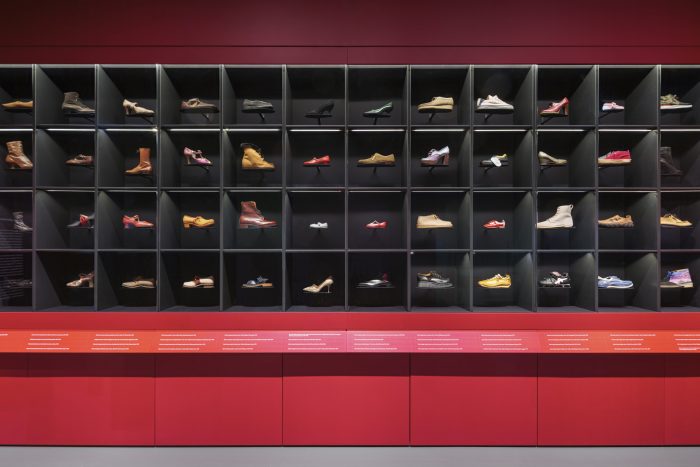
Visual product history wall
Two partial shop re-creations from the 1950s and 80s follow. The design challenge here was that the stores needed to be in a showcase/exhibition environment but still feel like a shop. The 50s shop environment features seats in the shapes of drums and graphic wallpaper, whilst the 80s shop is highly graphic and features large-scale geometric shapes. A number of interpretative elements are hidden under flaps and windows and in shoebox drawers so as not to detract from the overall retail feel. Labelling, for example, takes the form of price tags.
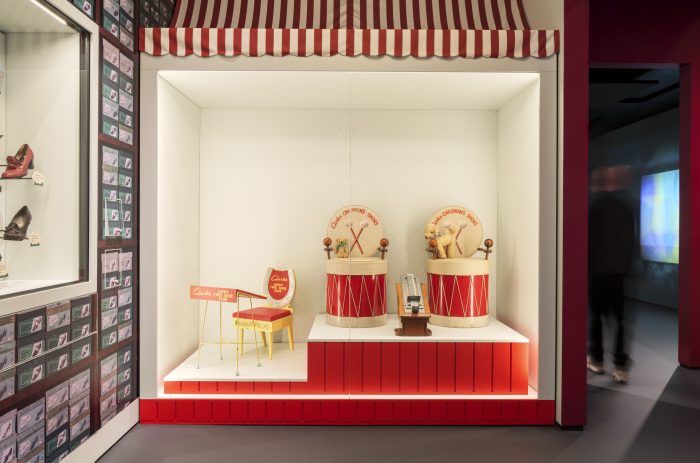
Partial shop re-creations, starting with a 50s store with drum seats
A back-to-school area with large wall hang sits between the two shops and features a number of child-friendly interactives from a till and dress-up area to a replicated shoe measuring kit.
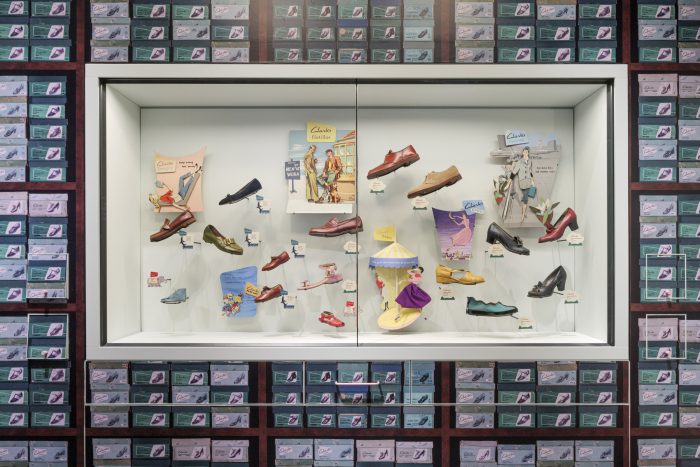
Shoe and point of sale display from the archive
A feedback area is located directly before the end of the shoe story, where visitors can design the colouring for a shoe or provide a memory of working for Clarks / factory life.
Rosie Martin, Director of Shoemakers Museum, commented:
“Our team thoroughly enjoyed working with Nissen Richards Studio, from the early days of identifying the themes, stories, and objects, to designing the galleries and overseeing the museum fitout. We are particularly pleased with the branding which perfectly reflects our personality and style. The feedback from our first visitors is extremely gratifying and we look forward to sharing Shoemakers Museum with the world.”
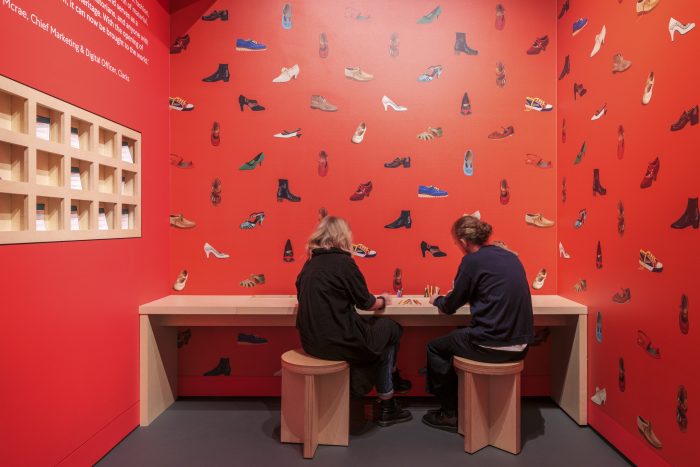
Visitors can design a shoe colourway or provide a memory of Clarks
Photography: Gareth Gardner