





Recouping Bio-By-Products for a Regenerative Built Environment
If the previous chapter in this material story was about harvesting nature, this one is about what happens next: recouping the bio-by-products that modern systems routinely overlook.
From agricultural residues and food waste to human hair and animal dung, these projects reframe “waste” as a secondary harvest, rich with latent value. Instead of treating by-products as liabilities to be disposed of, the designers featured here treat them as feedstock for a new material economy, one that works with cycles of decay, regeneration and return. The common thread is not just substitution, but transformation: turning residues into surfaces, structures and systems for the built environment, while allowing their origins to remain legible rather than erased.
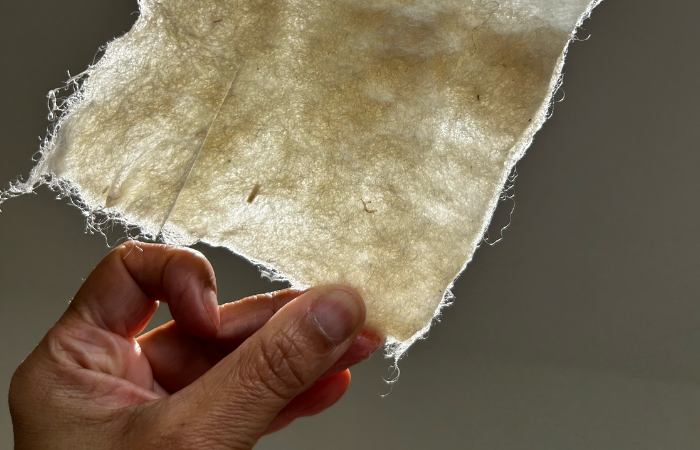
Romney Wool Biocomposite
Sandra Battistel’s Liminal Zone begins this conversation in the alpine borderlands between pasture and forest in the Dolomites, a landscape shaped by centuries of human–nature cohabitation. Her work draws on materials that were once central to mountain survival economies but are now marginalised or discarded: wool, pine resin, hemp fibres and a cellulose-based binder.
These are not exotic ingredients, but by-products of pastoral life and forestry, gathered from processes that already exist. Battistel treats them as a living archive of material culture, reassembling them into soft, tactile forms that sit somewhere between artefact and architecture. The notion of a “liminal zone” operates on multiple levels.
Geographically, it refers to the shifting edge between cultivated land and woodland. Materially, it describes the threshold between raw residue and refined object. Wool that might otherwise be low-value waste becomes a structural fibre; resin tapped from pine trees becomes a natural binder; hemp fibres, often underused compared to other crops, lend tensile strength. The resulting composites speak quietly but insistently about continuity: how older, low-impact material logics can be reactivated within contemporary design. In recouping these bio-by-products, Battistel is not nostalgic; she is pragmatic, pointing to a future where local residues are treated as strategic resources. Her work suggests that the built environment could be re-rooted in regional material ecologies, with by-products flowing back into use rather than leaking out as waste.
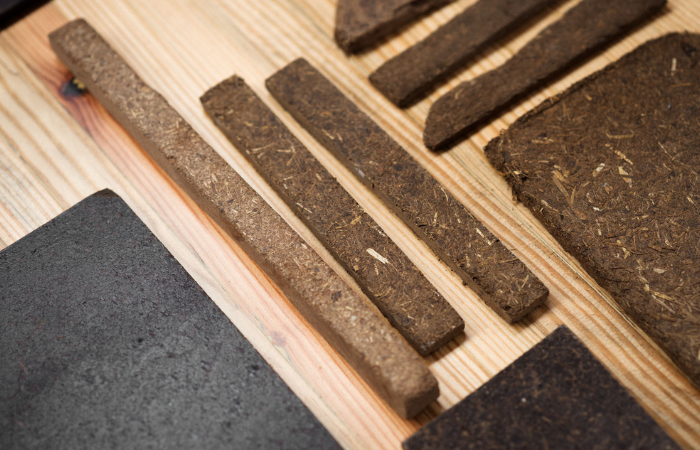
Dungse Labs pushes this logic into more provocative territory by working with one of agriculture’s most abundant and under-valorised by-products: cow dung. Drawing inspiration from Himalayan building traditions and combining them with modern processing techniques, the team has developed a material system that replaces wood, particle board and plastic with dung-based composites.
What might initially sound like a conceptual provocation reveals itself as a technically credible proposition. Cow dung is rich in fibrous plant matter and naturally antimicrobial; when processed correctly, it can offer insulation, water resistance and biodegradability. Dungse’s materials are designed for building applications, positioning agricultural waste as a future-proof construction resource rather than a disposal problem.
The project began as an exploration into indigenous wisdom and evolved into a rigorous programme of experimentation across countries and climates. Here, recouping a bio-by-product is not a symbolic gesture but a systems-level intervention. Livestock farming already produces vast quantities of dung; diverting even a fraction of this stream into material production could reduce pressure on forests, lower reliance on petrochemical plastics and cut embodied carbon.
Importantly, Dungse does not sanitise the narrative. The origin of the material is part of its identity, challenging cultural taboos about cleanliness and value. In doing so, it invites designers and specifiers to rethink what “acceptable” materials look like, and whether performance and environmental benefit should outweigh aesthetic prejudice. Cow dung becomes a regenerative building block, closing a loop between agriculture and architecture.
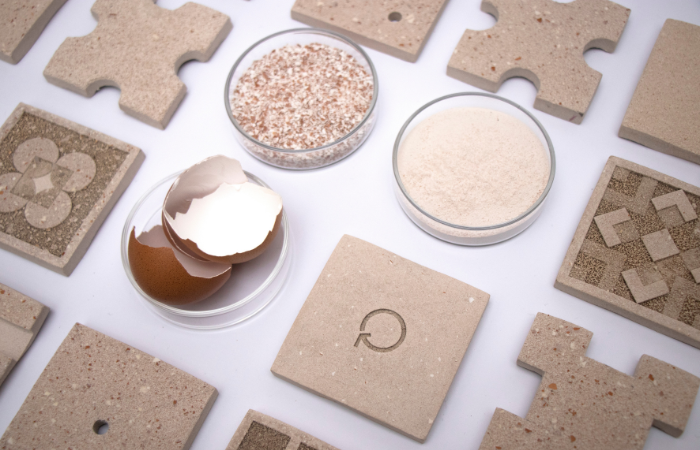
Mobina Rajabimoghadam’s Bio Recursive takes another ubiquitous waste stream, eggshells, and turns it into a versatile, fully biodegradable biomaterial. Eggshells, a by-product of food production, are rich in calcium carbonate and typically destined for landfill. Rajabimoghadam’s innovation lies in recognising both their chemical potential and their narrative power.
Bio Recursive is mouldable, machinable by CNC and laser, and available in varying thicknesses, from rigid panels to thin, translucent sheets that can be printed, folded, embroidered and even self-adhesive. It has been tested for strength, compression, flex, impact and heat resistance, positioning it as a serious contender for product and interior applications.
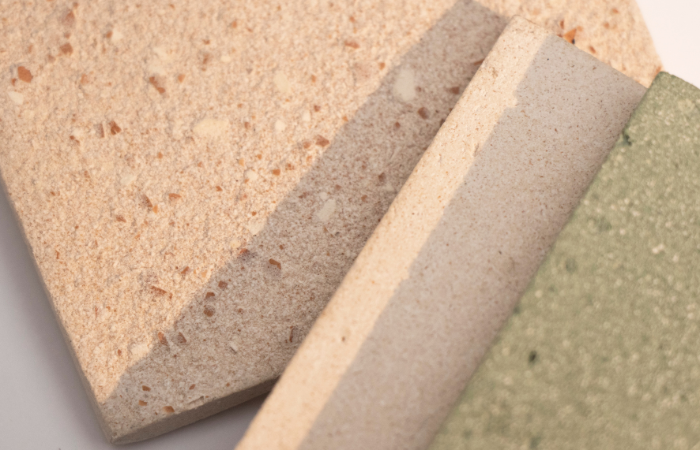
What makes it especially compelling in the context of recouping bio-by-products is its closed-loop logic. The material diverts waste from landfill, requires no virgin resources, avoids chemically intensive recycling, and when its useful life is over, it decomposes naturally in soil or water within days to weeks. Its calcium-rich residue then acts as a natural fertiliser, returning nutrients to the earth.
Rajabimoghadam describes materials made from such organic waste as one of the most underutilised resources in industrial design, and Bio Recursive is a direct response to that gap. It reframes eggshells not as a problem to be managed, but as a mineral resource to be activated.
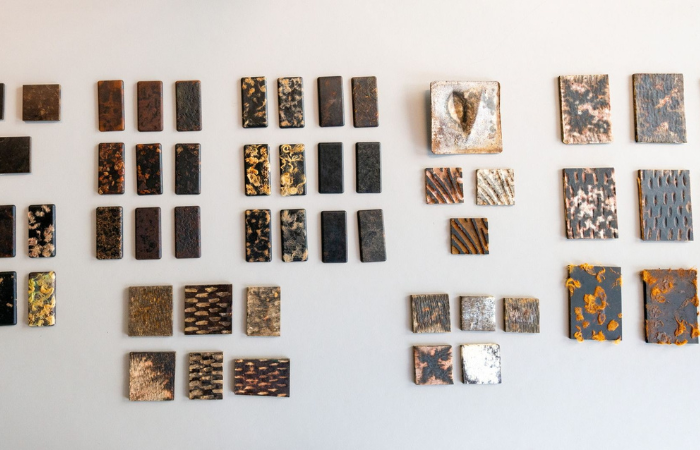
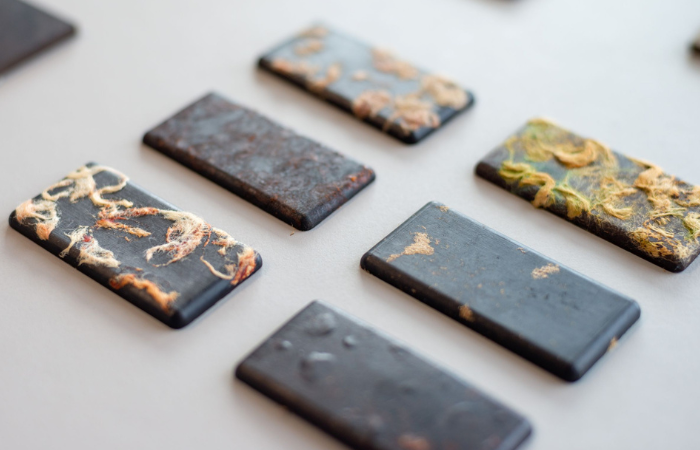
Living Traces, led by Isa Jansen, approaches bio-by-products through the lens of perception and acceptance. Working with N8040, a 100% bio-based, waste-derived biocomposite developed by NPSP, the project further confronts a persistent barrier in sustainable materials: social desirability.
N8040’s black resin limits pigmentation and has historically scored low on perceived beauty and sustainability. Jansen’s response is not to mask these qualities, but to amplify and aestheticise them. By adding fibres, including flax and wool, as well as fibres coloured with fungi and bio-based pigments, she introduces visual depth and material storytelling. Through processes such as sandblasting, accelerated weathering and lab simulations of wind, moisture, UV and biological colonisation, Living Traces anticipates how the material will age. Facade panels are designed to gradually reveal fibres, develop patinas, and even invite algae or mycelium growth.
Here, recouping bio-by-products is inseparable from recouping time and transformation. Waste-derived material is allowed to change, to show its life cycle rather than freezing it in a false state of perfection. The project reframes decay as a design opportunity, suggesting that acceptance of bio-based materials will grow when their evolution is celebrated rather than concealed. It points to a future built environment where surfaces gain value through use, weathering and biological interaction.
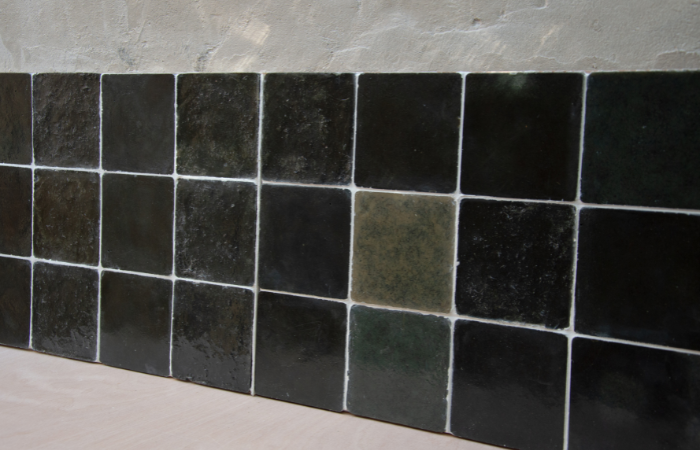
Jacob Marks’ explorations in pine resin and the collaborative development of Sylkera extend the theme of recouping by-products into the realm of natural binders and human residues. Pine resin, has a deep material history, once widely used before being displaced by petroleum-based alternatives.
Marks’ work revives and modernises this lineage, demonstrating how new techniques can reintroduce resin into contemporary applications, from handles and lighting to furniture surfaces. The material is mouldable, glossy and naturally antibacterial, making it both functional and sensorially appealing. This research becomes even more radical in Sylkera, a composite developed with Sanne Visser’s HairCycle. Here, pine resin is combined with short strands of human hair, a ubiquitous waste stream generated daily by barbershops and salons. The hair acts as an internal lattice, much like fibres in carbon fibre composites, creating a strong and durable structure.
Both components are organic and locally sourced, giving the material an extremely low carbon footprint and full renewability. What is striking is how unapologetically literal this act of recouping is. Hair, often treated as a contaminant or an embarrassment, becomes a performance-enhancing reinforcement. Resin, once sidelined by petrochemicals, returns as a bio-based matrix. Together, they form a composite that challenges both material hierarchies and aesthetic expectations. Sylkera does not hide its origins; it leverages them, turning human and botanical by-products into a new class of structural surface.
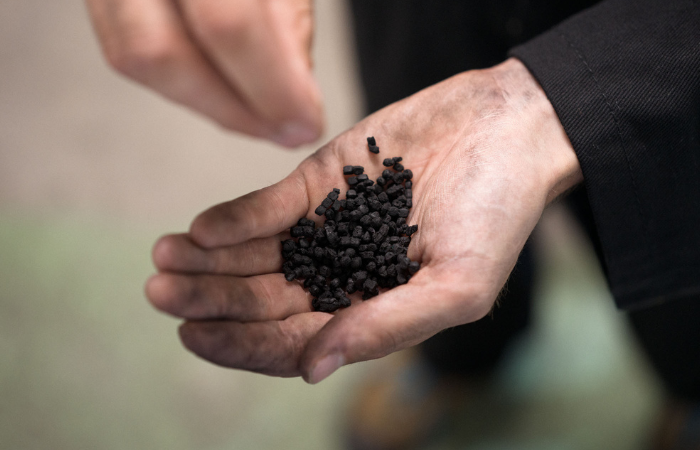
Carbon Cell brings the conversation into the realm of industrial scalability, using biochar derived from agricultural waste to create a fully compostable, non-toxic and carbon-negative replacement for polymer-based foams. Biochar is produced through a high-heat, oxygen-exclusive process that locks in the carbon sequestered by plants, preventing its release into the atmosphere.
By embedding this biochar into a foam matrix, the team has developed a material that is three times stronger than EPS, with good thermal conductivity, fire resistance and promising acoustic properties. Potential applications range from food packaging to construction, with plans to manufacture sheets for thermal insulation, acoustic panels and laminated foam-core products for interiors and furniture.
What distinguishes Carbon Cell in the context of recouping bio-by-products is its double dividend. It not only diverts agricultural residues from decay or burning, but actively removes more CO₂ from the atmosphere than it emits. This transforms waste into a climate-positive asset.
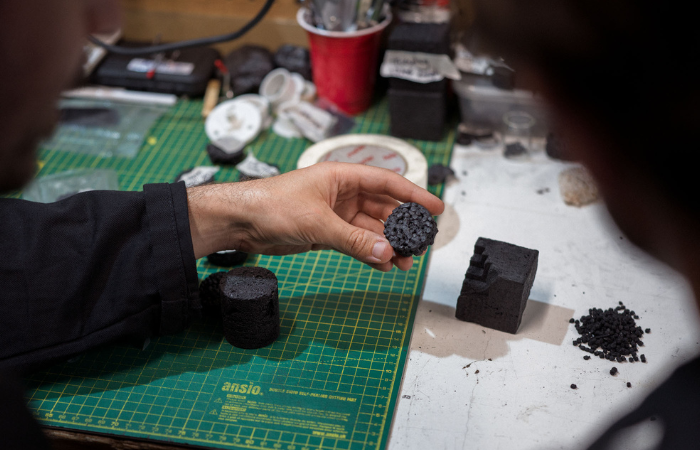
The team’s ambition to scale using adapted foam manufacturing technology underscores a critical point: for bio-by-product materials to reshape the built environment, they must move beyond prototypes into production realities. Carbon Cell demonstrates how residue streams can be industrialised without losing their regenerative logic, offering a credible pathway for replacing some of the most environmentally damaging materials currently in use.
Taken together, these projects outline a compelling material future built not on extraction, but on recouping. What links them is a refusal to treat by-products as the end of a story. Instead, they become the beginning of new material narratives, where the built environment is shaped as much by what we throw away as by what we choose to harvest.