







Resonating with Purpose: How Pernille Bonser Is Shaping Human-Centred Commercial Design
Design Insider spoke with Pernille Bonser, CEO and founder of Resonate Interior Architecture, a multi-award-winning studio renowned for creating exceptional, emotionally resonant spaces across commercial, educational, hospitality, and residential sectors. Drawing from her British-Danish heritage and a career shaped by luxury travel and high-end retail, Pernille brings a deeply human and detail-driven approach to interior architecture.
Since its founding in 2012, Resonate has been guided by a clear purpose: to design environments that are not only functional but memorable, spaces that foster creativity, connection, and wellbeing. With expertise spanning occupier workplace design to landlord shell and core through to Cat A+, the studio is grounded in values of sustainability, collaboration, and thoughtful curation.
In our conversation, Pernille reflects on how Resonate’s bespoke, narrative-led approach ensures each project is tailored to both the operational and emotional needs of its users. She discusses the studio’s commitment to sourcing locally, from drawing a 100-mile radius around each site to partnering with craftspeople who share their sustainable ethos. And she shares her perspective on the growing role of artificial intelligence in design, emphasizing its potential as a tool that empowers creativity without replacing it.
What emerges is a portrait of a practice that’s not just designing spaces, but reshaping how we experience them!
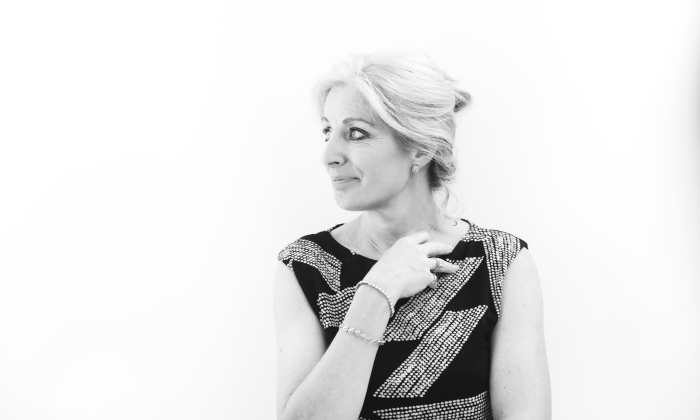
To begin, could you introduce yourself and share how your design philosophy has evolved over the course of your career, leading to the creation of Resonate Interior Architecture?
I’m Pernille Bonser, CEO of Resonate Interior Architecture. I’m half British, half Danish, and my Scandinavian roots have deeply influenced my design journey. I grew up surrounded by creativity — my mother was an antique dealer, and my father was a furniture designer during the 60s and 70s — so design was simply a part of life from a young age. Now, my two sons are continuing that creative legacy: one works as a graphic designer in London, and the other is studying textiles in Paris.
I began my career in luxury travel and high-end retail — notably with the Royal Scotsman train — where I developed a sharp eye for detail and learned how to combine beautiful materials, all back in the days of hand-drawn designs. Before founding Resonate, I led the interiors department at Scott Brownrigg for several years and later joined TP Bennett. Eventually, I felt a strong pull to create something of my own — a studio built around the idea of crafting environments that truly connect with the people who inhabit them. Resonate was born from that vision. It feels like my third child: I’ve nurtured it with care, but also encouraged it to be bold, inquisitive, and always evolving.
Resonate is celebrated for crafting exceptional spaces across commercial, hospitality, and education sectors, how do you ensure each project offers a layered, emotional experience while staying aligned with clients’ operational goals?
At Resonate, one of our core values is “crafted and curated,” which means every project is entirely bespoke. It’s not about imprinting our style — it’s about understanding each client deeply and guiding them through a design journey where they are the hero.
In workplace design, for instance, we aim to create environments where people feel genuinely connected to their company’s brand and values. We weave these elements into the design subtly — from biophilic features and natural light to inclusive layouts that make every employee feel welcome. In hospitality, we focus on flow, atmosphere, and authenticity — ensuring the space reflects the provider’s ethos and the site’s unique history.
In education, our priority is to support the full range of student needs: quiet areas for focused study, dynamic zones for collaboration, and informal pockets for one-on-one support. Across every sector, it’s about responding to the brief with empathy and imagination — matching operational needs with a meaningful design narrative.
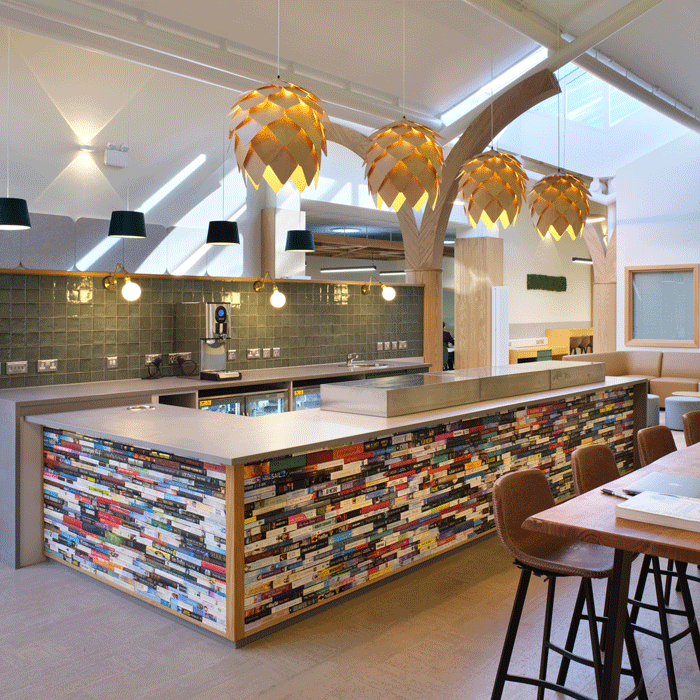
King Edward School 6th Form
How do you approach the idea of ‘supporting local’ in your projects, particularly in terms of integrating the surrounding community, local suppliers, or regional character into hospitality and workplace environments?
“Treading lightly” is one of Resonate’s founding values, and we’ve been committed to this for years. We aim to source materials and collaborate with manufacturers within a 100-mile radius of each project site whenever possible. We’ve built a network of over 1,000 vetted suppliers across the UK who share our design ethos and sustainability goals.
For example, in the Cadent Ansty project, we sourced 73% of materials locally — a commitment that earned us a BCO award for ESG excellence. We also love working with suppliers like Fallen & Felled, who repurpose felled council trees from London into stunning joinery pieces. For our NTT project, we transformed a London plane tree into a beautiful breakout bar.
As soon as a new project begins, we put a pin in the map and draw that 100-mile circle. It’s a simple idea, but one that makes a powerful difference — environmentally, economically, and creatively.
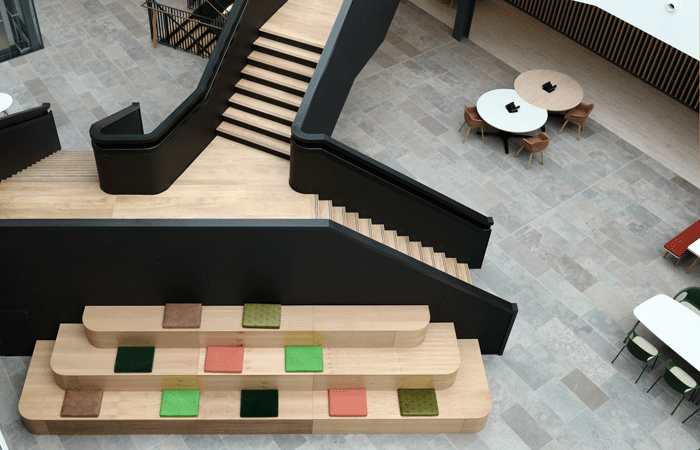
Cadent Ansty
Sourcing locally is often talked about in sustainability conversations, what do you see as the most impactful environmental advantages of working with nearby suppliers, materials, or craftspeople in your commercial projects?
Sourcing locally adds richness to a design — it brings a sense of place, story, and heritage to a project. It also supports local economies and craftspeople, which we believe is simply the right thing to do.
But beyond that, it creates a ripple effect. We’ve seen how connecting like-minded, sustainability-driven people can lead to truly exciting collaborations. We host roundtable events called “Go Green or Go Home” that bring together designers, makers, and clients to share ideas, build partnerships, and explore new possibilities. When creative people with shared values come together, the energy is contagious — and the impact, both commercially and environmentally, is far-reaching.
Artificial Intelligence is reshaping many aspects of design practice. Do you believe AI is beginning to erode the creative integrity of interior architecture, or can it serve as a tool without compromising design vision?
AI is a topic we actively discuss in the studio, and I firmly believe it doesn’t hinder creativity — if anything, it has the potential to enhance it. The key is understanding how to use AI as a tool that supports, rather than replaces, original thinking.
At its best, AI can accelerate our design process — allowing us to visualize concepts faster and explore options more efficiently. But we’re always mindful to ensure the core creative ideas originate from the team. AI is just one of the tools in our designers’ kit — a way to stretch their thinking, not a substitute for it. Creativity remains at the heart of everything we do.
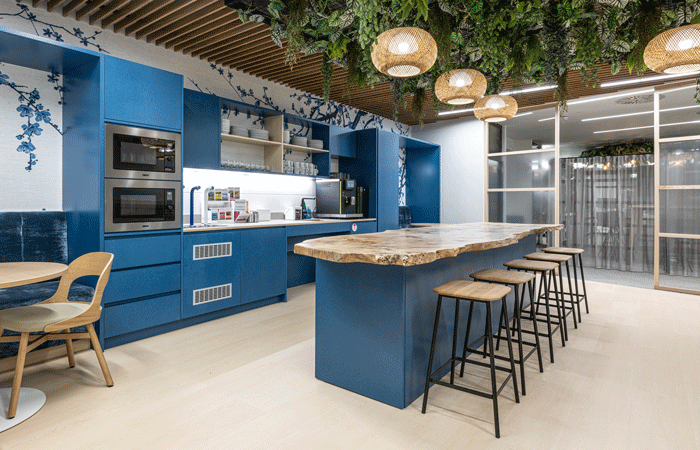
Fallen and Felled Workshop
While there’s understandable concern about the creative limits of AI, what do you see as the most exciting opportunities it presents for designers?
One of the most exciting things about AI is that it’s not just about visuals — it’s revolutionizing the more technical and time-consuming aspects of our work, like drawing production and scheduling. That frees up our designers to focus on the creative aspects where their talents shine.
We also see real benefits for team members who are dyslexic — which, interestingly, is a common trait among highly creative individuals. AI can assist with written documents, helping with grammar or spelling, so long as the original concept and design ethos are clearly input by the designer. It’s about reducing barriers and giving people more time and energy to think, create, and innovate.
From your perspective, how attractive is the commercial design sector to today’s most talented design graduates? Are there hurdles that make it harder for new designers to enter or thrive in this space?
Post-Covid, we’re seeing an exciting evolution in commercial design across all sectors. Workplaces are becoming more “resi-mercial,” blending comfort with functionality, and the idea of the “third space” — areas beyond desks or meeting rooms — is finally being taken seriously.
With sustainability at the forefront and a wealth of new materials and products emerging, there’s never been a more thrilling time to be part of this industry. Hospitality is embracing bold, social-first design, and education is shifting away from rigid classroom layouts toward more agile, inclusive environments. These changes mean we’re designing spaces for every kind of experience — from focused study to vibrant collaboration.
For new graduates, that means a world of opportunity. The canvas has never been broader.
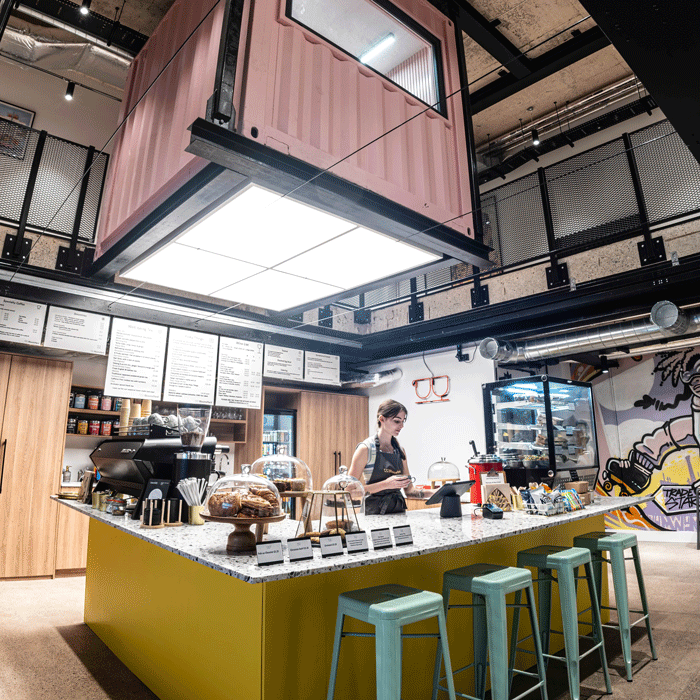
Tradestars
What more could established industry leaders and practices be doing to better support and mentor early-career designers as they step into the commercial interiors sector?
I believe we have a responsibility to mentor the next generation — and more than that, it’s a mutually enriching process. Experienced designers should be regularly engaging with universities, offering portfolio advice and real-world insights.
When graduates enter the workforce, they should have access to senior voices — not just as managers, but as mentors. I was involved with the BCO’s NextGen initiative in its early days, and it’s become an incredible support network with a thriving community of mentors and mentees.
Maybe we need a more formal structure — a “mentorship club” where industry leaders pledge several hours each month to support early-career designers. And let’s not forget: it’s not a one-way street. I’ve been in this industry for over 30 years, and I still learn so much from the energy and perspective of the younger generation.
Looking to the future, what’s on the horizon for you and Resonate? Are there particular people, technologies, or shifts in culture that you see as disruptive forces in the interior design industry today?
After a challenging 2024 — with financial and political uncertainty delaying many real estate decisions — Resonate is now in a period of exciting resurgence. We’re relocating to a new space in Southwark that we’ve designed for our fantastic clients, Tradestars. We’ve also brought on a brilliant Non-Executive Director and are deepening relationships with both new and long-standing clients.
There’s a renewed sense of purpose in the industry. At the recent BCO conference in Milan, CEO Sam McCleary spoke about the extraordinary quality of London’s property scene — and I couldn’t agree more. Our mission now is to keep pushing: be curious, challenge assumptions, stay disruptive.
We’ll continue to ask “Why?” and look for better answers. I love this industry — the people, the passion, the places we shape — and that love fuels everything we do at Resonate.