






Unknown Works Unveils a New Sonic Experience for SALT Salon
SALT Salon’s new Borough premises see the transformation of a Victorian storehouse in London’s historic Borough Market into a highly crafted listening environment, where hairdressing rituals are shaped by sound and club culture. Designed by architecture studio Unknown Works, the project creates a new, experience-led second home on Stoney Street for the fast-growing hair brand SALT Salon.
Unknown Works is an award-winning design studio based in London. The studio’s work spans architecture, urban design, exhibition design, installation art, graphics and digital media, practising at many scales with a focus on social, cultural and commercial spaces, residential projects, and immersive installations that bring together physical and digital media.
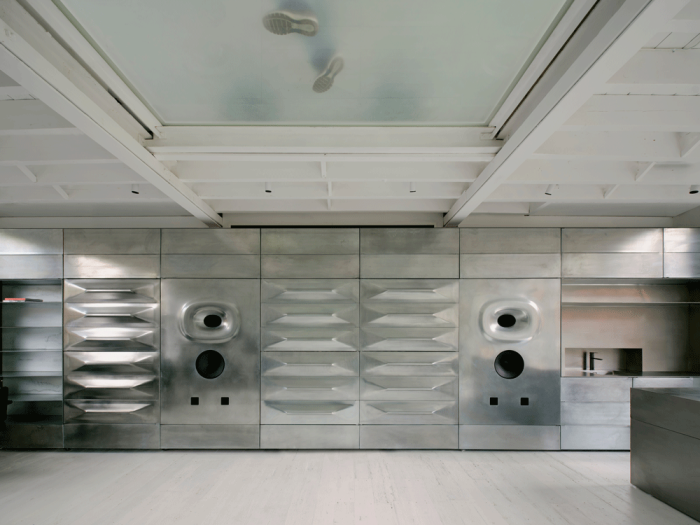
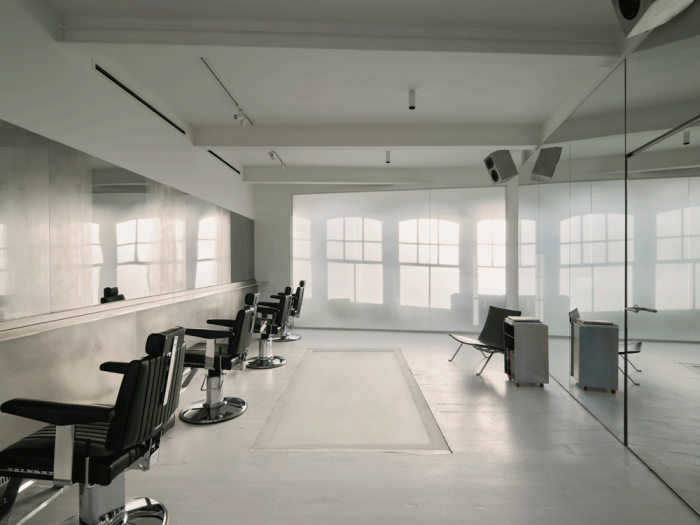
SALT Salon Borough is both a state-of-the-art salon and a vibrant cultural space. Taking over three levels of the listed brick building, each space has a distinct hairdressing function, spatial and acoustic identity. A sound system embedded into the bespoke interior is programmable to support unique sonic salon environments – ambient mornings, textured afternoons and immersive evening sessions. A Listening Room doubles as a venue for performances, talks and deep listening, allowing the space to transition with ease from service to event mode.
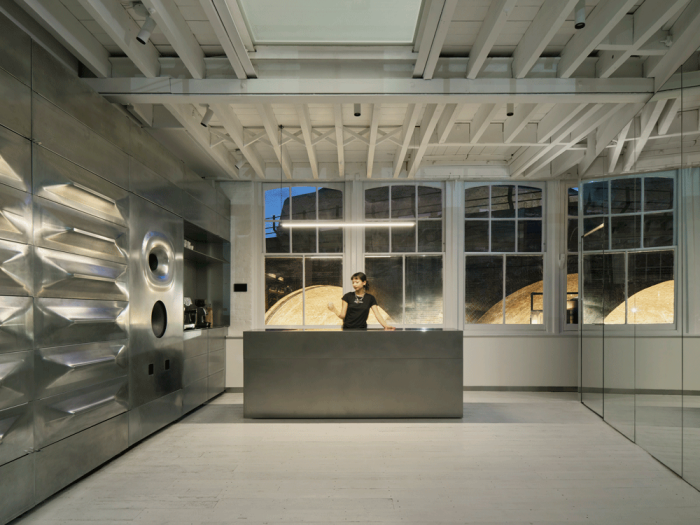
Set on the first floor is the ‘Listening Room’ – a row of cutting stations and a reception area (that becomes a bar at night for events) frame a central gathering space that is defined by a pair of large-scale, galvanised steel loudspeakers incrementally formed using roboforming – a pioneering low-energy digital fabrication technology.
The bespoke joinery and specialist metal roboforming for this particular project was designed and developed by Unknown Works and fabricated using salvaged metal and shelves from Blythe House; the storage facility previously used by the V&A, Science Museum and British Museum. Unknown Works had already used 225 of these same shelves to construct the Science Museum’s 800sqm Energy Revolution Gallery, which opened in early 2024. The speakers were developed in collaboration with Friendly Pressure, a high-fidelity start-up led by Shivas Howard Brown, whose designs focus on elements of UK soundsystem culture, and the joy and togetherness of sonic experience.
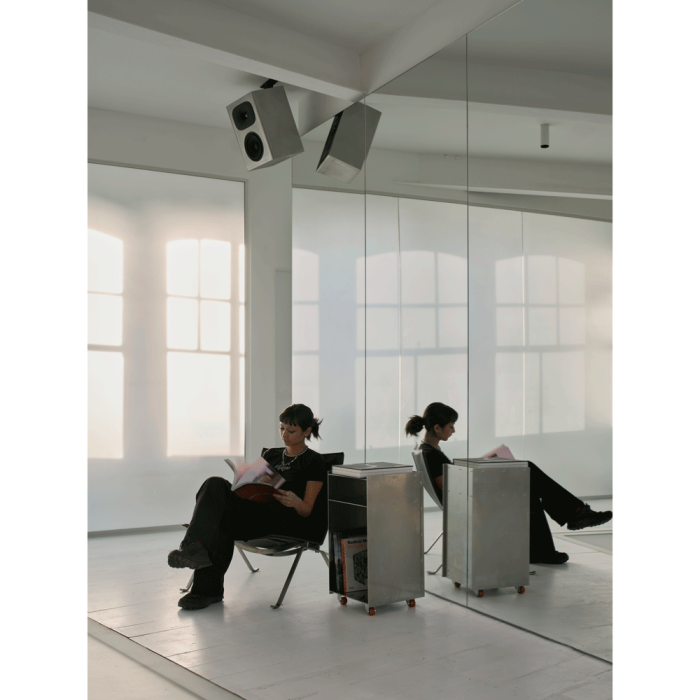
The second floor houses an open-plan ‘Cutting Floor’ – a cutting station that utilises a continuous mirror formed from stainless steel sheet, finished in a gradation from buffed and mottled for privacy to mirror-polished for fine reflection and fidelity.
Suspended above, stainless steel Friendly Pressure Pickney loudspeakers anchor the room visually and sonically. The rear of the floor accommodates a staff room, kitchen and social space, screened acoustically from the main salon with silicone screens.
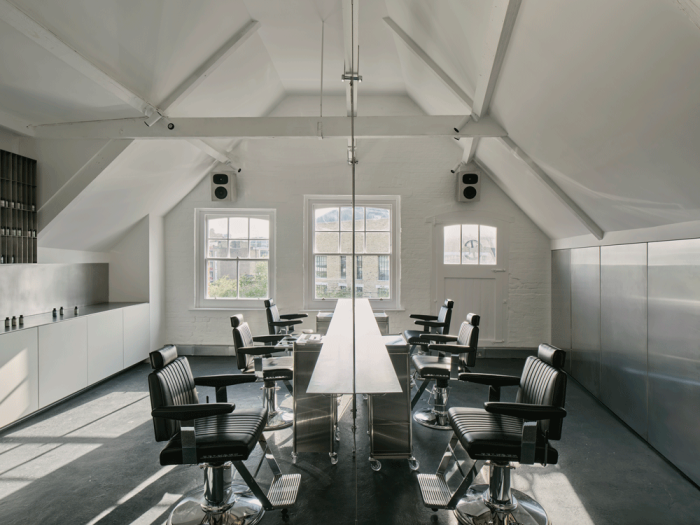
The ‘Colour Floor’ on the top level features a suspended, half-tonne sculptural mirror workstation hung from the original timber rafters. Crafted from ultra-bright stainless steel, it acts as both a reflective surface and a diffuser. Over time, this floor is intended to stain from dye use, recording the creative process in material patina. Mirrors throughout are polished to reflect but also refract, softening visual boundaries between guests.
Sound is embedded in every detail. Bespoke modular chairs made from recycled foam are not only extremely comfortable but absorb low-frequency sound. Floor-to-ceiling suspended silicone panels dampen reflections and optimise clarity. The architecture supports acoustic nuance, shaping the room as an instrument in itself. Bespoke bio-resin lights, imprints of the formed metal panels, have also been created for the space by Unknown Works.
SALT Salon’s first space offers a contemporary salon experience in a former 19th century tramway store in Dalston. This larger second salon take the same approach: an ultra-contemporary environment set within a historic casing. Both salons also take the unusual step of having no street-level frontage beyond discreet signage. This is a friendly and welcoming brand, but one very much with its own understated tone.
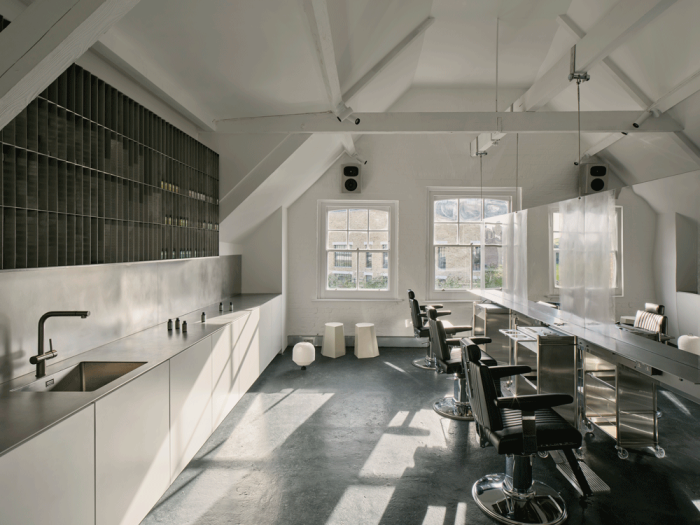
SALT Salon Borough also builds on the progressive ethos of its Dalston founder – hair stylist and former electronic music producer, John Paul Scott – reimagining the salon as a place of care, creativity and sonic awareness. The new space explores how high-fidelity sound, spatial acoustics and sculptural architecture can enhance daily rituals and social interaction.
Ben Hayes, Director at Unknown Works:
“This listed Victorian storehouse has been boldly reimagined as a space where sound operates as both material and medium. Every element, from the bespoke loudspeakers to the acoustic furniture, has been precisely tuned to create an entirely new salon experience. It’s a fundamental rethinking of what these spaces can be.”
John Paul Scott, Founder of SALT Salon:
“My ethos has always been to create the best hairdressing space for people to work in and visit, that caters for everyone. One of the things I love about hairdressing salons is that they are kind of impartial, open spaces. Anyone can come to SALT and be looked after and enjoy it. I’m a Londoner and have always had a bit of an obsession with Borough Market. You can feel the history there. It’s such an important place.
The brief for SALT Salon Borough was bring all the things we already do – hair, sound, music, drinks – and elevate it to a completely new level. We were ambitious with it, and Unknown Works ran with that. I wanted to do something that would almost shock people – but which put SALT Salon on the map. Unknown Works played a huge part in achieving that with their forward-thinking design. They have been amazing and it’s been a great collaboration.”