





74: From Rebellious Architects to Interior Design Visionaries – David Holt on People-First Design
In this exclusive Design Insider interview, we speak with David Holt, co-founder of award-winning Manchester-based design studio 74.
Known for their people-first approach, 74 specialises in large-scale PBSA, Build-to-Rent and hospitality developments, with a portfolio spanning the UK and Europe. Their work ranges from revitalising Grade I-listed heritage sites to creating sustainable, resident focused spaces shaped by a strong design philosophy.
David shares how the practice’s rebellious beginnings quickly led to early success and how that momentum evolved into a transition from architecture to a purely interior design focus. He also discusses how working from their creative hub in Manchester’s Northern Quarter helps the team stay connected, collaborative and constantly inspired. Whether working with funders, developers or operators, David believes that listening to clients, understanding a site’s history, and designing for future generations remain at the heart of 74’s success!
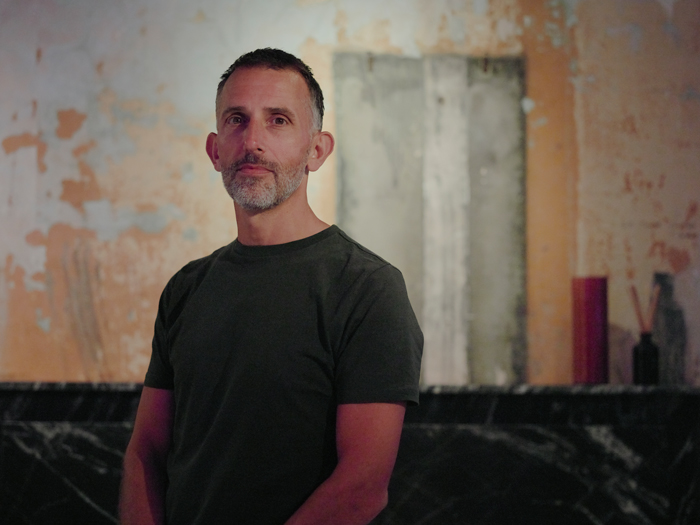
David Holt, Co-Founder, 74
David, could you start by telling us about the architectural origins of 74? What was the motivation behind founding the practice, and how did PBSA projects become such a significant part of your workload right from the very beginning?
74 was set up by 4 rebellious Architects who wanted to break free from the constraints of larger practices. We are now entering our 12th year, and it’s been quite a rollercoaster ride through recessions, COVID, wars and tighter regulations.
Our ethos has always been based on creating outstanding places for people and adding financial and experiential value to clients’ developments.
Within our first 3 months, we were fortunate to be commissioned on five PBSA projects by the US company Greystar, who were relatively new to the UK at the time. The studio was filled with an electric energy in those early days as we were tasked to make the impossible possible, completing projects with outrageous deadlines. This period of work was amazing. We were deep in it with the client and contractor, day and night, all with our sleeves rolled up and helping each other to make these projects a reality.
All the sites were opened on time and began to set a new benchmark, disrupting and influencing the sector and leading to a dramatic shift in the design and quality of student living in the UK.
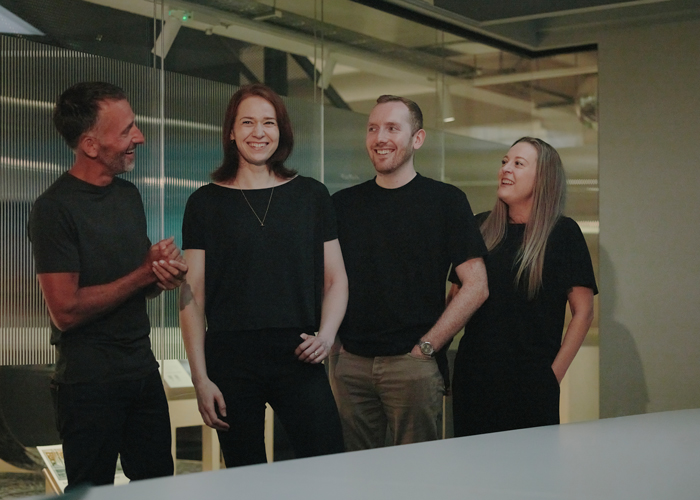
74 Management Team
Your early success with Greystar clearly opened doors for the practice. Did that lead to you being ring fenced into a particular project type, or were you able to diversify your project portfolio during those formative years?
We had a blast working on multiple residential projects across London, which kept us busy during our first year in practice. Our relationship with Greystar went from strength to strength as they quickly accelerated into becoming one of the largest residential developers and operators globally. We picked up new clients and worked around the country on projects of all types and sizes. We worked on masterplans, architecture, Grade I & II Listed heritage buildings and on some shoddy old building stock. The intensity at 74 was high, and the energy was unbridled; it was an incredibly positive time for the practice.
As we evolved, we brought in skilled Interior Designers to complement the architecture team, and we worked seamlessly together on several projects, each bringing out the best in each other and enabling us to create some outstanding projects in multiple sectors.
It’s interesting that 74 evolved from being predominantly architecture-focused to becoming an interior design-led practice. Could you talk us through how that transition unfolded and where 74’s focus lies today?
After overcoming a challenging time for the business through COVID, we became much busier with the Interior Design side of the practice and developed the ID team into the beating heart of 74. Today, we are a 100% Interior Design-focused practice, but the architecture lifeblood still runs through our veins.
We are naturally at home on large-scale projects, especially those with an aspiration to improve elements of the design to create a place that has a positive contribution to people’s daily lives. We pride ourselves on our ability to evolve a design from a compelling concept into the technical
stages, onto site and to achieving successful completion and occupation whilst keeping design, compliance, budget and programme targets under control.
Our Manchester studio is led by Bianca Yousef and supported by our management team and talented designers. They work together, collaboratively, to develop ideas through critiques and debates in a very fluid way that harnesses everyone’s perspective, experience and insight.
Could you tell us more about your current team structure and where everyone works? How does being based in Manchester’s Northern Quarter influence your creative process, and how do your international partnerships support your work across different cultures and regions?
The 74 nerve centre is Manchester.
We work in an open-plan studio in the heart of the Northern Quarter, a part of the city that has retained its independence and eclectic vibrancy. It’s a place that has not completely fallen victim to gentrification, it’s full of expressive people, and there is still a punk attitude that pervades and adds to its diverse character. We are continually inspired by the ever changing street art and layering of history.
Due to our work across Europe, we have design partners in Dublin, Berlin and Seville, who we work closely with to ensure we are designing effectively for different cultures, harnessing local distinctiveness and adhering to regional compliance and governance requirements.
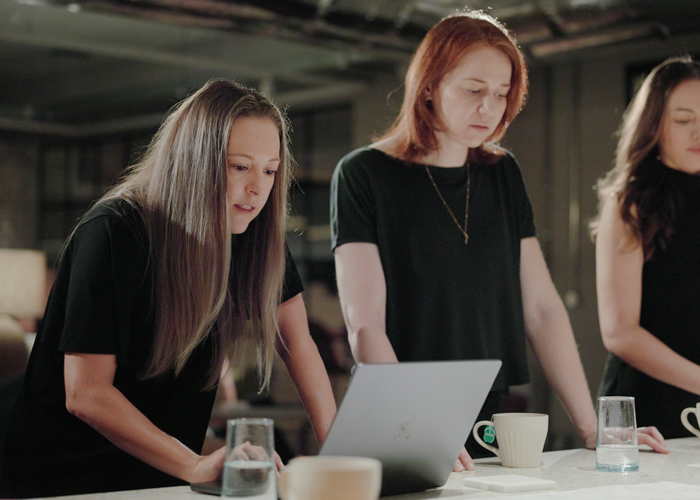
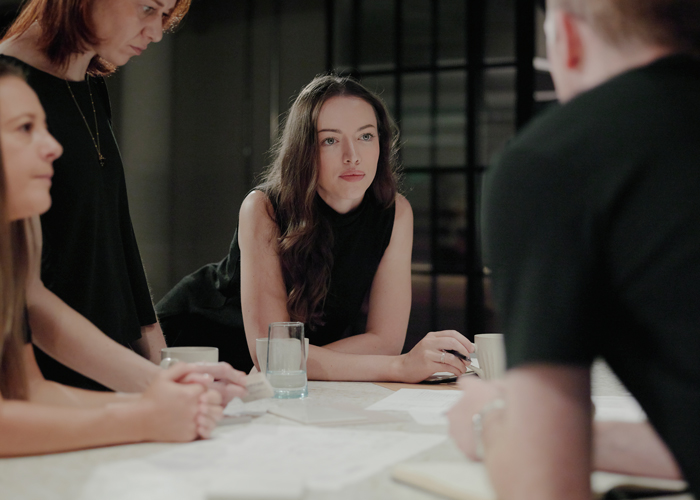
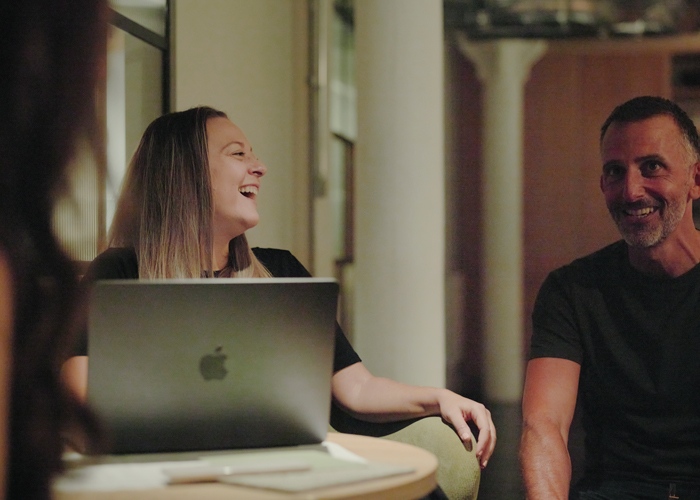
Our designers all work from our studios. We do not work from home to ensure we work together, collaboratively and seamlessly. We are often gathered around a screen or a sketch book or a collection of samples, and we often jump into design reviews and debates in an ad hoc way. This way of working allows fast, hands-on and effective interaction that is not restricted by Teams.
Would you say that working in the heart of the city helps keep your team connected. How important is that physical presence to staying inspired and up-to-date with what’s happening in the design world?
It is so important to us, as designers, to stay on top of what is happening around us. This allows us to be constantly looking for fresh inspiration and to be exploring into new or better ways of doing things.
Manchester has a bustling design scene and we are very fortunate to be able to take full advantage of that. Working in the heart of the city means we are constantly plugged into industry events and socials where we can catch up with our industry friends, meet new connections and stay in the know about everything from new product launches to thought-provoking seminars.
We are a sociable bunch and therefore love being able to have visits from suppliers or clients, which works well being just a stone’s throw away from Piccadilly Station.
We’d love to hear more about how your team typically approaches delivering projects, what’s your process, what specific skills do you rely on, and which stages of a project do you find the most rewarding as a studio?
Form always follows function.
The practice was set up by our Director, David Holt, who is a registered Architect. As such, we follow the RIBA Plan of Work and apply the rigours of architectural design, management and practice to our work daily. This approach helps us as our projects are always fairly large scale and we are therefore embedded into architect-led design teams, all working through the RIBA Plan of Work sequence.
The Leonardo PBSA, Leeds
Our work ideally starts at Stage 1, the all-important briefing stage, where we will discuss, at length, the objectives and aspirations of the project with the client. We will aim to define all the key drivers which will enable us to develop highly functional layouts and delve deeply into the more emotional drivers to develop a strong narrative and the right experiences within the development.
At this early stage, we will engage with user groups to understand what they do and don’t want, and we will look at the demographics and marketplaces we are designing for. We speak to ops teams to ensure that the spaces we are designing are highly functional.
Stage 2 involves analysis of the site and the development, and quite often, into the client’s brand. We will extract kernels of information about the site’s history, the context, maybe the people who used to live there, the proposed architecture, colour schemes and material palettes. We will use all of this to create a tapestry of information from which the narrative and concept grow. We use this process to define a series of design rules that are adhered to throughout the project to create a coherent whole.
We don’t design according to trends. The drivers behind each project are unique and site / context specific which lead to well considered, cohesive schemes with life, soul and character.
The Leonardo PBSA, Leeds
We use sketching as a tool to design as it is quick, fluid and with practice it becomes the fastest route from brain to page. Especially at an early stage, we believe the pen is mightier than the mouse..!
As our work evolves and moves into Stage 2 & 3, our work becomes more expressive and three dimensional; we add layers, motifs and features to accentuate the design narrative and concept and create the right moods and atmospheres within the places and spaces we are designing. We still sketch regularly deep into the project, but as we progress from Stage 2 to 3 we use 3d modelling to create and experience the spaces we are designing.
Our design work is debated and tested internally and then with our clients at each stage. We present and then listen to the feedback. We check for compliance, cost, programme and procurement accuracy, we evaluate all comments from the client and design team and adjust our work to suit. We are hands on and very engaged with the design team throughout the project. We like to form strong working relationships and are always up for having a chat and going for coffee where we can, which can sometimes be lost with meetings often being over teams.
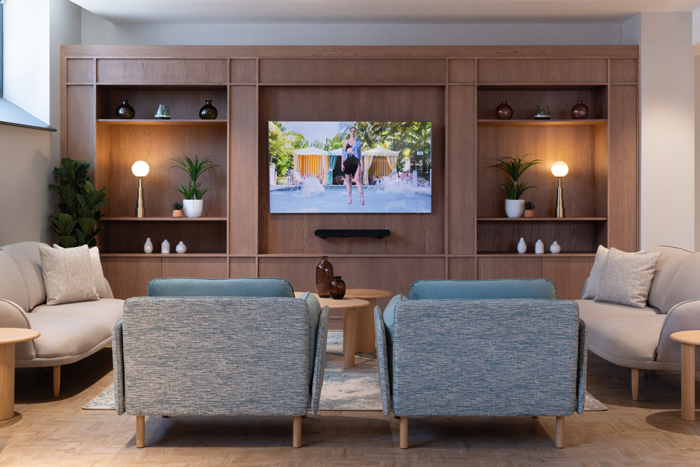
The Leonardo PBSA, Leeds
David, could you give us an insight into what’s currently on the 74 team’s desk? Are there any exciting projects in development that you can share with us?
We are continually trying to push forward and improve our quality levels, our knowledge and experience to ensure that we are creating the very best places and giving the best service we can to our clients.
We are implementing changes to our structure with a new management team dedicated to the smooth running of projects and our teams of designers. This will enable our directors to focus on improving the practice.
We have increased our business development focus with Rosie McDonnell now working with myself to raise our profile, increase the prominence of 74 and find like-minded clients who really value the end users of their buildings.
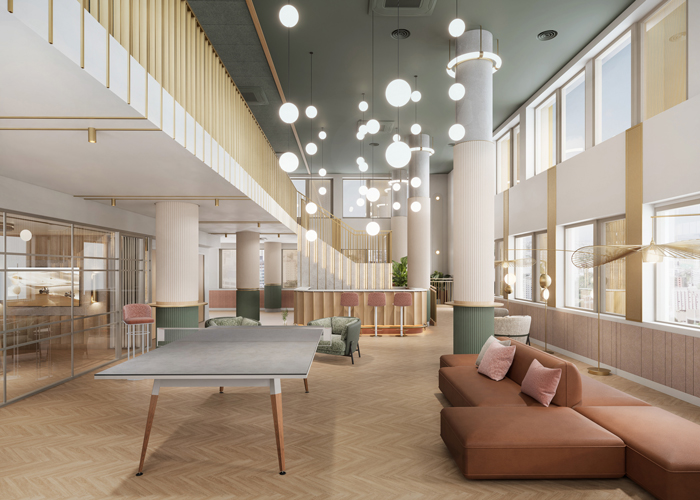
Crutched Friars PBSA, London
In the UK, we have several new projects in London, Leeds, Glasgow, Edinburgh for long standing and new clients.
We are also proud to be working regularly in Europe with projects in Dublin, Berlin and Leipzig. We also have further projects in the pipeline across Germany and Spain. We will be growing our teams to support our projects, ensuring that quality levels are kept high and communication is fluent.
We have undertaken several notable hotel projects, such as Ducie Street Warehouse in Manchester, and we’ve always wanted to do more. This sector gives us the opportunity to fuse together all of the skills we have developed designing places for people to work, live and socialise. We have recently been appointed to design the interiors within a stunning new boutique hotel in the heart of Edinburgh and we cannot wait to get moving with the project..!
Please tell us about a selection of your key projects?
North Dockland’s, a class-leading, mixed-use development comprised of 702 apartments in Dublin.
The masterplan delivers a comprehensive placemaking strategy to create a thriving community, with an abundance of places to eat and drink, work, rest and play. The main public square at the heart of the development is animated by a mix of uses at the ground floor, with a rich vibrancy on offer across the site.
We have designed all of the internal residents’ spaces and the external, rooftop amenity spaces. Our work will create the heart and soul of this development, to bring people together, create interactions, build connections and friendships, which all work towards enabling a successful and sustainable community.
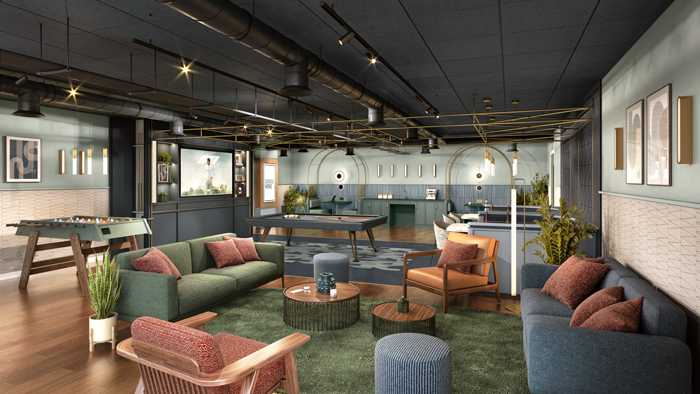
North Docklands BtR, Dublin
The design will be reminiscent of the site’s rich history but distinctly contemporary and forwardfacing. Crutched Friars is a landmark student living project in the heart of The City of London, surrounded by London’s iconic tall buildings.
The client’s brief is to create a best-in-class residential environment over six floors, culminating in a double-height amenity space with a mezzanine level and external terraces which embrace the views over London, to the Thames and beyond.
The contemporary architecture takes inspiration from neighbouring historic buildings, with their classically proportioned facades which use order, symmetry and rhythm. The base architectural system is articulated with strong horizontal banding and vertically oriented openings.
This design rationale continues internally to ensure that the architecture and interiors blend to create a powerful whole with interior spaces that are full of natural light, offer amazing views out at upper floors and create a beautiful home for young adults setting out on life’s journey.
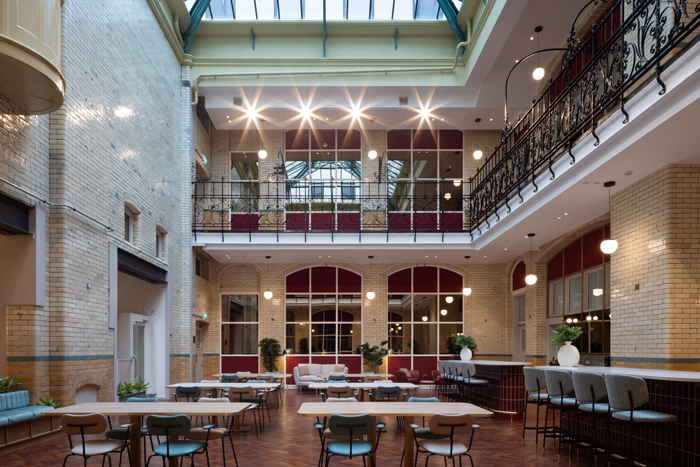
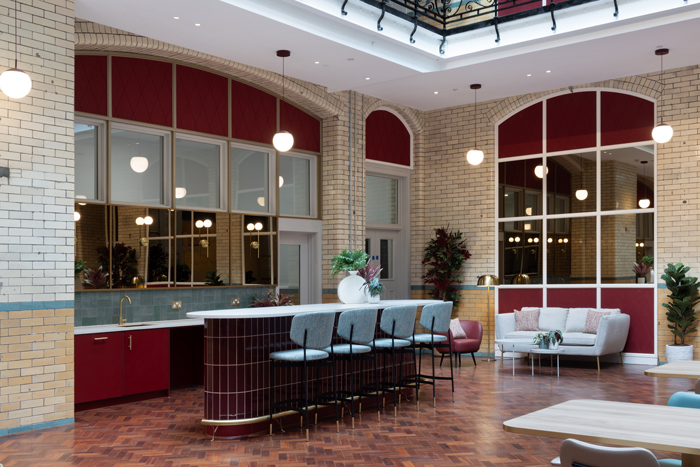
The Leonardo is a student living project located in the centre of Leeds, opposite the Cathedral and Millennium Square. This complex development comprises a Grade II Listed Victorian school house building and a new build element, linked together by an external courtyard.
We have worked with the client and existing design team to create a design language and palette that unifies the old and the new without being reverent to the existing building. We have emulated both style, material and colour palettes to give the overall development a contemporary, hospitality aesthetic.
The palette for the existing building lets the historic fabric sing, the effect is more restrained and subtle with a greater proportion of neutral colours to create a timeless interior which is respectful of the historic architecture. The palette for the new building is more contemporary with a greater proportion of deeper, bolder colours and materials. The interiors will be well crafted, layered, and have rich textural qualities with refined details throughout.
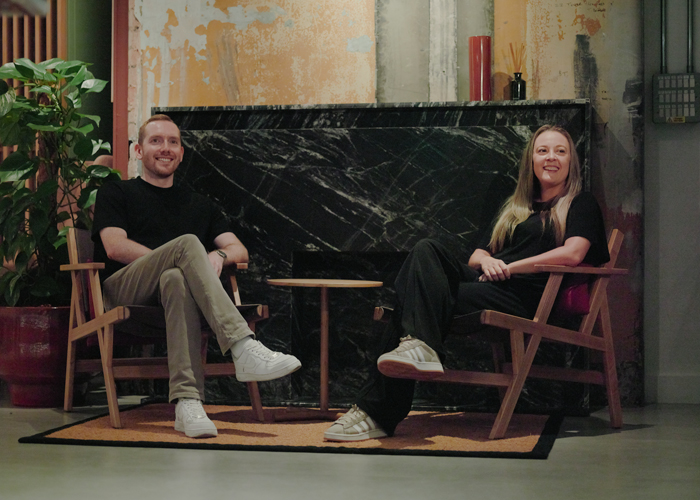
Megan Jones and Andrew Murray
Looking ahead, what are your ambitions for the future of 74? Are there particular project types, sectors, or new markets you’re keen to explore? What factors do you think will shape the future development and growth of your studio and what are you most excited to achieve as the next chapter unfolds?
We remain optimistic about the years ahead. We are continuing to work on large scale residential developments, which exploit our ability to think big and conceive design from a masterplanning scale and through to the smallest of details. We are also excited to be increasing our pipeline of workplace and hotel projects as we continue to build relationships across both sectors.
The BSA process will hopefully get smoother as the industry adapts to it. All professionals dealing with residential buildings over a certain size are wrestling with the requirements of the Building Safety Act. Nobody wants a repeat of the Grenfell Disaster and we are fully behind buildings
becoming safer. We feel fortunate to have been appointed as BR_PD (Building Regulations Principal Designer) to lead the design and application process on several high-risk buildings for residential use.
This has has given us an unrivalled insight into the BSA process and hands-on experience of delivering technical design and specification that is compliant. We are continuing to learn how to mitigate the challenges and delays that are widespread within the BSA application process by
ensuring that our design work and information are technically watertight and thoroughly coordinated with the rest of the design team.
The practice is evolving, with more defined structure and systems put into place to improve efficiency whilst keeping our free creative spirit very much alive. Our team will continue to grow organically. We are always looking for great people to join our Manchester studio.
74 is growing, getting sharper and developing experience of working across Europe, where we may open studios in key locations in the future… watch this space!