





dMFK launches ‘Downstairs at dMFK’, a Creative Hub for Suppliers and Makers
Beneath its award-winning London headquarters at 76 Charlotte Street, dMFK has transformed a lightless basement into ‘Downstairs at dMFK’ – a living sample library designed to showcase innovative products, strengthen relationships with pioneering suppliers and immerse the studio’s growing team in material exploration.
Blurring the line between office, gallery and party place, the new spaces host flexible work, intimate suppers, gatherings, collaborative workshops, design talks, exhibitions, industry roundtables and more.
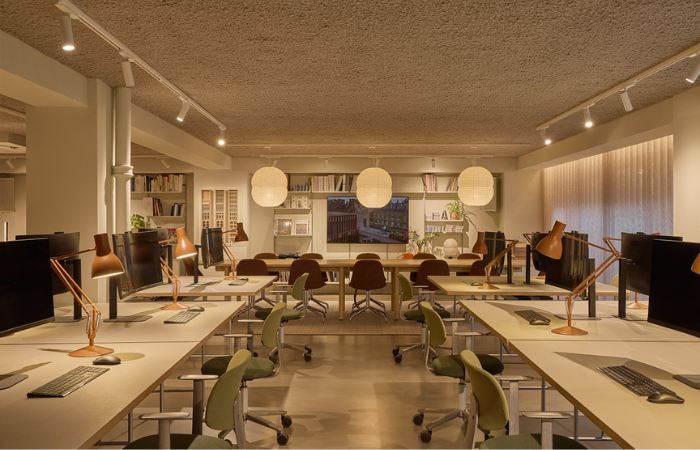
Furniture Supplied by twentytwentyone / Photography by Ed Reeve
Founded by three friends from architecture school, dMFK has grown over 25 years into a multi-award-winning practice of around 60 architects and interior designers. The AJ100 studio is known for creating beautiful buildings to live, work and gather in – characterful, timeless places that people truly cherish. Every project begins as a conversation, helping to pinpoint the architectural need and ensuring interior design and architecture work in harmony. By considering everything, from the foundations to the perfect door handle, dMFK creates joined-up, human spaces that make moving through your day feel natural, important, spectacular.
The architecture and interiors studio relocated to Fitzrovia in 2022, working with former dMFK employees Sher and White Architects, who helped them transform Channel 4’s former cinema and bar at 76 Charlotte Street into a residential-inspired creative office for 45 people. The new studio was a major boost for the practice, and soon after they secured major commissions from returning and new clients including The Grosvenor Estate, British Land, Lazari, Dorrington and the Tower 42 Estate – meaning the team had quickly outgrown the space.
Julian de Metz, Director at dMFK:
“A lightless, low ceilinged former postproduction studio, we saw an opportunity to do everything that we couldn’t do upstairs, downstairs – and show how basement spaces can be thoughtfully designed to be viable workplaces. We decided that every design decision we made down there would somehow improve on our current office – bigger desks, better acoustics, more privacy. But most importantly, we wanted to enable the practice to build relationships with our suppliers, and to explore and showcase some of the interesting and sustainable innovations coming to the market – something that we had no space to do upstairs.”
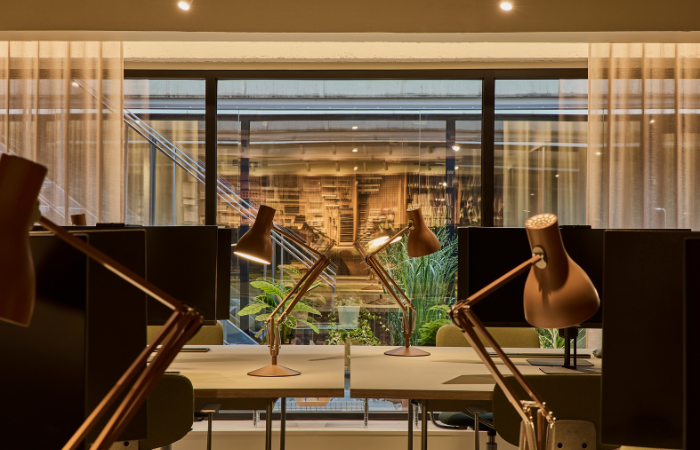
Photography by Ed Reeve
Now approaching 60 staff, dMFK’s expansion into this 2,000 sqft Derwent London–owned basement has enabled the studio to create an open, flexible environment centred on creativity, collaboration and craft.
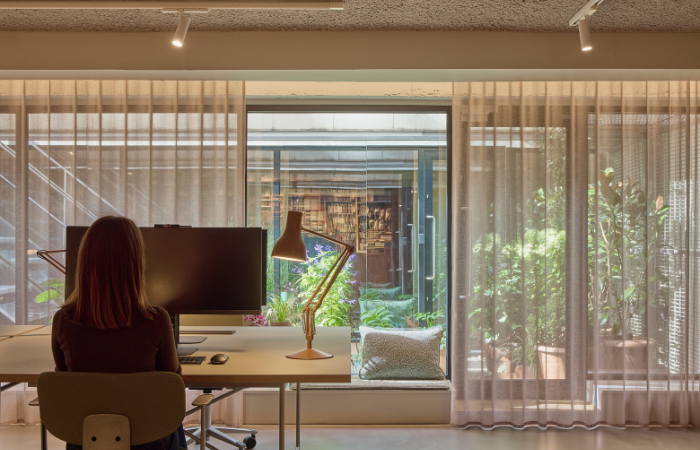
Accessed via a lushly planted narrow lightwell that has been mirrored to create the illusion that the space extends under the street, Downstairs at dMFK includes 16 workstations, a materials library, a bar, a family table to seat up to 22 and The Living Room – a rotating furniture display curated by twentytwentyone – alongside two meeting rooms, a two-person focus booth, kitchen and WCs. Every element has been designed to be flexible, and to encourage connection and experimentation, supporting the studio’s evolving ways of working.
Most importantly, dMFK invited suppliers to experiment in the space, and to try out products in development, provided that they worked with the Downstairs at dMFK aesthetic.
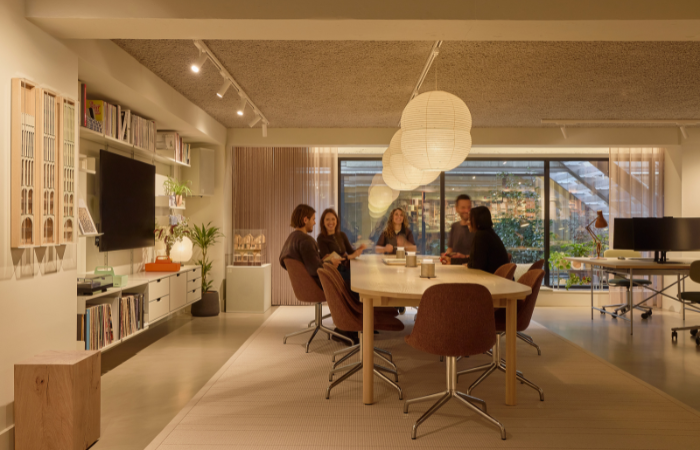
Photography by Ed Reeve
For example, the materials library features a curated selection of samples anchored by a striking 5m long terrazzo bar by Avantgarde Tiling, who were interested in trying out a new technology. Made from Thames Flint – a stone that doesn’t normally bond with cement – the bar uses a bespoke CSA (calcium sulfoaluminate) binder, which securely holds the aggregates and incorporates recycled aluminium by-products. Durable, repairable and fully recyclable, the installation was an experiment in material innovation.
The Living Room’s opening display includes William Plunkett’s Kingston lounge chair and day bed, now made under licence by twentytwentyone, upholstered in a textile derived from Annie Albers’ 1925 Wall Hanging, alongside the Selsdon coffee table. Michael Anastassiades’ One Well Known Sequence floor lamp provides a sculptural counterpoint, casting soft light across the setting. The pieces will rotate quarterly, echoing the studio’s ongoing interest in craft, materiality and form.
Flexible lighting is provided by Light Forms, who designed a bespoke curtain grazing light, and provided flush, in track LEDs to light the bar, as well as a range of LED track lights.
Demountable Egon Eiermann desks (designed in 1953) show the power of classic, enduring design, and pair with HÅG Tion task chairs designed by Anderssen & Voll, BIG-GAME, and Hunting & Narud, which were lauded the ‘most sustainable on the market’ by DAMN magazine in 2022 – made from 75% recycled materials and designed for full disassembly.
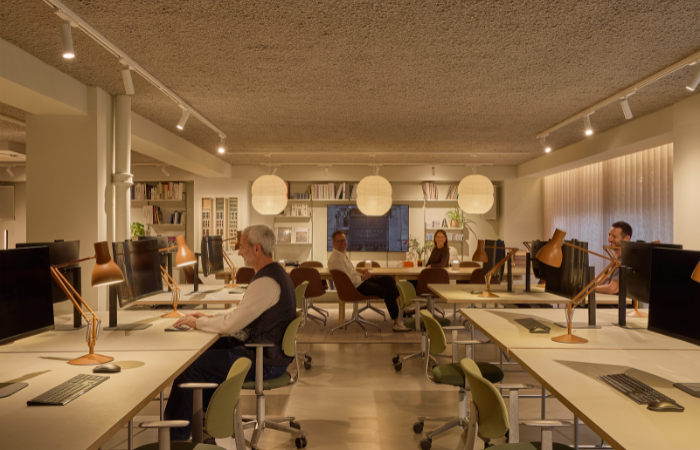
Photography by Ed Reeve
Around the central ‘family table’, Harbour swivel chairs by Norm Architects (with whom dMFK worked on the award-winning Chancery House) accompany a remarkable 5m long solid ash table by Jenni Roininen for Nikari, a set piece in longevity. Barber Osgerby’s Hotaru Double Bubble pendants showcase Japanese paper craftsmanship, whilst David Chipperfield’s dimmable table lamps and Woodnotes’ woven paper-yarn, willow dyed ‘vegan’ rug complete the layered composition of light, tone and texture.
The finishes continue dMFK’s commitment to sustainable and experimental materials, chosen to create a calm, soft environment. Sphere8 supplied seamless resin flooring made from castor beans, with recycled plastic chippings producing a terrazzo-like effect in the corridor. Overhead, an acoustically absorbent SonaSpray Eco+ ceiling by Oscar Acoustics is made from recycled newspapers – the product’s first installation in London. It softens sound and adds visual warmth. Together, these surfaces balance performance with a crafted, comfortable aesthetic.
Photography by Ed Reeve
The perimeter walls layer tactility and acoustic performance. Focus booths are lined with fluted, highly absorbent acoustic panels by The Collective, produced from 80% recycled plastic bottles, while lightweight joinery by Zen Joinery introduces precision and warmth. Kvadrat’s Daybreak curtains at the shopfront diffuse daylight into the studio, and Divina fabric frame the rear wall and focus area, completing a soft and cohesive envelope that complements the calm, residential-inspired character of the interiors.
Wanting the space to easily transform for events, dMFK reused a top-tier sound D&B audiotechnik system recovered from Spiritland’s Royal Festival Hall – a music-focused bar and restaurant formerly graced by DJs such as Laurent Garnier, Sasha, and Norman Jaye MBE. The iconic system now delivers rich, precise audio for talks, screenings, and parties. In the lightwell, a full-length mirror creates an unexpected outlook, doubling the courtyard and drawing light deep into the interior so the studio feels open and connected rather than subterranean. Combined with Studio Supernatural’s planting and sculptural lighting, the result is a warm, immersive environment that feels both social and contemplative.
Paul Forbes, Director at dMFK:
“Downstairs at dMFK brings together over two decades of experience across the commercial, residential and cultural sectors. A natural extension of the studio above, the multifunctional, tactile environment is designed to adapt, demonstrate the value of working face-to-face, and reflect our ethos – calm, characterful and confident.”