






The Wellness Trifecta: Where Science, Art and Technology Unite
The focus among hospitality leaders is moving beyond the practical form of fitness centres and spa menus and is leaning towards something more powerful: the design of a sensory experience. Increasingly, leading hospitality brands are turning to specialists who can translate neuroscience into atmosphere – blending science, art and technology to create environments that feel restorative on a physiological level.
Cue the arrival of White Mirror, a sensory innovation studio quietly reshaping the future of wellbeing with this radical and inevitable three-part formula that works in perfect harmony. The studio, co-founded by sensory designer and therapeutic music pioneer Tom Middleton and immersive technology strategist Ramy Elnagar, has been building wellness environments that go as far as to reprogram the nervous system.

White Mirror Team
Ramy Elnagar said:
“We see a major opportunity for hospitality brands to move from offering amenities to engineering environments that actively improve wellbeing. When sensory inputs are guided by science and designed with precision, they don’t just elevate the guest experience they deliver measurable physiological benefits. That’s the shift we’re enabling.”
Rooted in what it calls the 7 Pillars – Empathy, Evidence, Biophilia, Creativity, Innovation, Validation, and Impact – White Mirror believes that wellbeing is a physiological necessity. The studio’s work sits at the confluence of neuroscience and nature – art and algorithm – building environments that regulate the nervous system, inspire emotion and create meaningful moments of restoration.
This, in short, is wellness you can measure and feel. It is designing wellness experiences that are driven by empathy, grounded in science, guided by nature, shaped by art, delivered by technology, demonstrated through experience and felt by communities.
Increasingly, hospitality brands are turning to sensory design specialists to translate these principles into practice – crafting spaces that don’t just look good, but work on a biological level. With art, science, and technology in perfect harmony, the studio is reshaping what it means to truly feel well.
White Mirror’s experiences are carefully orchestrated rituals, designed at the core of a space to intervene at the physiological level – its biophilic immersion meets brainwave entrainment. The consultancy’s work is mindfulness as a somatic reality – measurable, trackable and deeply felt.
Tom Middleton asked:
“Every sense we engage with has a direct line to the brain and body, so why wouldn’t we design those inputs with precision? Whether it’s a sound frequency that tones the vagus nerve or lighting that supports melatonin production, sensory design allows us to create environments that are beautiful and biologically supportive. This is wellness you can feel on a cellular level.”
And nowhere is their sensory mastery more evident than in two recent hospitality collaborations that quietly set a new gold standard for high-performance wellness.
Act I: A revolution in sleep – Equinox Sleep Lab, New York
When Equinox Hotels set out to redefine sleep as the ultimate pillar of performance, they turned to White Mirror to help them engineer the conditions for true nocturnal transformation.
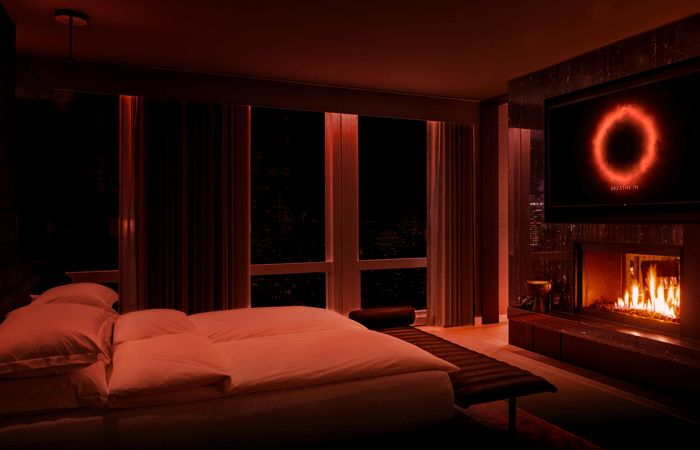
White Mirror, Equinox Breathe
What followed was a multi-sensory symphony of sleep science and design, where circadian biology has become the blueprint for experience. In collaboration with world-renowned neuroscientist Dr. Matthew Walker, White Mirror crafted in-room rituals to gently lull guests into rest – and reawaken them with care.
No jolting alarms. No blue-light disruptions. Instead, a meticulously designed suite of soundscapes, breath-led audio cues, and red-shifted lighting that eases the body into stillness and out of it again, aligned with the natural rise and fall of melatonin.
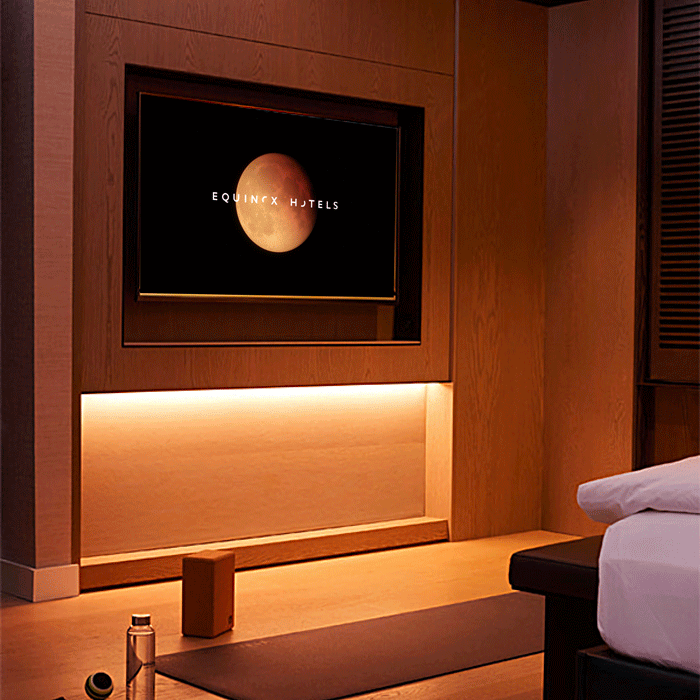
White Mirror, Equinox Breathe
The highlight, perhaps, is a custom wake-up soundscape that gradually coaxes the mind from delta-wave sleep into alertness, preserving the integrity of sleep cycles. It’s less of a morning routine, and more of a neuro-sensory ascent into consciousness.
Chris Norton, CEO of Equinox Hotels says:
“The Sleep Lab isn’t just about rest – it’s about regeneration. It’s the convergence of neuroscience and luxury – an experience that allows guests to truly recover at a cellular level.”
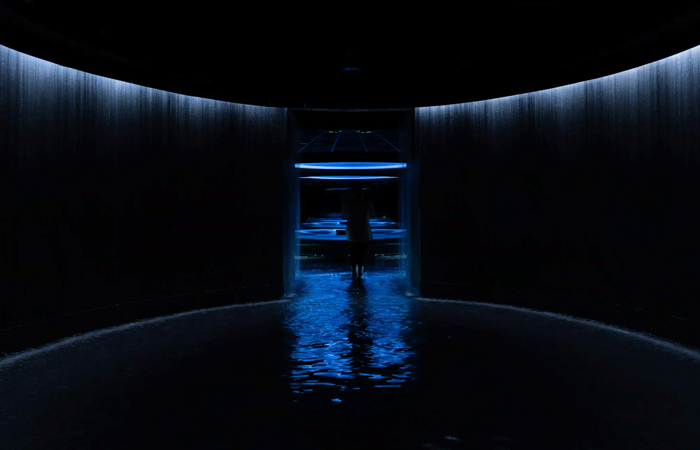
Act II: The Forest, Reimagined – Forest Bathing : Lupuna, Thermengruppe Josef Wund
If the Equinox Sleep Lab is about sensory subtraction – removing noise, stress and stimulus – then Lupuna is a study in sensory congruency.
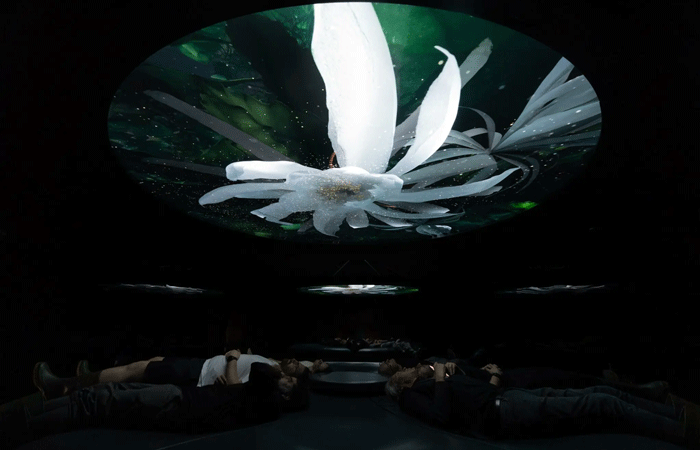
Lupuna
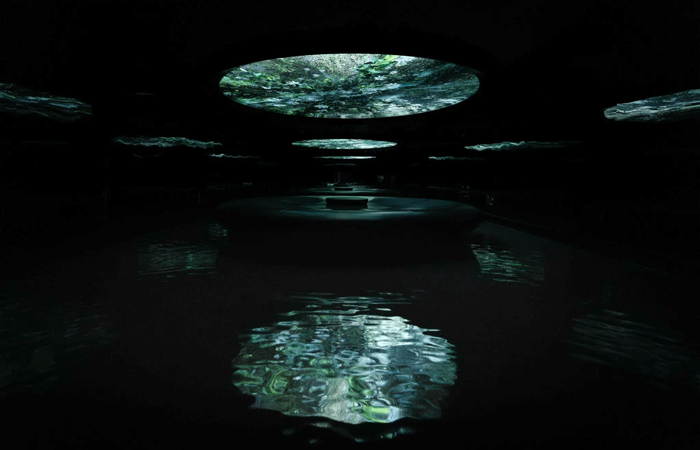
Commissioned by one of Europe’s most innovative spa groups, Thermengruppe Josef Wund, and created in partnership with visual visionaries Marshmallow Laser Feast, Lupuna compresses 24 hours in the Amazon rainforest into an immersive 24-minute forest bathing journey.
Guests step beneath a cascading waterfall into a simulated tropical downpour. Spatial rain sound envelops them. The scent of petrichor rises. Reclined on vibroacoustic lily pads, they gaze up at a projection of the towering kapok tree – the legendary Lupuna – as day cycles into night overhead.
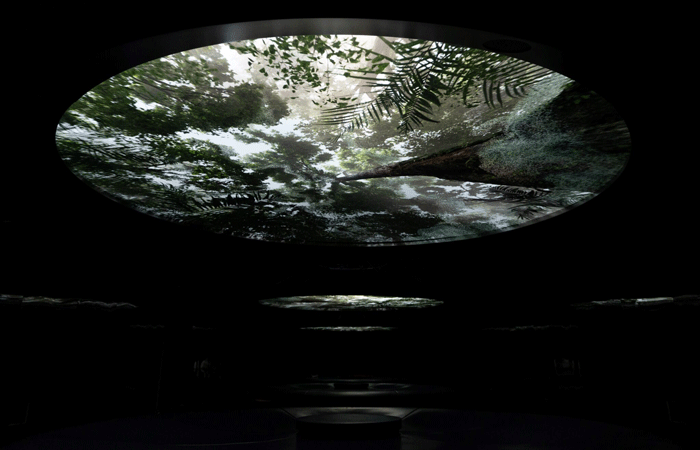
Lupuna
But this is no passive escape. Every sensory detail is choreographed to recalibrate the autonomic nervous system. And the data tells the story:
- 81% of participants reported reduced anxiety
- Heart rate variability increased
- EEGs revealed brainwave shifts toward meditative states
It’s biophilic therapy, delivered through the lens of storytelling and science.
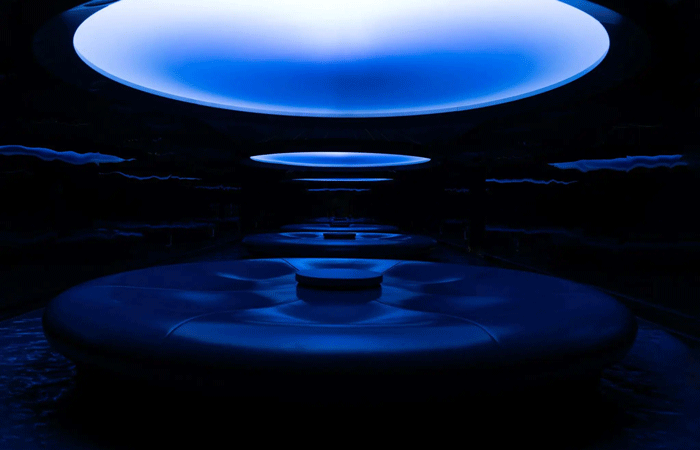
Lupuna
A new era of sensory wellness
According to the Global Wellness Institute, the global wellness market is expected to grow from $6.3 trillion in 2023 to $9.0 trillion by 2028[1]. But as the industry accelerates, it’s also becoming crowded with trend-driven concepts and surface-level aesthetics. In this rapidly evolving space, the role of science-led sensory expertise is becoming essential.
Lupuna
Collaborating with specialists who root their work in neuroscience, physiology and evidence-based research enables wellness experiences to go deeper than visual appeal. These are not just environments to admire, but systems designed to regulate, restore and rebalance – immersive experiences with measurable, biological outcomes.
Sensory wellness may not always be visible. But for the guest who sleeps deeper, wakes more gently, or experiences unexpected calm in a rainforest-inspired installation, the impact is undeniable.
Lupuna
As hospitality continues to redefine wellness for the 21st century, sensory design is no longer a luxury extra added to improve a guests’ first impression in the lobby or spa – it’s becoming the foundation for how we feel in a space, not just how we function.
[1] https://globalwellnessinstitute.org/industry-research/2024-global-wellness-economy-monitor/