




Where Everything Connects: The New Thinking Behind Cruise Interiors
At Design Insider, we amplify the expertise of designers, suppliers and operators working across the global commercial interiors sector, including the fast-evolving world of cruise. Through interviews, project features and industry conversations, we explore how design is shaping the future of spaces at sea, from guest experience and material innovation to sustainability and operational complexity.
The perspectives shared here reflect input from leading cruise brands, designers and collaborators, offering a joined-up view of how thinking across the sector is evolving.
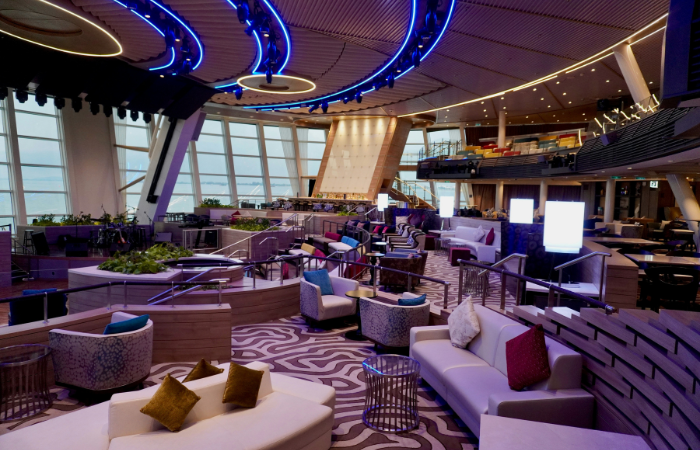
For an industry that operates on a global stage, cruise design has always been about balance. Consistency must sit alongside differentiation, and large-scale thinking must work hand in hand with detail. Increasingly, design thinking is playing a quiet but important role in shaping how these spaces come together.
This influence is not about a singular aesthetic. It is about an approach, one that blends hospitality expertise, material understanding and a strong sense of narrative.
Across contemporary cruise interiors, that approach is evident in how brands define identity. As Petu Kummala of Carnival Cruise Line explains, even when ships share the same technical platform, design becomes the key point of difference. “The hull has the same design, but the general arrangement and interior design offers guests a totally different experience.”
Working within constraint is something cruise designers and manufacturers have long excelled at. In hospitality, layered experiences are expected, and that mindset translates naturally to ships. A vessel is no longer a single environment, but a collection of distinct settings that must work together.
This growing complexity is clear on ships such as Royal Caribbean’s Star of the Seas. Designers are asked to create multiple neighbourhoods within one vessel, each with its own atmosphere and identity. The real challenge is not just designing these spaces individually, but ensuring they connect in a coherent way.
Material-led design plays a central role in this.
For Ulster Carpets, whose Axminster designs run throughout Star of the Seas, flooring is more than a surface. It helps guide movement, defines transitions and supports the character of each space. The success lies in how these schemes are coordinated, creating continuity without repetition.
This kind of orchestration reflects a wider shift across the sector. Design is no longer about isolated moments, it is about how everything works together over time.
In more refined segments, the same thinking is applied in a quieter way. On Mein Schiff Relax, designed by Joi Design in collaboration with TUI Cruises, the focus is on emotional clarity rather than spectacle. “It’s all about emotions,” explains Barbara Wiethoff. “As long as your core intention is strong enough, it will survive one or another cost efficiency change.”
Here, Northern European design principles shape the experience. Natural materials, restrained palettes and careful detailing create a sense of calm that feels deliberate rather than understated.
Within The Ritz-Carlton Yacht Collection, the approach shifts again. The ambition is not to replicate land-based hospitality, but to reinterpret it within a very different context. As Alejandra Obregón explains, the challenge is to translate expectations into a space shaped by movement, structure and constraint.
Across all of these examples, the common thread is clear. Design is treated as a system, not a series of individual decisions. Spatial flow, material consistency and narrative all contribute to how a guest experiences the ship over time.
As cruise interiors continue to evolve, this way of thinking is becoming increasingly important. In an environment where every detail matters, success depends not just on individual moments, but on how everything connects.
This article brings together insights from a series of conversations and features originally published on Design Insider.
Design Insider is an online magazine and media outlet. We amplify the expertise of global commercial interior designers and suppliers by publishing the latest products, projects, and people from across the whole commercial sector, while also instigating the sector’s most important conversations. Design Insider is published and owned by Commercial Interiors UK.
Subscribe to our newsletter to stay close to the conversations, people and projects defining commercial interiors. Subscribe here.
Cruise Ship Interiors Design Expo Americas (CSI Americas) brings together leading cruise lines, design studios, shipyards, and the global cruise interiors supply chain on 9 – 10 June 2026 at the Miami Beach Convention Center. Join the cruise interiors community for two valuable days of knowledge-sharing, product discovery, and relationship-building across the industry. Register for your free pass.
Hotel & Resort Design South (HRDS) is the world’s only event dedicated to the design of hotel, resort, and private island developments across the Southern States, Caribbean, and Latin America. Dedicated to connection and collaboration, HRDS attracts leading hotel operators, designers, procurement firms, and interior suppliers to the Miami Beach Convention Center on 9 – 10 June 2026 to drive project success and together shape the next gen of hotel and resort design. Visit the website to register for free.