


20 Questions for 20 Years: Clint Nagata on BLINK, Culture and What Comes Next
To celebrate BLINK Design Group’s 20th anniversary, we shot 20 quick-fire questions to Founder and Creative Partner Clint Nagata, giving us the chance to learn more about the man behind the studio, the company he has built and some of the smaller details you may never have had the opportunity to ask.
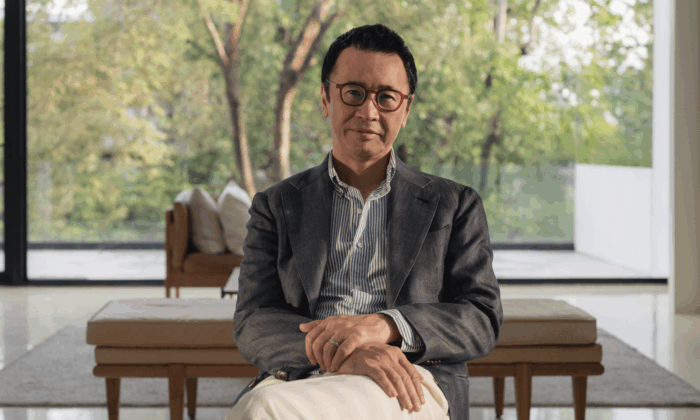
Clint Nagata, Founder and Creative Partner, BLINK Design Group
His answers took us from the story behind the BLINK name and the career risk that started it all, to bronze owls born from a design problem, salt air drying on warm teak and a long-standing appreciation for Maroon 5’s Sunday Morning. We discovered the places still on his travel wish list, heard why his favourite project will always be the next one and were reminded that, for Clint, the most valuable lessons of the past two decades come back repeatedly to culture, curiosity and the relationships built along the way.
Perhaps most striking was how often his answers returned to people: the emotional maturity encouraged by BLINK’s S.W.A.P initiative, the perspective gained through the Kayte McMillan travel scholarship and his hope that the studio’s eventual legacy will be defined as much by kindness and trust as by the spaces it creates.
Across all 20 answers, what emerges is a picture of an agile and restless studio that is still looking forward. There is a clear care for the people who make BLINK thrive, an enduring confidence in the creativity and skills of its teams, and a belief that, after 20 years of growth, new studios and increasingly ambitious projects, some of the company’s most exciting chapters are still to come.
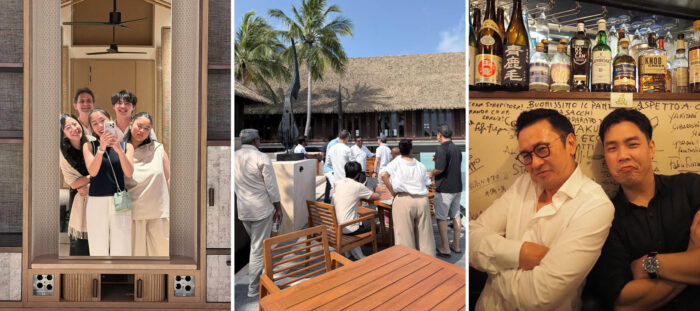
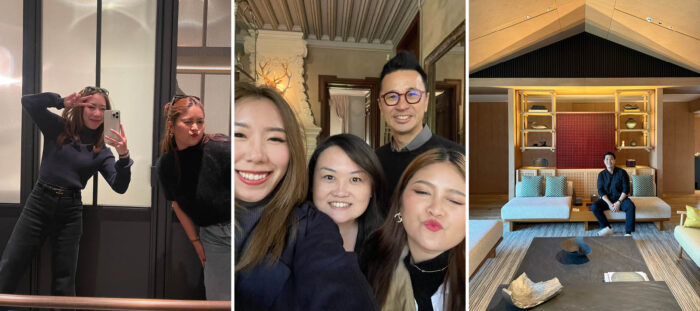
Left to right: Team site visit in the Maldives, team site visit in the Maldives, Clint and Marc in Japan for the exchange program
1. Firstly, why did you name the company ‘BLINK’ 20 years ago?
I didn’t want the studio to be about me. Instead, I decided to name it as a direct homage to Malcolm Gladwell’s book, “Blink: The Power of Thinking Without Thinking”.
2. The S.W.A.P initiative sends designers to live in each other’s cities and work in other studios. What’s the most useful thing someone brought back that had nothing to do with design?
New perspectives would be the obvious answer. However, emotional maturity is what I noticed most from this initiative.
3. Describe the studio’s culture using a smell, not a word…
Salt air drying on warm teak. That moment on a terrace just after the rain’s stopped – wet stone, frangipani and something cooking three rooms away that you can’t quite place. That’s BLINK. We’re never one fixed scent. We’re the change in the air right before you notice it.
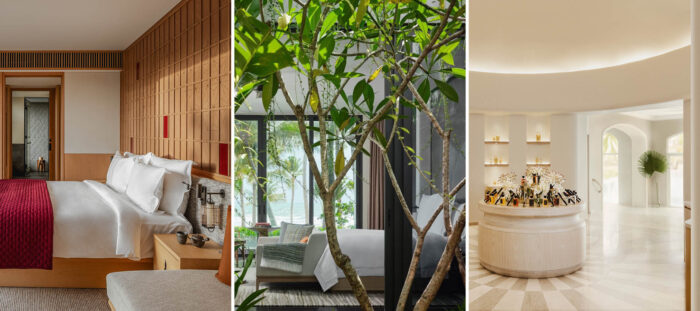
Left to right: Six Senses Kyoto room, Regent Phu Quoc villa, One & Only Le Saint Geran Guerlain spa entrance
4. Kayte McMillan was a deeply valued member of BLINK, how does Kayte’s legacy live through the studio?
In so many ways. Kayte’s spirit is kept in motion. The studio runs on the same restlessness she had: get out, see something new, let it change how you design and see the world.
The travel scholarship in her name is built into how the studio operates, sending designers off to chase the same curiosity she lived by. People come back from those trips talking less about the destination and more about what it shook loose in them – a slower pace, a sharper eye, a deeper connection to nature and a reminder of why they fell in love with this industry. That’s the real inheritance: a habit the whole studio keeps choosing to practise. Kayte’s love of travel and adventure very naturally became part of the studio’s operating instinct.
5. What is the most compelling thing that one of your team has brought back from the Kayte McMillan’s – A Wish to Remember initiative?
This is a very difficult question to answer but what I have noticed is that their perspective changes. The opportunity to travel and experience not only wonderful designs but more so to immerse yourself in another culture helps you to see things through a different lens, and that is priceless.
6. When did you feel you were taking the biggest risk in your career?
When I left WATG without a clear plan. I only knew I loved traveling and taking clients on a journey.
Left to right: Team site visit in France, team site visit in France, Marc visiting the completed Six Senses Kyoto suite
7. What has been your biggest failure to date?
Probably the doors on a spa we did in France. We’d specified these beautiful bespoke antique-looking wooden doors – the kind of thing that sounds simple until someone prices it outside Asia and you realise you’ve designed yourself into a budget disaster. We had to rethink it on-site, fast. Knowing the client had a slightly mischievous streak, we ended up forging a series of bronze owls onto simplified painted doors instead – closed, you see owl faces; open them, and the owls look like they’re taking flight.
It’s a better detail than the doors we lost. That’s usually how it goes here – the failure turned into the fix. I’ve stopped learning much from the projects that go to plan. It’s always the ones that nearly fall apart that teach you something.
8. What is BLINK’s take on AI?
AI’s useful, but it’s a tool. Where it earns its place is in the unglamorous parts of the process: reading data, understanding preferences, automating space planning and material selection. That’s work I’m happy to hand over, because it frees us up to spend more time on the things that require taste – creativity, cultural sensitivity, the stuff that can’t be optimised. What it can’t do is replace intuition or emotional connection, and that’s the part of the job that makes a space memorable.
9. You call it a ‘journey’ with every client and project – how do you cope with that journey coming to an end once a project is complete?
I don’t think I ever fully sit with the ending. The moment a project is complete, part of me is already somewhere else – the next site, the next brief, the next place I haven’t been yet. What does stay, though, is the relationship. The people you went through it with don’t end when the project does.
I’ve said before that my favourite project is always the next one, and I mean that quite literally. It might sound like I don’t let myself enjoy what we’ve built, but it’s the opposite – staying restless is what keeps the work from going stale. The fear of getting comfortable outweighs any attachment to a finished space.
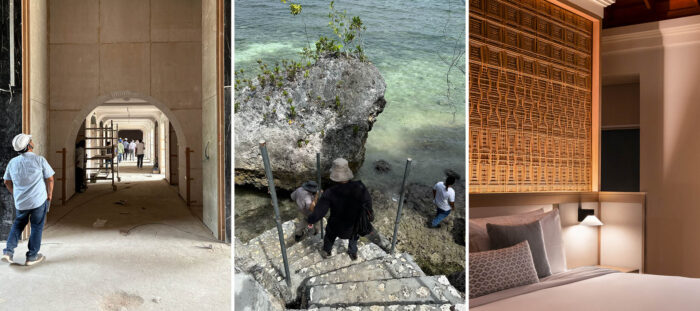
Left to right: Site visit in Lucknow India, site visit in Bohol Philippines, Huvafen Fushi
10. Name a project (in the works or completed) that makes you smile when you think about it…
Six Senses Loire Valley – I can’t wait for the world to see it.
11. If BLINK’s legacy was written today, what would you like it to be?
I’d rather it wasn’t written about the buildings at all. Anyone can point to a hotel and say it photographed well. What I’d actually want people to say is that BLINK was kind to work with – to clients, to contractors, to each other – and that we were accurate in how we executed a brief.
The studios and the leaders I respect most don’t need to be the loudest voice in the room to be the most trusted. If that’s what outlasts us, I’d take that over any award.
12. You are constantly travelling. Is there anywhere left on your travel bucket list that you would like to explore?
Greece and Morocco.
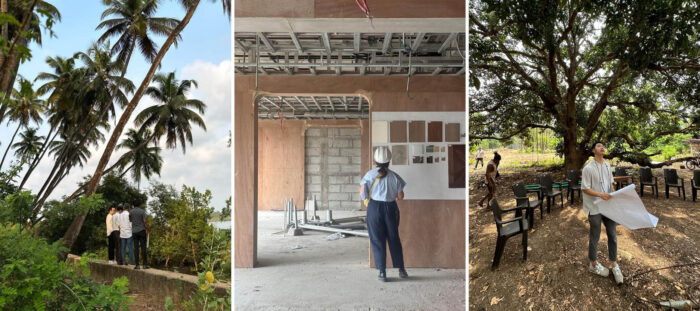
Left to right: Site visit in Goa India, site visit in Lucknow India, site visit in Goa India
13. Fashion houses keep opening hotels / branded resi now – is that flattering or infuriating?
Flattering. I love it when an outside movement comes in and rattles the cage a little. It’s a reminder to clients and operators that design is strategy. If fashion houses moving in means more emphasis on design, and more recognition for what good design requires, that’s only a good thing for everyone already doing the work properly.
14. What is the difference between a well-branded hotel to a well-designed hotel?
A well-branded hotel tells you which hotel you’re in before you’ve looked at anything. A well-designed hotel doesn’t need to. You could take every logo off the walls and you’d still know exactly where you were, because the place itself is telling the story, not the standards manual. Branding is consistency. Design is soul. One you can hand over in a 50-page bible. The other, you can’t write down at all.
15. What has been the most invaluable lesson from the last 20 years?
Culture, culture, culture. Our success is rooted in our belief in our culture. To have one voice and one mind has been priceless.
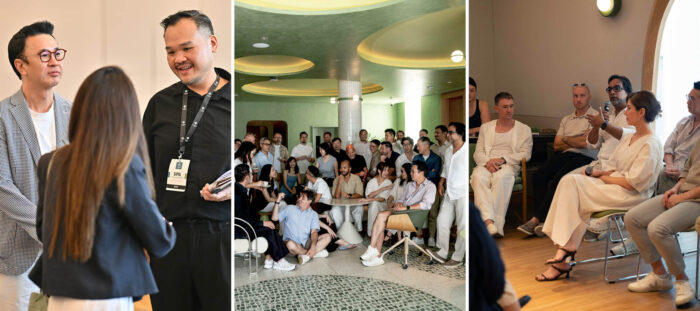
Left to right: Clint, Sapol and Ing attending HiDesign Asia, leadership team from all four studios, Rengy sharing his thoughts as BLINK leadership meeting
16. We have noticed that you are growing the team in London… what does it take to become a BLINKer?
Curiosity, an eye for detail and the ambition to be part of something outstanding! We’re a flat studio by design – ideas matter more than seniority here, so the first thing we look for is someone who’ll use that, not someone waiting to be told what to think.
The official line is that we want explorers: people who are curious about a place before they’ve even opened a brief, who’d rather ask an odd question than give a safe answer. London’s no different – it just means we’re now looking for that same restlessness in a city that already has plenty of its own. If you can sit in a design review, get challenged and come back with something better rather than something defensive, you’re already halfway to being a BLINKer.
17. You mentioned, in your ‘Cultural Dinner Party’ article with us, that you had a man crush on Adam Levine. What’s your favourite Maroon 5 track?
Sunday Morning.
18. What has been the biggest change to BLINK Design Group in the last 5 years?
We’ve grown up with studios now in Dubai and London and along with that we’ve added some wonderful people.
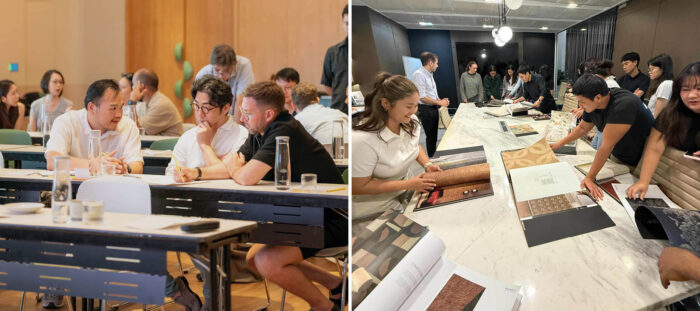
Left to right: Team discussion at BLINK leadership meeting, Supplier materials review
19. We loved seeing BLINK recently collaborate with Conran & Partners to design your own panel discussion on the topic of legacy. What did that process teach you – and what lesson did you hope the industry took from that?
As industry we should be more collaborative and supportive of our peers. If we are able to help each other the better off our industry’s future will be. Making the competition better only forces you to be better yourself.
20. What do we have to look forward to in 2027 from BLINK?
This coming year (or even towards the end of this year) we are looking to open Mandarin Oriental Makati, Taj Lucknow, Alila Landsdowne, One & Only Reethi Rah, and Oberoi Diriyah.
Twenty years on, BLINK’s greatest strength may be that it has never stopped looking towards what comes next, and we’re looking forward to making that journey with them!