

Beyond the Workplace Checklist, An Interview with Dominic Dugan, Creative Director at Oktra
The workplace sector continues to evolve in response to hybrid working, changing employee expectations and increasing pressure to deliver more value from existing space. At the same time, designers are being challenged to create environments that are adaptable, distinctive and sustainable, while avoiding the pitfalls of trend-led design.
In this interview, Dominic Dugan, Creative Director at Oktra, discusses the growing importance of flexible workplaces, the need to design around genuine employee behaviours rather than aesthetics, and how material reuse and circular thinking are influencing workplace specification and fit-out projects.
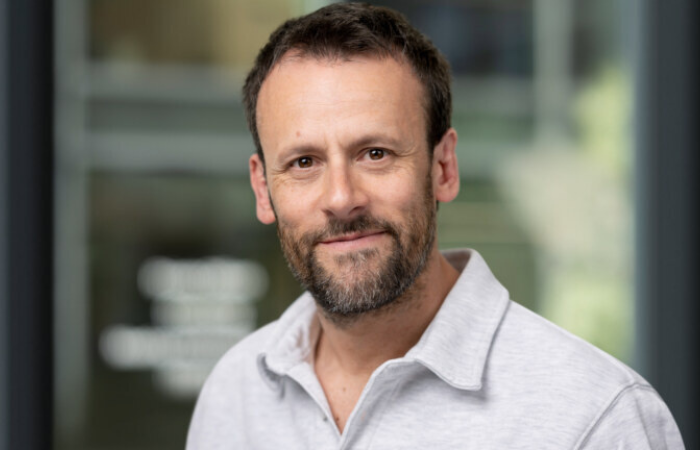
Dominic Dugan
JB: Are modular, multi-use spaces that can respond to change increasingly necessary as a result of the pandemic and a volatile, unpredictable business market?
DD: The pandemic shifted our relationship with office culture, introducing remote and hybrid working as the new norm for many. In the wider context, the office market has also been under increasing pressure, with demand for quality office spaces continuing to outstrip supply. Every square metre has to work harder, and multi-use spaces can maximise the value of the office. We’re starting to see businesses include features like demountable partitions, modular layouts, and integrated cafe-style areas for eating, hosting and collaborative work. These features allow businesses to be more creative, supporting fluctuating teams and reconfiguring workspaces without costly strip-outs or moving premises. As the market evolves, the office needs to be flexible and future-proof, anticipating change as well as adapting to it.
JB: How have recent macro trends for biophilic design, tech-driven features and multi-purpose environments influenced office design, and have they inadvertently created generic spaces that aren’t inspiring to work in?
DD: Modern offices have evolved beyond just functionality and are now visually impressive environments. However, the widespread adoption of features like biophilic walls, social spaces and integrated tech means offices risk becoming a checklist of the latest macrotrends.
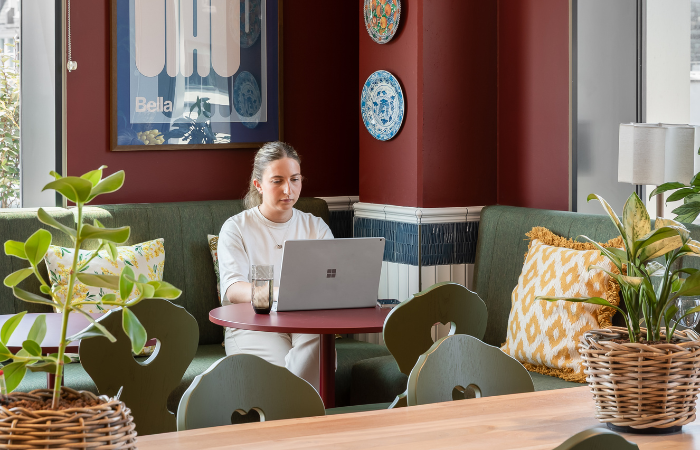
Global Software Company
Part of the problem lies in where our inspiration comes from. We live in an age of endless reference points, and designers are drawing from the same sources, from algorithmic platforms like Pinterest and Instagram, to model libraries and databases. They regurgitate ideas that are already popular, creating a cycle of replication, instead of authentic design tailored to employee needs.
Another issue is that businesses can be caught up in designing for perception over reality. They reference trendy designs seen in other successful spaces, without interrogating whether any of it reflects how their own organisation actually operates. It’s an aesthetic trap, where the design is convincing because it looks good, but it hasn’t been tested. The consequence is that employees are left with spaces that look great but don’t really speak to them or support their working styles – leaving them feeling like a cog in a beautifully designed machine.
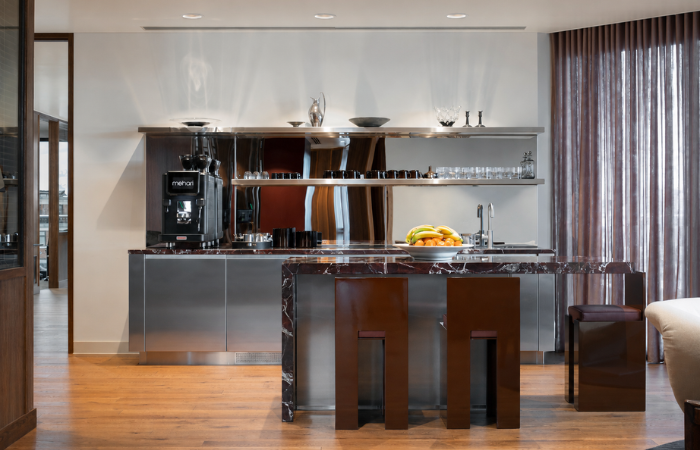
Modern kitchen with marble island
JB: How do you counter this – by turning away from trends altogether? Or do designers need to find a better balance while being selective with them?
DD: Inspiration is always valuable, and avoiding trends isn’t always realistic – good designs are usually derived from other sources. It’s useful to keep an eye on industry best practice and analyse what works and what doesn’t, but ultimately we shouldn’t lean too heavily on what’s already been done.
The answer is to always design with intent. Selecting a feature because it’s popular is short-sighted, and every design decision should be scrutinised to see if it aligns with real employee behaviours and specific business needs. Trends shouldn’t be used as a blueprint, but as a thoughtful reference point to guide the creative process.
The goal is a workplace that feels tailored, with trends helping to form the thinking, but the final result is an original space.
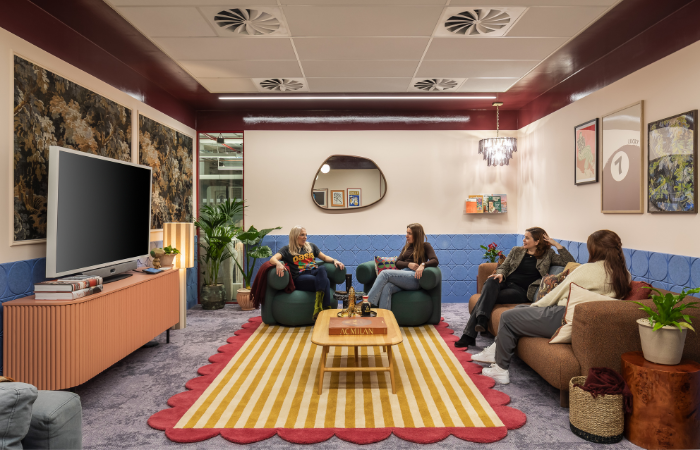
Monday 53
JB: So, as a company, how do you avoid standardisation in the workplace? What is your process to ensure that workspaces have a distinct visual identity rooted in brand, values, and culture? Is there a blueprint or set of standards you follow, or does every project require a unique approach?
DD: Before thinking about aesthetics, each project should start with analysing how people are really working day-to-day, and identifying real patterns that design can respond to. Whether that’s a meeting room that’s always at capacity, a favourite sofa for informal chats, or how regularly desks are being used – this kind of insight will shape a more distinct, tailored workplace.
Consultation and research are essential to each project. Early engagement with people using the space through surveys, utilisation data and honest conversations helps to ground designs in reality. Before mood boards or furniture selections, the design brief needs to be informed by the people, working from the inside out.
While branding is important in expressing a distinct identity, visual language can also be built through design motifs, statement furniture, choices in layout or lighting, a consistent colour scheme or interesting artwork. There are opportunities to inject standout elements that celebrate the business’s history, achievements, values and culture. Having a defined visual language that ties this all together creates an office with real personality that can’t be replicated.
JB: How do you bring the employees and their varied, individual needs into the equation?
DD: People should feel a sense of belonging and ownership over how and where they work. Flexible and intelligent planning ensures the space adapts to a range of working styles – so the office feels less like a fixed environment and more like one that moves with them. Having multiple spaces for social interactions, quiet zones for focused work, and areas to mentally reset gives people choice and control, and makes the office feel more personalised.
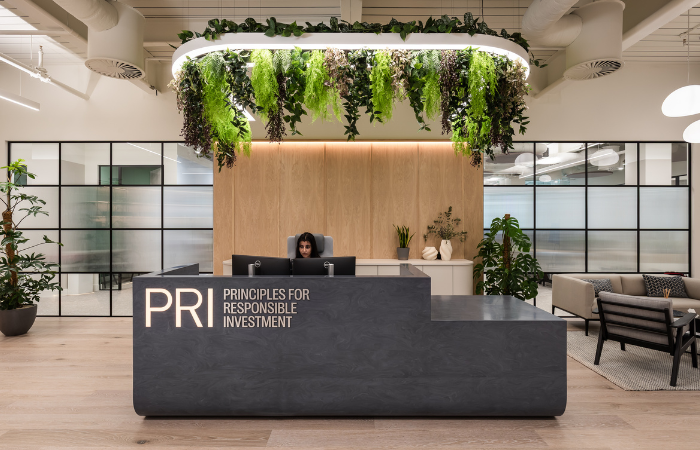
PRI London
But getting the basics right is equally as important as shaping the office for individual needs. Most people agree that harsh lighting, awkward layouts with obstacles, inconsistent heating, and poor acoustics undermine their working environment. Enlisting the right specialists and technicians to get these fundamentals right shapes a space where everyone can do their best work.
JB: We can’t talk about contemporary office design without bringing sustainability into the equation. How does longevity and materiality influence your specification process? Can you give some insight into the sustainability timeline?
DD: Existing furniture and built environment elements that are still fit for purpose should be kept where possible – the most sustainable option is always what’s already there. Refurbishments and retrofits are a good example of this in practice, reducing waste, carbon impact and cost simultaneously. With historic buildings, there’s the added benefit of retaining character that new builds simply can’t recreate.
Circularity should also shape every material decision from the outset rather than being considered as an afterthought. Oktra’s project with PRI demonstrates this – from flooring made from ocean plastic and cocoa husks to boardroom chairs crafted from marine debris, sustainability informed every specification choice. Sustainability is a long-term commitment that requires ongoing attention beyond individual projects – spanning everything from furniture reuse to low-energy heating and lighting, and certifications like BREEAM and SKA Rating.