


CCD’s London studio launches as Halkyn: Interview with Jonathan Aeberhard & The Halkyn Team
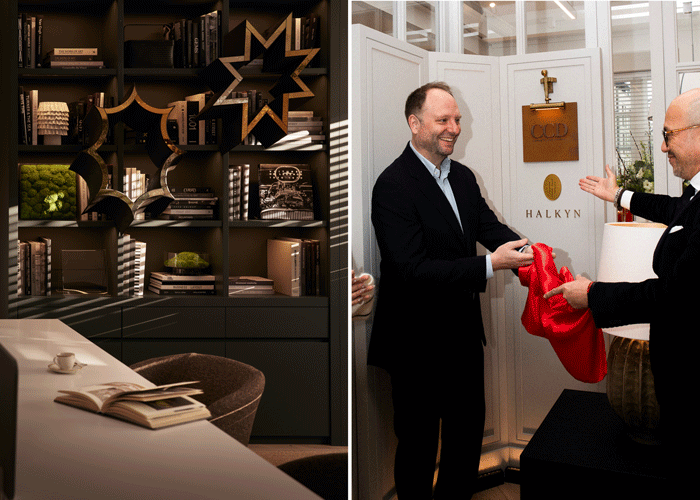
The morning after Halkyn’s launch celebrations, Design Insider returned to the studio with the energy of the night before still very much in the air. We had already experienced the new London space, heard the speeches, and raised a glass to the arrival of the brand. Back in the Headfort Place studio, with the energy of the evening celebrations still present, there was time to sit down with Jonathan Aeberhard and the wider team to talk about what Halkyn is, where it has come from, and what this new chapter could mean for hospitality design in London, across Europe, and globally.
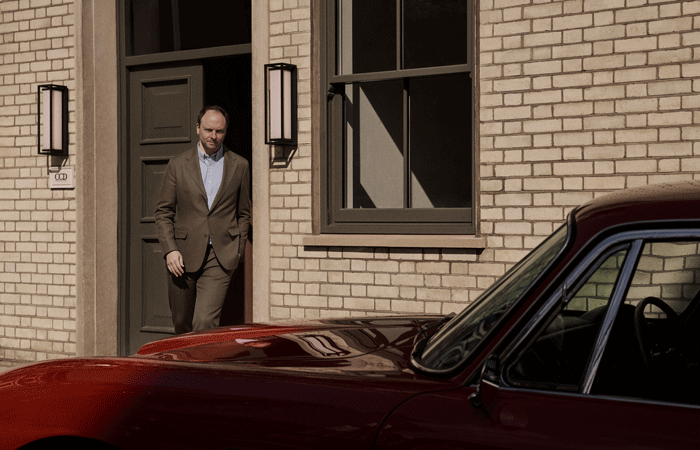
Before we could speak about Halkyn itself, I was keen to understand the heritage behind it. Halkyn may be newly launched in name, but it comes from Cheng Chung Design (CCD), one of Asia’s most established hospitality design groups, founded in Hong Kong in 1994 by Joe Cheng and now operating at significant scale, with Shenzhen as a major base and a portfolio that spans hospitality, luxury residential, clubhouses and wider lifestyle-led interiors.
It was a privilege to have Kinny Chan walk me through that story, because the scale and ambition of CCD gives context to what Halkyn has the opportunity to become. “A few years ago, we thought we could go out to the world. We established our Singapore office, last June we opened our Tokyo office, and we also have Melbourne, Dubai and of course London. The whole company is delivering the world’s most luxurious hotels and luxury residential projects.”
As Kinney talked through CCD’s growth, the conversation also touched on the thinking that first shaped the business. He spoke about Joe Cheng’s ambition to bring an Eastern sense of beauty to a wider international stage, and to build a design language informed by Chinese culture and philosophy while engaging confidently with the wider world.
“We have our sense of beauty,” Kinney said. “We have our own eyes to look at how to make the East meet West. China has a very long history of philosophy, how we treat things, how we see things. So if we can combine this philosophy with the modern world, that would be great.”
Halkyn has grown out of a business with depth, heritage and a powerful design infrastructure behind it.
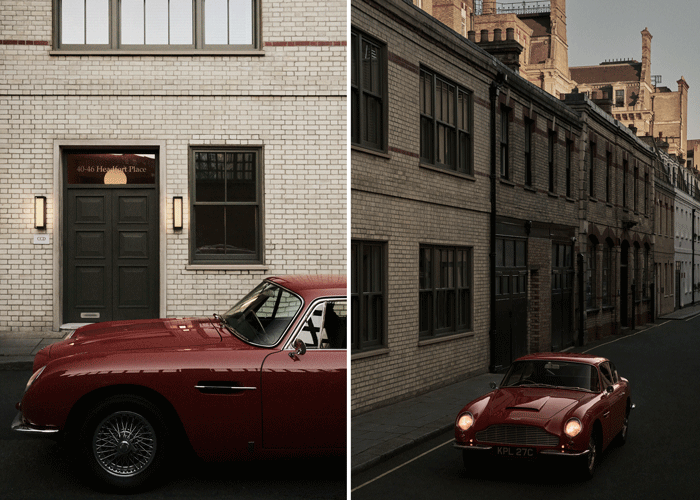
Part of the family, with its own character
One of the things that had stayed with me from the launch event the night before, over cocktails and canapés, was the Halkyn name itself. It is a confident move, and I was keen to begin there with Jonathan. Why launch under a new name at all? Why not simply remain CCD London?
Jonathan’s answer was and incredibly revealing. “CCD London is not CCD London,” he said. “It’s Halkyn, because we’re cousins. We’re part of the family, we share the DNA and the characteristics, but a cousin can be quite different to a direct daughter or son.”
It was such a strong way of explaining the relationship, and Jonathan returned to that family idea several times as we spoke. Halkyn clearly sits within the CCD world. It shares the heritage, the backing, infrastructure, the capability and the values. At the same time, it has been given room to develop its own identity and its own relationships in this market.
I was keen to hear how that translates in practical terms for clients, and Jonathan explained it beautifully. “We wanted to be a personal access point to the European market and London market,” he said. “We didn’t want people to be confused and think, I’m going to have to be dealing with Shenzhen to do all my work. We wanted them to know that they can come to us here and we can work in a local fashion.”
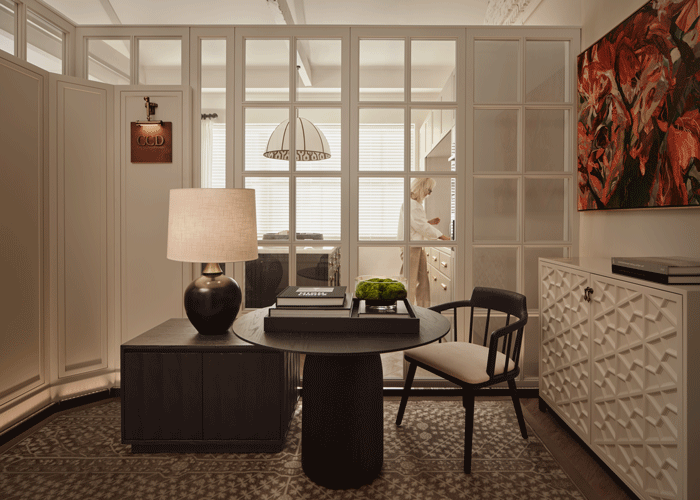
Jonathan and the team were speaking about a studio that can build trust face to face, work locally and move with agility, while still drawing on the reach and structure of a much wider international business. It is a compelling balance.
Jonathan also spoke about the importance of creating a name that could stand comfortably in London while remaining connected to the CCD family. Halkyn, “Hal” meaning healthy and “Kin” meaning family in Old English, has arrived with its own voice, but there is no distancing from the heritage behind it. Instead, there is a sense of shared DNA and local expression working together.
Understanding the scale behind the studio
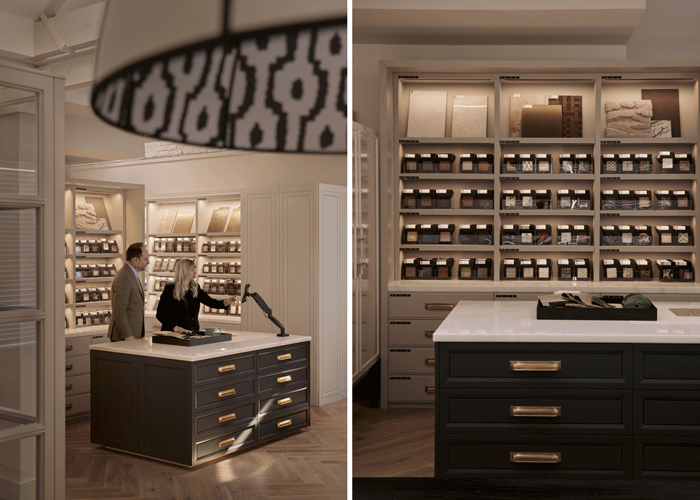
As the discussion opened out, Kinney and the team brought the wider CCD platform to life in more detail. This was one of the moments where the breadth of the business really became clear. Alongside interiors, they talked about lighting, MEP, signage, artwork consultancy, procurement and a major materials platform that supports both design development and delivery. Kinney described the materials library as one of the biggest in Asia, and the wider ecosystem felt impressively joined-up.
I was particularly interested in how Jonathan sees that support working through the London studio, especially on live projects of different scales. His answer gave a very grounded sense of what Halkyn can offer. “You have the business of design and then you have the design,” he said. “In London, I think sometimes in the past we’ve been guilty of thinking a lot about the creativity, which is the most important thing, but you also have to move forward and adopt the latest technologies and platforms to help you move quicker. Halkyn is brilliant for us because we’ve now got a platform to help us do our work faster and better.”
Great ideas matter enormously, but clients also need confidence in delivery, coordination and technical depth. Jonathan talked about the fact that smaller and mid-scale projects can be handled very directly through Halkyn, while much larger and more technically complex work can draw more deeply on the wider CCD network. He also referred to the BIM capability available through Shenzhen, which gives the London team access to a much broader technical infrastructure when required.

Why London matters
With that context in place, I wanted to ask Jonathan why London, rather than other UK or European cities, was the right base for this next chapter. For him, London still matters enormously as a design city. It is where talent, suppliers, exhibitions, conferences and international conversations continue to converge, and it provides a powerful point of access into Europe and beyond.
Jonathan talked about London as the natural base for a studio that wants to work across the UK, Europe, North Africa, Eastern Europe and the Middle East. The address may be London, but the ambition is broader in reach.
Jonathan was generous in recognising the quality of work coming out of cities such as Paris, Milan and Madrid, but he was also very clear about where Halkyn sees its opportunity. The studio wants the agility to take on boutique projects while also being able to deliver much larger hospitality schemes, and London offers the right kind of international platform for that range.
The team seemed genuinely energised by the variety of the pipeline and by the fact that the studio can sit at the meeting point between markets, rather than being confined to one geography or one project type. Jonathan was open about his appetite for growth, and his phrasing captured the mood well. “I like to grow rapidly,” he said, before adding, “We’re talking about growing quality as well.”
The team referred to more hires coming into London, support from the Middle East team, and even the physical studio itself having room to expand further. When Jonathan spoke about growth, he also returned to the importance of finding the right collaborators. He talked about building relationships with clients who are curious, ambitious and willing to create something distinctive.
Starting from scratch, every time
As much as I enjoyed hearing about the structure and scale of the business, I was especially keen to hear the Halkyn team talk about design itself. What kind of studio do they want Halkyn to be creatively? How does that way of working reveal itself at the beginning of a project?
The answer was one of the most exciting parts of the conversation because it moved quickly into process, instinct and the pleasure of discovering something new in each brief. Su Doggett, Design Director at Halkyn, explained that their approach was “the harder way to do it because we’re starting from scratch every project. You have to empty your mind of everything else that you’ve done and come in and ask loads of questions.”
I loved that phrasing because it captures both the discipline and the openness involved in this kind of work. Su, and Head of FF&E London, Lara Tyler, talked about listening carefully, understanding the owner and operator, visiting the place itself, travelling in the surrounding area and allowing the concept to emerge from what is there. He described a process that is immersive, collaborative and shaped by curiosity.
I was keen to hear more when Su said, “It almost feels like the property has this story waiting to be told.” She continued: “It’s about finding the heart and drawing it out.”
The conversation kept returning to the importance of developing a story that can guide spatial planning, materials, branding, sequencing and mood, without ever becoming forced. The guest should feel the story rather than have it over-explained. The conceptual narrative should sit within the experience and reveal itself through atmosphere, details and rhythm. That kind of restraint is often where the magic happens in hospitality design, and it was refreshing to hear it spoken about so directly.
Another point that I was pleased to hear Jonathan make was how valuable this process can be for owners and operators too. “They feel very much part of the project,” he said. “It makes the concept much quicker and much easier to get signed off because everyone’s been part of the process to get to the end of concept.”
Bringing the conversation to life through a current project
One of the most exciting moments of the meeting came when Su and Lara brought the studio’s thinking to life through a presentation of one of their current projects. Certain details remain confidential, but the scheme, a riverboat on the Nile, offered a vivid example of how Halkyn approaches narrative, atmosphere, and the practical realities of hospitality design in equal measure.
As the team talked me through it, what stood out immediately was the way the design responds to the boat’s architectural constraints while still finding opportunities for drama, flow and delight. Su explained that one of the key moves had been to strengthen the connection between levels and draw more light into the interior. “We’re trying to link the areas,” she said. “We’ve introduced a spiral staircase that goes all the way through the key areas and it has a lightwell at the top that goes all the way to the deck. The light filters through.” A second lightwell brings daylight down into the main lobby, helping to open up what could otherwise have been a more enclosed experience.
The conversation also revealed just how carefully the team had worked with the realities of the boat itself. Existing structural columns had to be absorbed into the layouts, ceiling heights were lower than in a conventional hospitality setting, and every decision carried technical implications, from flexibility of use to the weight of materials and the clearance needed beneath bridges. Yet rather than feeling restricted, the scheme seemed to gain character from those challenges.
What Su and Lara presented felt bold and confident in a way that was particularly exciting. There was a real richness in the use of pattern, texture and form, with a palette that draws subtly on Egyptian references without tipping into pastiche. The furniture choices in particular felt adventurous, embracing curving silhouettes, playful shapes and a more expressive sense of luxury. In the guest rooms and public spaces alike, the team had clearly pushed for something layered and transportive, while still keeping the overall experience elegant and resolved.
Jonathan described the wider narrative as being centred on crossing, moving from land to water and into what he called “river time”, but what made the presentation so compelling was seeing how that concept was carried not just through story, but through light, layout, materiality and mood. It was a strong example of current work, and of a team clearly enjoying the challenge of shaping hospitality experiences that are both imaginative and deeply considered.
Looking ahead
By the end of our discussion, what stayed with me most was the clarity around the kind of work Jonathan and the team want to do. The conversation kept coming back to the value of fit: the right clients, the right stories, the right ambition, and the right appetite for creating something distinctive.
Jonathan expressed that very simply. “We want to bring on more great clients to work with and to deliver more great designs. We want to work with people that share that mindset, that are curious and want to create unique stories with their projects.”
It is an optimistic note to end on, and one that feels very true to the atmosphere in the room. Halkyn has launched with warmth, confidence and serious design backing. It has the heritage and capability of CCD behind it, and it has its own identity taking shape here in London. Most exciting of all, it has a team that speaks about hospitality design with real enthusiasm for what can be achieved when story, place and experience come together.
And, in the end, Jonathan’s family analogy still says it best. Halkyn shares the DNA, the capability and the heritage of CCD, while developing its own character and its own place at the table.