




Skopos: Where Bespoke Begins with Design
Skopos has more than 50 years of experience supplying flame-retardant contract fabrics and made-to-measure, flame-retardant soft furnishings for commercial interior projects across the globe. The Skopos brand stands for design, expertise and service, supported by a bespoke design offer and on-site manufacturing.
To understand how that bespoke service works in practice, Design Insider spoke with three members of the Skopos team: Deborah Franklin, Design Manager, Karen Mowat, Senior Designer, and Lynn Wade, Marketing Manager.

Deborah leads the company’s design department. She explained that much of the bespoke work comes through her, from early customer conversations to developed artwork. Karen’s role focuses on collection development, including concepts, colour mood boards, technical details, supplier liaison and photoshoots, while also supporting bespoke projects. Lynn works with the design team on new product development, the launch calendar and how Skopos presents itself across its various markets.
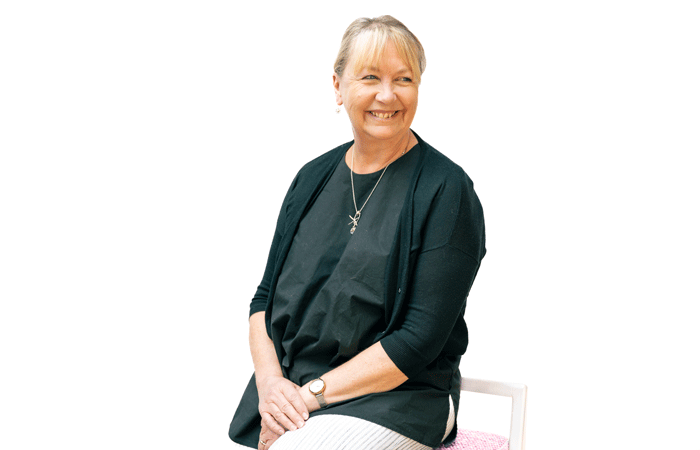
Deborah Franklin, Design Manager, Skopos
Across the conversation, the colleagues returned to the same point; when customers work with Skopos on a bespoke product, they are gaining the creativity, imagination, technique and skill of an experienced design team. The service is shaped by people who understand pattern, colour, base cloths, woven construction, print processes, commercial performance and contract soft furnishings.
As Deborah explained, this design expertise has shaped Skopos from the beginning.
“Skopos has always, from its birth in the early 70s, had design at the core of the business. Design is key to a project’s success. Whether it’s a design from a standard collection, or something developed to be completely unique to that project or customer, design underpins everything.”
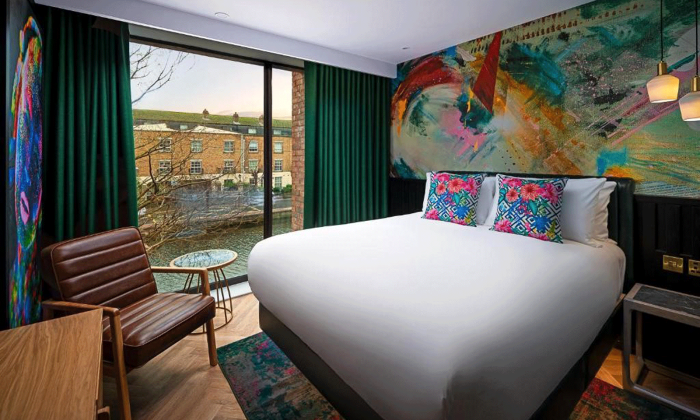
NYX Dublin, Portobello Cushions
What the bespoke service covers
Deborah explained that Skopos has offered a bespoke service since its early years. Production methods have changed, but bespoke remains part of its design-led service.
The scope ranges from small adjustments to fully bespoke design. A customer might need a print background changed to match a wall finish, carpet or upholstery, or a single motif recoloured to connect with another tone in the room. A more complex brief might involve recolouring a woven product, adapting an archive pattern or creating a design from scratch.
“No matter how much product you bring out in a collection, there’s always the need for something different. That’s where the versatility of Skopos and the Bespoke service comes in. We are able to offer a unique solution, to meet the needs of our customers.”
For print, Skopos can adapt colour, scale, layout and artwork. Deborah explained that print is part of the company’s history, from hand printing on a large table to today’s digital processes. Digital print allows the team to create digital drawings, produce samples and respond quickly to project deadlines. It also gives the designers freedom to test ideas with imagination and technical control. The base cloth can shape the end-result. Skopos can print onto flame retardant velvets, waterproof upholstery for care environments, linen-look fabrics, blackout qualities and textured cloths. Because these cloths are already tested to comply with contract standards, the team can achieve the right look to fit an end-use more quickly.
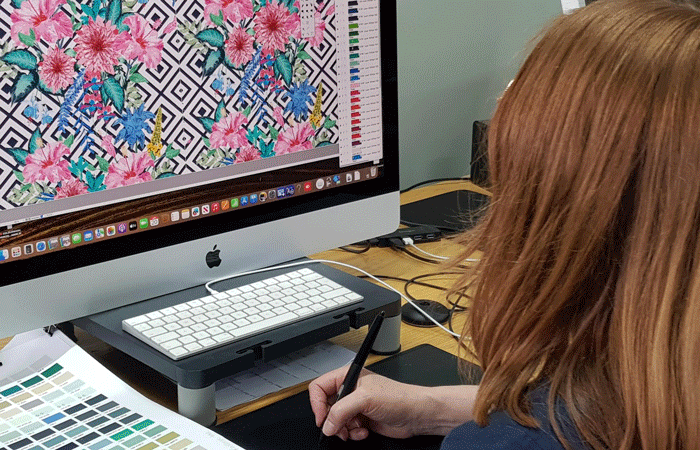
NYX Dublin, Portobello Cushions, design development
Woven projects follow a different process. Recolouring an existing weave can be more straightforward because the quality, construction and testing are already established. A new weave requires development from the start, determining construction, performance, severe contract suitability, Martindale counts and adherence to relevant regulations.
How customers benefit from the design team
Skopos’ see the Bespoke offer as a way for customers to achieve an original textile that fits the project more closely. The brief may come from a hotel owner, interior designer, contractor or project partner. It might start with a detailed specification, or with a theme, colour palette, sample or local reference. In each case, the customer benefits from Skopos’ design expertise. The team interprets the brief, suggests creative options and uses technical knowledge to make the textile producible.
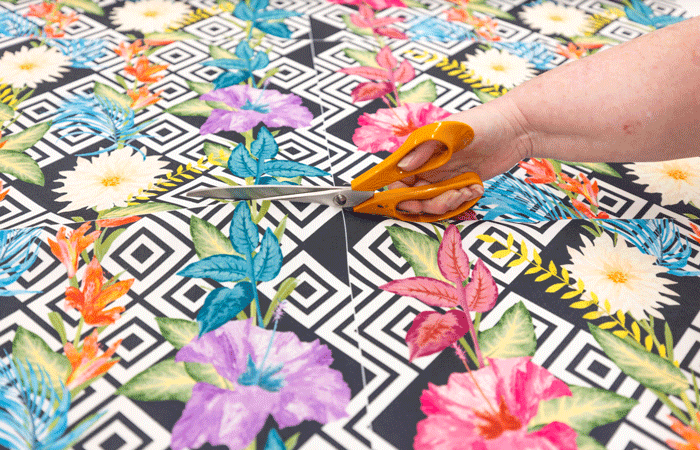
NYX Dublin, Portobello Cushions, production
Many requests begin with the account manager, but the design studio becomes directly involved when a brief needs interpretation. Deborah explained that some customers now come to her directly because an established design relationship saves time.
“When you build that relationship with the customer, you’re able to truly understand their project aims. When another project comes in, you’ve got a head start. A designer- to-designer relationship often helps the process and can speed things up.”
Skopos’ skill is in knowing when to balance a colour, soften a line, adjust a motif or rethink part of the pattern so the finished textile works in the wider scheme and really works well on the intended fabric.
The starting point for print is CAD artwork or paper prints. Digital images help early discussion, but physical prints are needed to review colour accurately. Once a direction is approved, the team moves to fabric. Artwork can be turned around very quickly and Skopos endeavour to help their customers to meet demanding timelines.
“Designers are always juggling lots of projects. They’re busy and they need things quickly. Now we can offer CADs, and then fabric, very quickly so they have something for their scheme board or to present to their client,” Lynn explained.
Once a bespoke print has gone into production, repeat orders are simple. After the initial minimums are met and production costs are covered, there is no minimum for repeat print orders, which helps hotels, care settings and commercial interiors replace items over time.
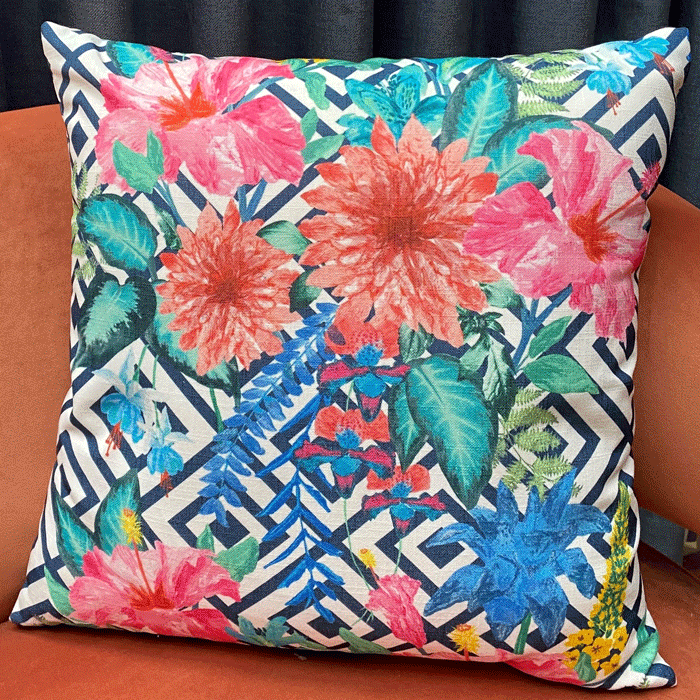
NYX Dublin, Portobello Cushions
Bespoke project examples
The team shared just a few examples that show how design expertise becomes practical, creative and project-specific.
NYX Hotels: floral, geometric and precise placement
Karen discussed a project for NYX Hotels in Ireland, where Skopos created a bespoke cushion fabric by combining an existing collection design with a new geometric pattern.
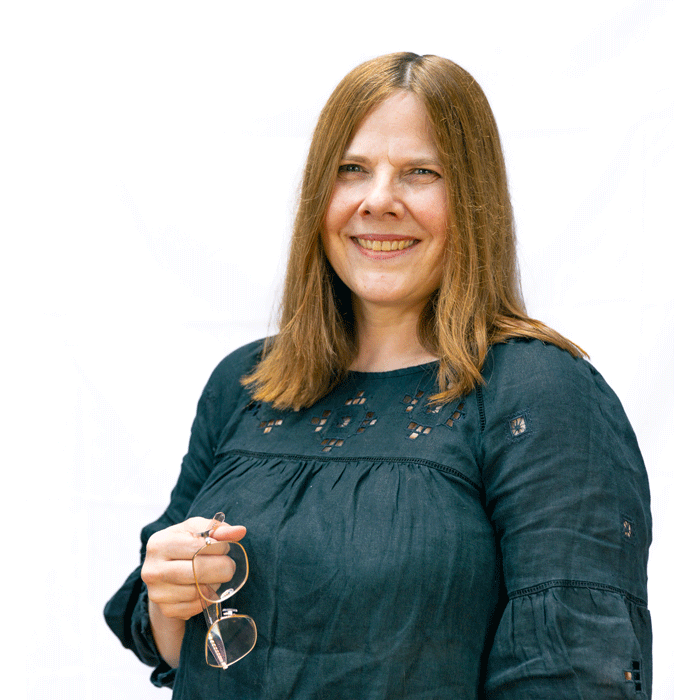
Karen Mowat, Senior Designer, Skopos
The starting point was Aloha, a large-scale floral print from the Skopos Mau Loa collection. The hotel wanted a more contemporary look, so the team developed a geometric design to sit with the floral. The final cushion combined vibrant floral elements with a navy and white geometric, a contemporary fusion, printed onto Ashford, a linen-look base cloth.
This required more than placing two patterns together. The team had to balance the floral and the geometric, control the colour, choose the right base cloth and make sure the finished cushion connected to the wider room. The cloth softened the sharper geometry, while the colours linked to impressionist artwork behind the bed.
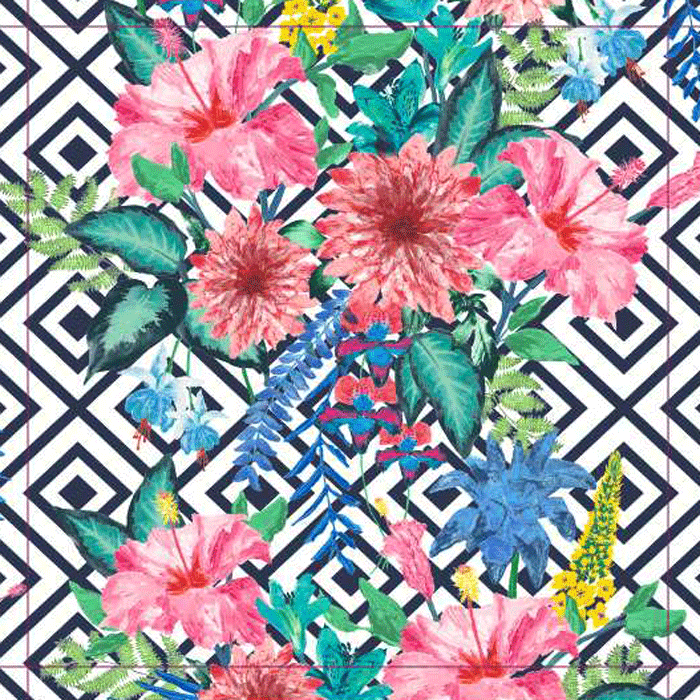
NYX Dublin, Portobello Cushions, panel design
Lynn explained that:
“The cushion became the focal point linking through to the artwork. We supplied all the curtain fabrics as well, which were very plain, but the small element of the room, which wasn’t the most-costly part, was the focal point of the room, and the thing people staying in the hotel will remember.”
Deborah also explained that digital panel printing helped with consistency. The sewing team can cut each panel with the key feature in the right place, reducing waste and avoiding awkward pattern placement.
Hotel Metropole Leeds: banded curtains without joins
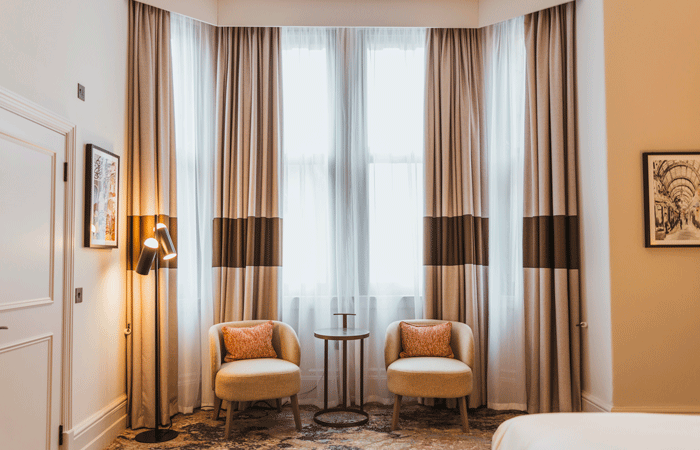
At Hotel Metropole Leeds, the client wanted horizontal banding on the curtains. Lynn explained that the effect could have been created by joining three separate fabrics, which would have been very costly and could have been very bulky in appearance. To overcome these issues, Skopos developed a printed panel design with the bands built into the curtain.
Hotel Metropole Leeds
That solution shows the team’s technique and problem-solving skills. The design gave the appearance of joined fabrics while keeping a softer drape. It also helped manage cost. The team developed three sizes to suit the hotel rooms, allowing the feature band to rest in-line with the window sill.
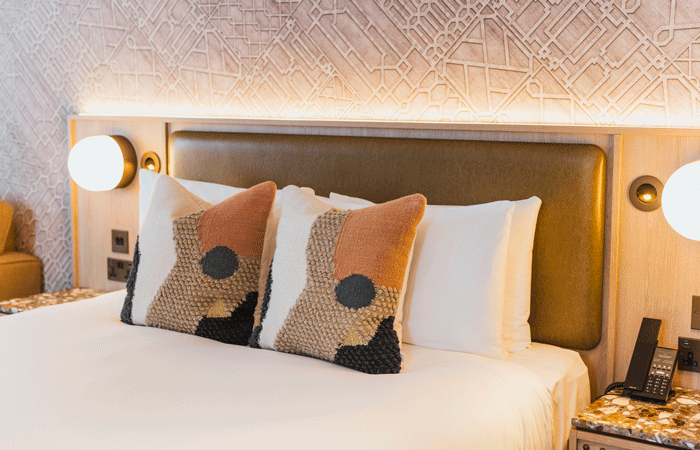
The same project included a bespoke colourway of Kiri, one of Skopos’ standard faux leathers, for the headboards and other standard products for upholstery.
Hotel Metropole Leeds
York Ibis Styles: a cushion with a clear location
For York Ibis Styles, the brief was to create a cushion that belonged clearly to the hotel and the city. Lynn described it as a design created for one location, giving the hotel something it could own.
“Ibis Styles is a good example of where something is created for a particular location. Sometimes there will be artwork by a local artist in the rooms, or the geographical landscape translated onto curtains or panels. It nods to the environment around that destination.”
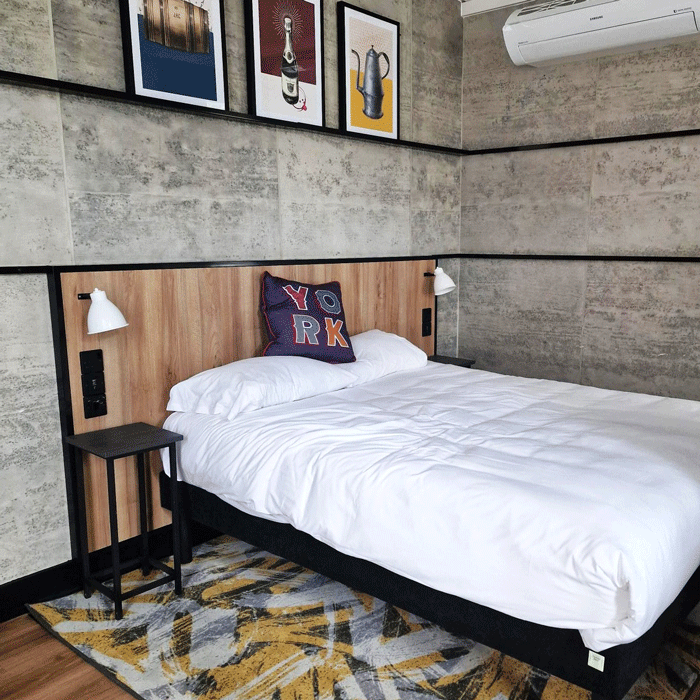
Ibis Styles York
The cushion gave a direct nod to York and helped connect the room to its setting. In hospitality projects, the team explained, local references can help a room feel specific rather than generic. The detail is important here, with lettering styles and choice of colours vital.
Marella Discovery: a full-service project at scale
The Marella Discovery project showed how far the bespoke service can extend. For the TUI cruise ship, Skopos supplied a mix of bespoke pieces, archive designs and standard products across cushions, upholstery, bedding, curtains, sheers and bed throws. Lynn explained that a cruise ship does not have a fixed location, so the design had to create an identity for the brand and the ship.
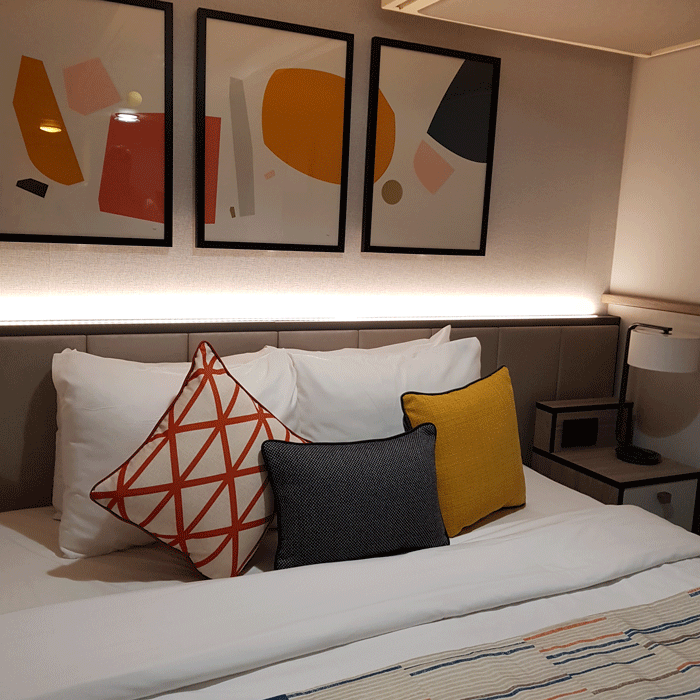
The Marella Discovery, TUI
“Marella Discovery is a good example of a project that had a lot of bespoke pieces in it, creating cushions, upholstery and bedding that were quite different, but could be owned by that brand and that ship. It was just for that ship.”
The project also drew on the Skopos archive. One design used on a contemporary chair came from the company’s founders in the 1970s. Deborah adapted it with added texture so it worked for the scheme. This brought archive knowledge, creative adaptation and technical delivery into one project.
Skopos handled design, sign-off with the TUI team, manufacture and delivery to a fixed deadline and budget. Cruise ship projects cannot slip because products need to meet the ship at the right dock for installation.
Beyond the individual project
Bespoke work can feed back into the wider Skopos offer. Some specials have later become collection or portfolio pieces as the Skopos team explained. Examples include plain velvets, herringbone designs such as Plume, and textures now included in the Studio Library. In these cases, a bespoke request revealed a wider market need. If a design is not exclusive and has broader use, it can then become available to other customers.
Sometimes a brief requires honest feedback. The design team understands the limits of print, weave, construction and scale, and can guide customers toward a solution that will work, which may sometimes involve adaptions to the original brief.
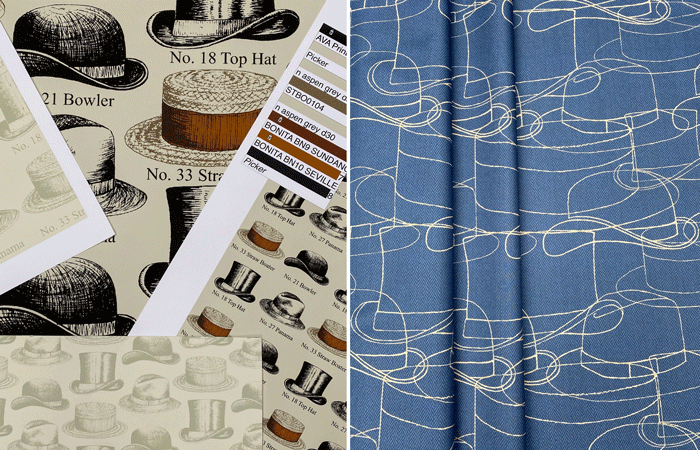
Curtain in a Luton Hotel celebrates the millinery heritage of the town
For larger projects, Skopos often produce trial curtains, cushions or throws, often for a full room, before wider production begins.
“We can do trial room quantities. If it is a project with many rooms, we can install a trial throw, trial curtains or a trial cushion, usually a whole room if it is a new concept. Because it is digitally printed, we can do a small quantity and make slight tweaks if necessary.”
This helps interior designers and specifiers gain sign-off. A trial room can be reviewed, adjusted or used to compare options. Digital printing allows this to happen quickly.
What bespoke delivers for the end user
For Skopos’ customers, the bespoke service offers the opportunity to be unique. The team described it as a way to create textiles that strengthen the identity of a space and give guests something specific to remember. For the customer, that distinction matters. Bespoke textiles can support brand identity, create a stronger sense of place, help an interior feel more considered and allow for future replacement when items need to be reordered. The value sits in having a design team that can interpret the brief, apply imagination and technique, and turn that work into a finished product. Lynn explained that this is particularly important in hospitality, where a memorable detail can become part of the guest’s experience.
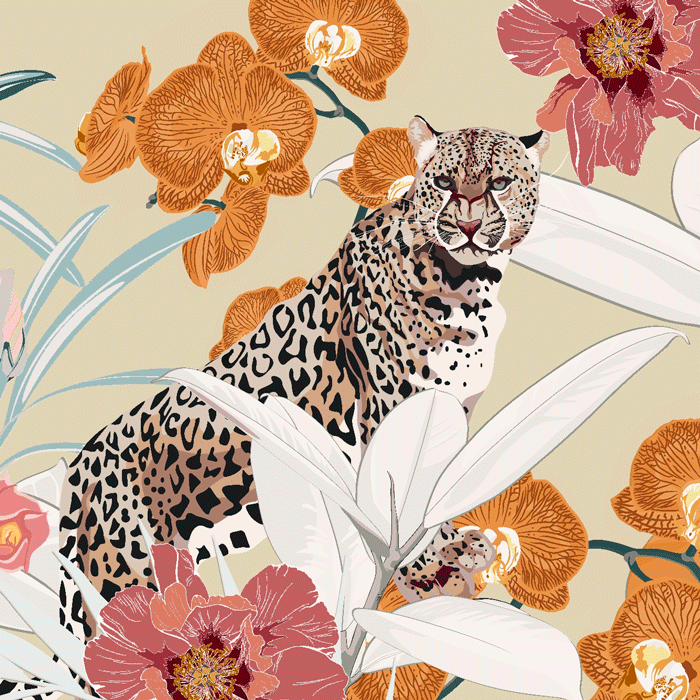
Bespoke panel design
“It’s about creating memorable experiences. With something like the York cushion, people put that in their memory bank and understand that it is part of that hotel and part of that experience.”
Karen added that bespoke design can give hotels the confidence to be more adventurous. That does not need to mean loud or overly complex. A scheme can be comfortable, inviting and tasteful while still feeling distinctive.
A full-service project can move from design to print and manufacture with ease: designed in-house, printed locally in Yorkshire, and made into finished items such as cushions, curtains or throws. Skopos can support the whole project with made-up items such as curtains, cushions and throws, with installation where required, engaging their highly-skilled team of manufacturers. At the end of the day, it’s about delivering what the customer wants!
Find Skopos on Supplier Finder
Supplier Finder is the UK’s only search platform for accredited suppliers of commercial interior furnishings.
At Supplier Finder, our mission is simple: to help you find the perfect commercial furnishing suppliers for your interior schemes and projects. We understand the importance of having confidence in the suppliers you specify and the products that bring your designs to life. That’s why each supplier featured on our platform is accredited through Commercial Interiors UK’s rigorous membership application process. This ensures that you engage with only the best in the industry!