


What Does True Flexibility Look Like in Modular Seating?
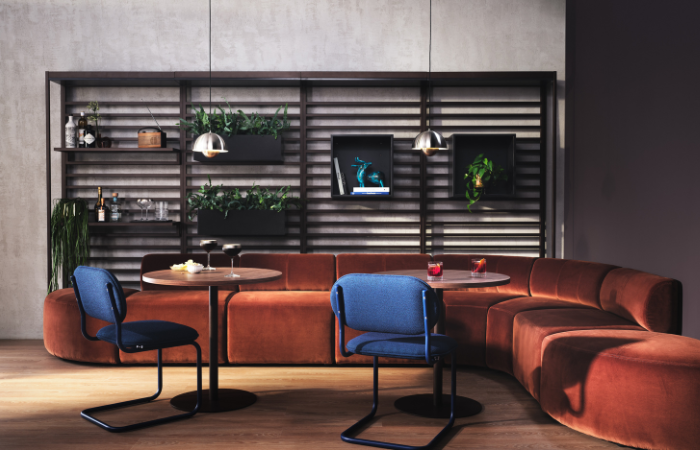
The best design solutions often begin with a frustration. For Hayley Lightfoot, Designer at sixteen3, that frustration was seeing ambitious curved layouts repeatedly compromised by furniture systems that couldn’t quite deliver. The result is Camino, a modular seating collection built around geometry, adaptability and long-term flexibility. We spoke to Hayley about designing systems rather than products and why modular design must balance freedom with restraint.
1. Hayley, could you begin by introducing yourself and your role at sixteen3, and tell us how your design philosophy aligns with the brand’s commitment to creating furniture that brings comfort, clarity, and connection?
I’ve been a designer at sixteen3 for seven years. My design ethos is really centred on creating furniture with satisfying proportions, and with a soft playfulness. I’m drawn to forms that feel logical and well-resolved, where nothing is awkward, forced, or overly showy. Good design is frictionless for the user, the maker, and everyone in-between.
This approach fits naturally within sixteen3, because so much of our furniture is customisable, and sits within a range of environments. The intention is that our pieces act as a foundation for personality rather than dictating it. The result is something that feels welcoming, legible, and able to take on the character of its context.

2. Camino was born from a very real design frustration, can you share what originally kept you awake at night and how that moment of problem-solving became the seed of this new modular system?
For a long time, I was frustrated by how poorly most systems deal with curved layouts – the geometry didn’t work logically, so pieces simply wouldn’t reconnect or resolve cleanly. At the same time, we didn’t want to repeat the design vernacular of similar products. The challenge was to create that flexibility while retaining our own visual language and achieving a comfortable scale to each individual module.
The answer finally came, as these things often do, during a sleepless night of overthinking. I visualised concentric circles and very specific slices that could unlock maximum flexibility while still feeling resolved. Rather than starting with a shape and adapting it over time, the entire range is built on a clear mathematical framework. It supports not only what exists now, but also allows us to add modules with new purposes, different angles, or even larger concentric circles – and it will all still add up.
3. You’ve spoken about seeing “impossible layouts” on floorplans. What kinds of spatial challenges were you encountering, and how did they inspire you to look for a more universal, “skeleton key” design solution?
We kept seeing the same issues come up: sweeping curves, changes of direction mid-run, or combinations of concave and convex seating were almost possible, but not quite and were ending up as bespoke joinery, or a compromise of the original design. I started collecting examples of every layout we couldn’t respond to and used them to define what a new system absolutely had to do.
Camino became a kind of skeleton key not because it solves everything, but because it solves a very specific and recurring set of real-world problems in a clear, coherent way.
4. Many modular seating systems promise flexibility, but often fall short in practice. What does true flexibility mean to you, and how did you ensure Camino delivers functional adaptability without becoming “design for everyone and therefore design for no one”?
Nothing is infinitely flexible, so I think where a lot of modular systems fall short is simply that they over-promise. Camino was born from a very specific set of real-world problems, and I’m confident it solves those problems well. There will absolutely be situations where Camino isn’t the right answer – and that’s okay. It can do several things extremely well, some things reasonably well, and some things its simply not designed for.
To me, true flexibility isn’t about universality; it’s about clarity of purpose. Knowing exactly what a system is designed to do and designing it to do those things properly. That’s far more valuable than trying to appeal to everyone
5. Walk us through some of the key design details within Camino, how did you approach the materiality, form, and craftsmanship to balance aesthetics, comfort, and sustainability?
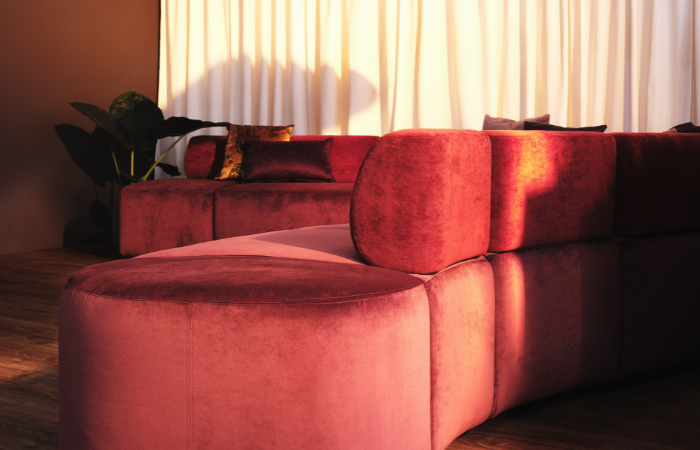
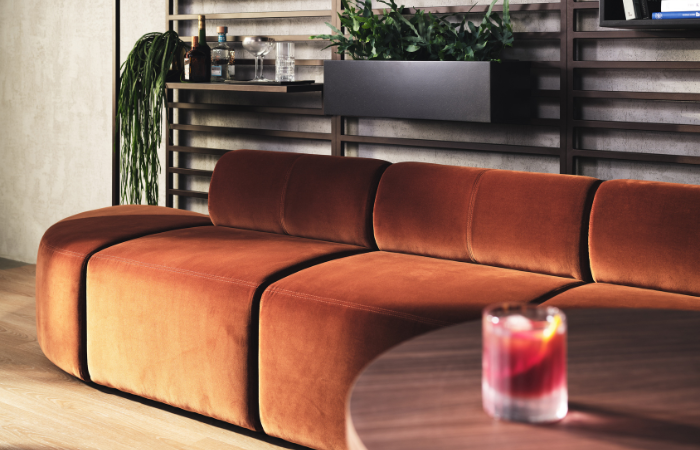
Camino was intentionally designed to be visually “quiet”. There aren’t many overt details because the focus was on proportion, continuity, and sense of purpose, rather than statement gestures. One of the key details is the rounded termination at the back of the backrests. The front needed to remain continuous to allow uninterrupted seating, but the rear didn’t. By softening that outer vertical edge, the modules feel finished from every angle. When multiple units are placed together, the backs form a subtle scalloped rhythm, adding softness and interest. This allows Camino to work equally well against a wall, back-to-back, or freestanding in the centre of a space.
Structurally, the frames needed to be extremely strong. The slim backrests have a small point of contact with the seat, so material integrity was critical. We opted for predominantly plywood – a proven, durable, and sustainable material. The foam construction uses layered recycled foams to balance comfort and support. We always aim for re-use, refurbish or recycle – so materiality, durability and disassembly are three pillars that, coupled with our takeback scheme, help us to achieve this.
6. Camino sits at the midpoint between lounge sofa and banquette. In your view, which types of spaces or settings does it suit best, and how does it respond to the growing overlap between workplace, hospitality, and social environments?
Camino is of course a great problem solver in physically awkward spaces – areas interrupted by columns, or layouts that feel too irregular for standard furniture. But the same can be said for areas like big open atriums where there aren’t floorplate limitations, but where the furniture can too easily interrupt the flow and the desire paths. You can create expansive, flowing arrangements but also small, highly tailored solutions where nothing else quite fits.
Because it sits between lounge seating and banquette, it’s particularly suited to spaces that change function throughout the day – workplaces that soften into social settings, hospitality environments that need flexibility, or hybrid spaces where people move between working, meeting, and relaxing.
Its ability to be disconnected and reconfigured also means it can evolve over time, not just within a single day. That long-term adaptability feels increasingly important as spaces become less fixed and more fluid and operators are looking to unlock greater value from the space they have.

7. Looking ahead, how do you see Camino influencing sixteen3’s future collections, and more broadly, how do you think modular design will continue to evolve to meet the changing demands of hybrid and multifunctional environments?
Camino reinforced the value of designing the system first. Starting with a clear framework – and establishing how a range could evolve, not just what it needs to do now, leads to more resilient, considered products. I’d love future collections to begin with that same mindset: clear rules, purpose, and coherent geometry that make sense long-term.
Aesthetically, Camino has also shifted our internal understanding of what else is possible – extending into really soft, fluid forms without losing the clarity, functionality, or ease that often sits more readily within geometric, linear ranges. It opens up new territory with furniture that retains logic and rigour, while also creating something warm and welcoming.
More broadly, I think modular design will continue to move away from the idea of furniture as something fixed or final. Hybrid environments – where spaces shift between work, hospitality, and social use – demand something that can adapt without feeling temporary or illegible. The challenge is ensuring that flexibility doesn’t come at the expense of identity. The most successful modular systems will be those that are underpinned by strong structure and clear intent, allowing spaces to change while still feeling resolved, calm, and purposeful.
Find sixteen3 on Supplier Finder
Supplier Finder is the UK’s only search platform for accredited suppliers of commercial interior furnishings.
At Supplier Finder, our mission is simple: to help you find the perfect commercial furnishing suppliers for your interior schemes and projects. We understand the importance of having confidence in the suppliers you specify and the products that bring your designs to life. That’s why each supplier featured on our platform is accredited through Commercial Interiors UK’s rigorous membership application process. This ensures that you engage with only the best in the industry!