



Inside BW: Where Culture Meets Construction
As BW: Workplace Experts enters a bold new chapter, the scale of its recent growth tells its own story. In the year ending 31 December 2025, BW reported record turnover of £326.7 million, up from £244 million in 2024, alongside a 132% increase in pre-tax profit to £13.9 million.
With a target of £350 million turnover this year, and ambitions to reach £500 million by 2030, the business has grown from a team of 65 in 2016 to close to 320 employees today. In March 2026, that momentum was reflected physically in BW’s move into a new 16,500 sq ft workspace at The Carter, close to St Paul’s Cathedral.
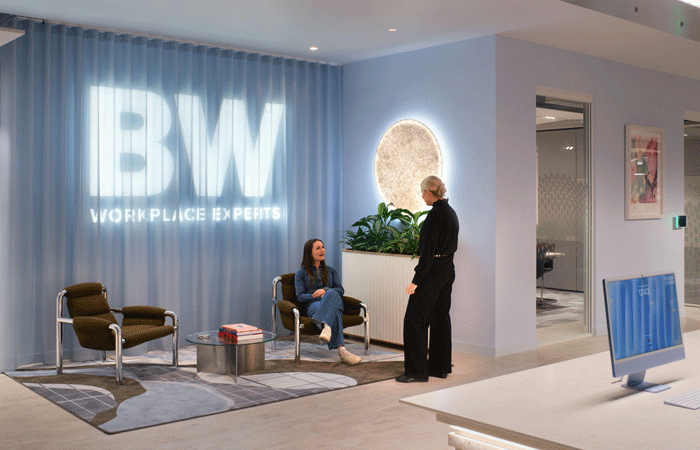
Design Insider visited BW’s new workspace to meet Anthony Brown, CMO and co-owner of BW: Workplace Experts, Zoë Allen, Founder of Artistic Statements, and Hayley Marcroft, Associate at Siren Design Group and lead designer on the project. Across our conversation and tour, we explored the role of art in shaping the identity and atmosphere of BW’s new workplace, how the team responded confidently to a complex structural floorplate, and how subtle, intelligent detailing brought BW’s fascination with construction vividly to life.
A New Era for BW
BW’s new support centre has been described as the start of a new era for the business. I began the conversation by asking Anthony what this project needed to say about who BW is today, both to the team and to the clients walking through the door.
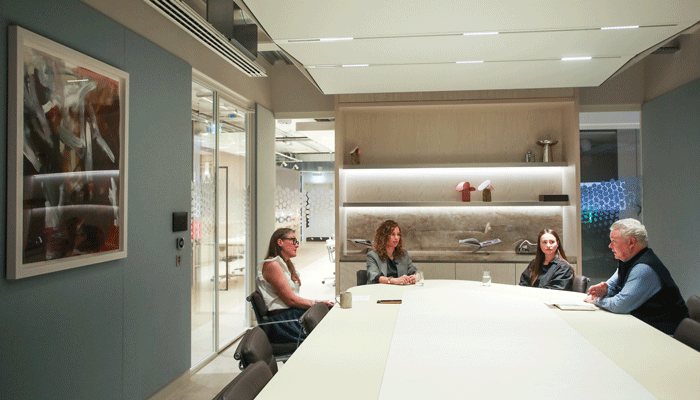
Left to right: Alys Bryan, Editorial Director at Design Insider, Zoë Allen, Founder of Artistic Statements, Hayley Marcroft, Associate at Siren Design Group, and Anthony Brown, CMO and co-owner of BW: Workplace Experts
Anthony explained that BW’s previous office belonged to a much earlier stage in the company’s story, and that ten years on, with the business now firmly established as a major force in the sector, the new space needed to say something different.
“We wanted a space that made a stronger statement about who we are as a company. It also needed to support recruitment. We are very focused on being defect free, not just as a delivery standard, but as a reflection of how people conduct themselves, so we wanted an office that lived up to that.”
What mattered was allowing more of BW’s independence and character to come through.
“We’re a private company. We’re not answerable to public markets or to shareholders looking for a return next quarter. That gives us some freedom to do things our own way, and we wanted an office that reflected that.”
Celebrating Construction
A central idea behind the project was ‘celebrating construction’, with materials, services and structure intentionally revealed, so I wanted to understand why that felt right for BW’s own workplace. For Anthony, the decision was rooted in pride, not just aesthetics.
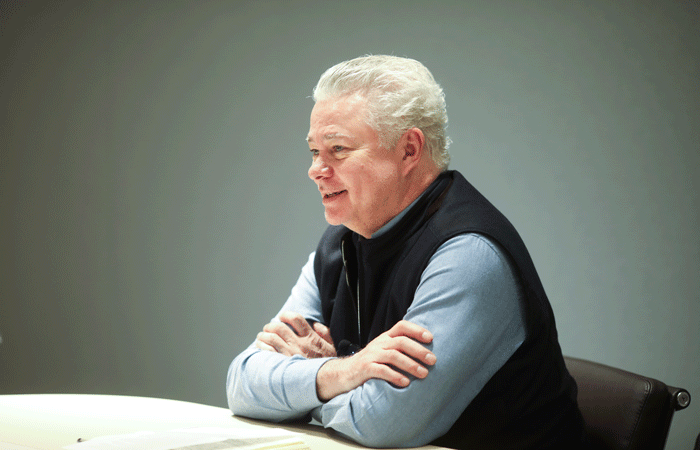
Anthony Brown, CMO and co-owner of BW: Workplace Experts
“I’m a workplace construction nerd, but it was important that the space revealed what we do rather than hiding it. Our industry does a lot of covering up with ceilings, raised floors and boxed-in elements. We enjoy what we do, and we wanted to take pride in it and share that.”
He added that this was one of the earliest and clearest ideas to emerge through the briefing process with Siren, and it went on to shape the entire project.
Designing for Community
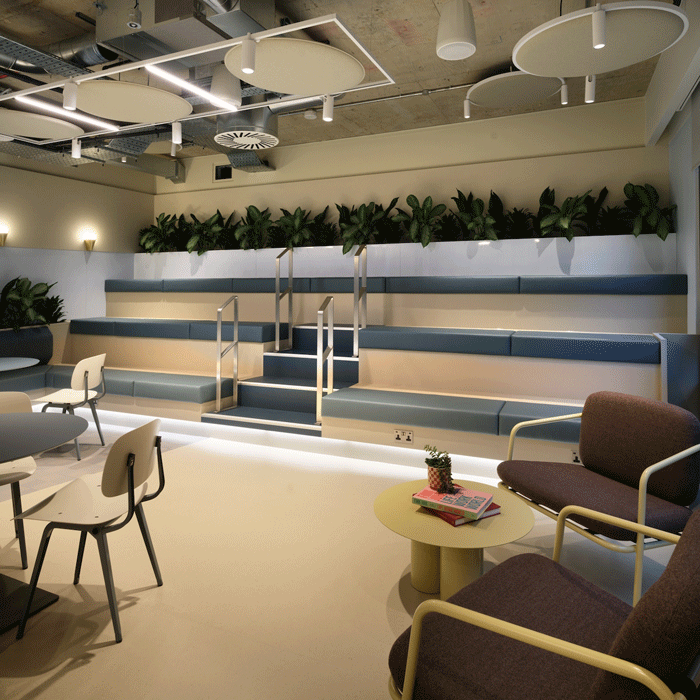
With the social hub, banquette seating and flexible meeting spaces playing such a visible role in the scheme, I asked Anthony what kinds of behaviour, connection and sense of belonging BW had hoped the office would actively encourage.
Rather than talking about formal collaboration, Anthony focused on the conversations that happen when colleagues cross paths.
“It was about capturing the conversations that don’t happen in meetings, the ones just before or just after, or when people meet by chance in the kitchen or the hub. That’s where the real business of work gets done.”
Even within the first few weeks, he said, the new environment was already shifting behaviour.
“People greet each other, even if they don’t know each other. People from different departments are coming together in the kitchen in ways they wouldn’t have before, and we’re seeing new groups form as a result, book clubs, chess groups and other activities that have grown from people getting to know each other and using the space differently.”
He also linked that atmosphere to the art scheme itself, adding:
“The art is part of that too. It gives people something to talk about that isn’t work.”
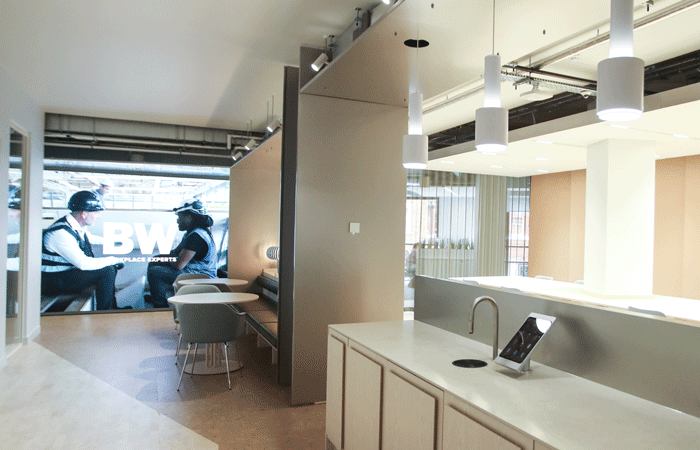
On our tour, that intention was easy to recognise. The planning supports overlap between focused work, informal exchange and social connection, rather than treating them as separate activities.
Why People Want to Come In
Because BW’s office-based team work from the workplace five days a week, I wanted to ask Anthony what, in his view, makes people genuinely want to come in and feel part of something bigger than their individual task list.
He first pointed out that around seventy per cent of BW’s people are site based, so the office functions more as a support centre than a conventional HQ. Even so, he was clear that being together still matters deeply.
“We were keen to welcome people back. We believe companies are communities of people who work best when they have time for informal conversations.”
He was also direct about what he sees as a diminished understanding of work.
“Most of what we now call work is sitting in front of a computer, answering emails or working through a task list. I don’t think that is the real work. The real work happens in the conversations, exchanges and ideas around it. The rest is simply the admin that comes with the job.”
On our tour, Anthony repeatedly returned to the fact that the workspace needed to support different working preferences rather than impose a single model of office behaviour. That could be felt in the variety of settings, from more social shared areas through to quieter rooms and lower-screen environments.
Space, Hierarchy and Culture
One of the most striking decisions within the project is that the best daylight and views have been given to shared spaces rather than senior leadership areas, so I asked Anthony what that says about the culture BW wants to build.
He framed the issue in terms of what space communicates.
“Space is always a political act. We are very much about trying to subvert hierarchy. We have no privileged spaces, and that is really important to us. Even if hierarchy never disappears completely, the way you allocate space still shapes culture.”
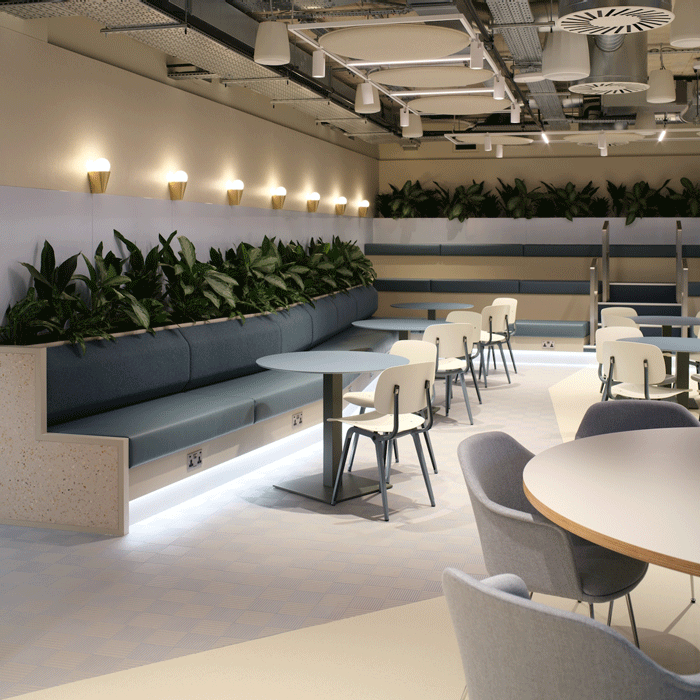
On our tour, that decision felt especially meaningful. Rather than reserving the best daylight for senior leadership, BW has given it to the café and social hub, creating a generous shared space where the team can gather, eat, meet informally and work more socially.
Reclaiming Attention
One of the most interesting things about speaking with Anthony is the way he uses the workplace not only to respond to current patterns of behaviour, but to question where those patterns may be taking us. To close my first set of questions, I asked him which workplace conventions he thinks most urgently need to be challenged, and where he believes the next shift may come.
For Anthony, the question is how the workplace can better support focus, clarity and more meaningful interaction.
“I think one of the great challenges of our age, not just in working culture but more broadly, is how people reclaim attention.”
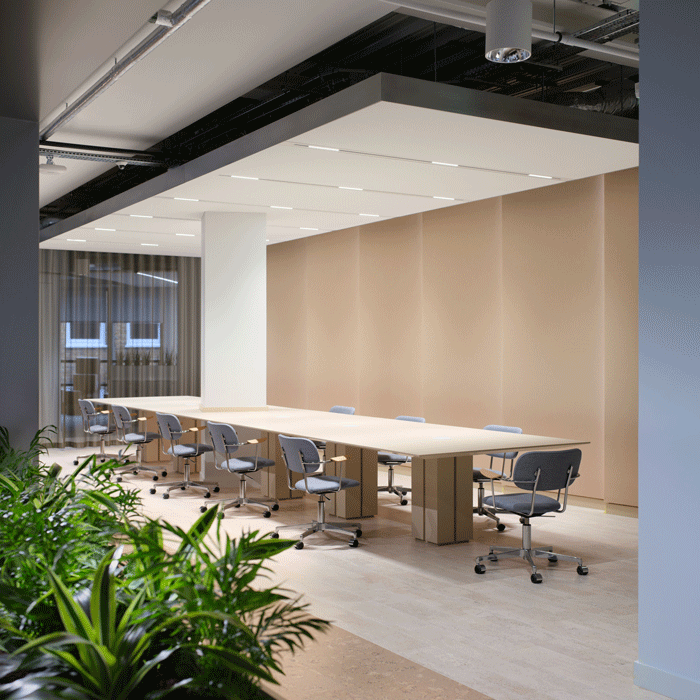
He explained that BW had thought carefully about quieter environments, acoustics and the role screens now play in shaping workplace behaviour, with some meeting spaces intentionally designed to feel lower-tech and less prescribed.
“One of the big challenges now is how we get people away from screens and over-specified meeting rooms. The meeting rooms without screens are actually the meeting rooms that are hardest to get, because the quality of discussions people are having in those rooms is very different.”
He added that this was never intended to be a fixed solution. Like the best workplaces, BW’s new space has been designed to evolve, with room to learn from how people use it and adapt over time.
Curating Art into the Workplace
I then turned to Zoë Allen of Artistic Statements. The art in BW’s new office feels closely connected to the identity of the business and the wider property and design community, so I asked where she began in shaping an art strategy that felt rooted in the project rather than decorative or secondary.
Zoë described the process as one of reading the business as much as the brief. Sustainability and integrity stood out early, but so did the importance of materiality within the developing design language.
“Materiality was one of the things that stood out in the vision of the space and I saw art as an extension of that.”
For Zoë, that meant treating art as part of the spatial language and starting the conversation early enough for it to genuinely shape outcomes.
“There were lots of conversations between Hayley and me to really make sure that it was all working in tandem, to be cohesive.”
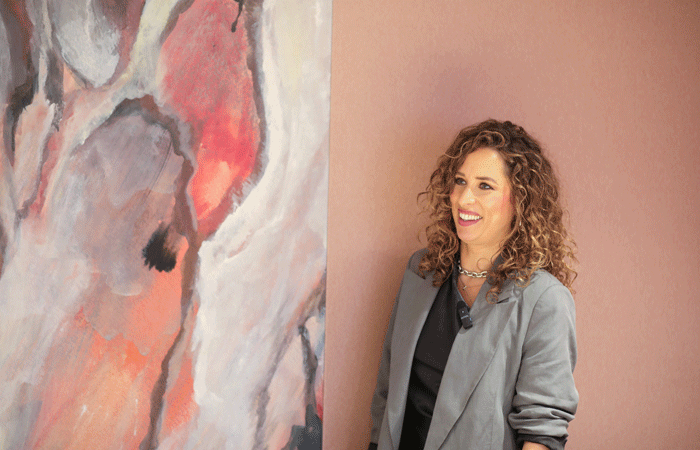
Zoë Allen of Artistic Statements with artwork by Fleur Peck
As we toured the workspace, that became much clearer. The works were selected in response to materiality, tone and atmosphere, often in close dialogue with Hayley and the design team.
Artists, Architecture and Storytelling
Several of the commissioned artists have direct links to architecture, design or workplace strategy, and I was keen to understand why that mattered so much within this scheme.
Zoë said the pattern became visible as the shortlist began to take shape, and then became part of the strategy in its own right.
“I think it creates a really interesting talking point for people coming into the space that the artists are connected to the industry itself. I don’t see art curation as sitting only within the art world. For me, it sits within the wider design industry, including architecture and craftsmanship.”
That overlap, she felt, gave the work greater relevance inside this particular environment and strengthened the project’s storytelling.
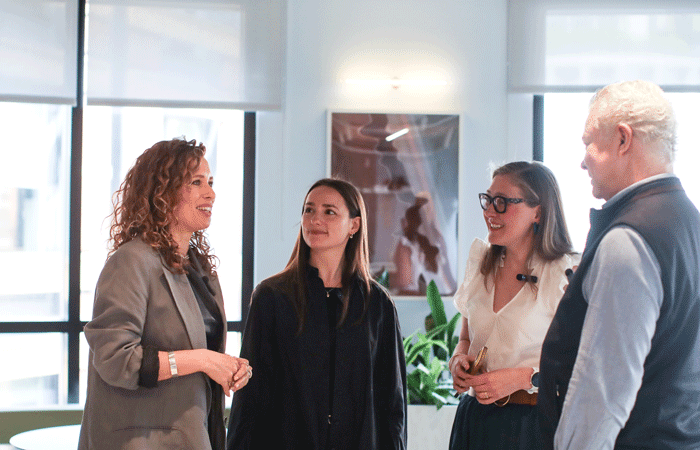
Artwork by Daniel Copitch
On our tour, Zoë spoke in more detail about how those disciplinary links played out across the scheme. Daniel Copitch’s work felt particularly at home in the café and social spaces, while Fleur’s pieces brought energy and movement into the meeting rooms, responding closely to their palettes and finishes.
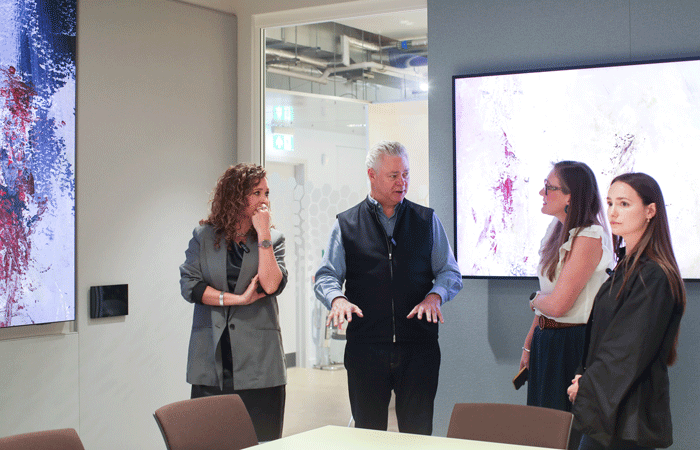
Artwork by Fleur Peck
Because three quarters of the commissioned artists are women, I also asked whether that balance had been intentional or whether it had emerged more organically through the selection process. Zoë was clear that it was not driven by a target, but by the artists whose work felt right for the brief and the wider story of the space.
Selection, Trust and Originality
From there, I asked what becomes possible when a client takes a risk on authentic and original artwork, rather than relying on off-the-shelf or tightly controlled solutions.
“I think seeing it from the viewpoint of the artist, it’s really important to be able to have the freedom to experiment.”
For Zoë, the brief still matters, but trust changes what the brief can become.
“It is my role as a curator to ensure the work responds to the brief. Beyond that, the process depends on trust, trust that I understand the objective and the aesthetic direction, while allowing the rest to remain open.”
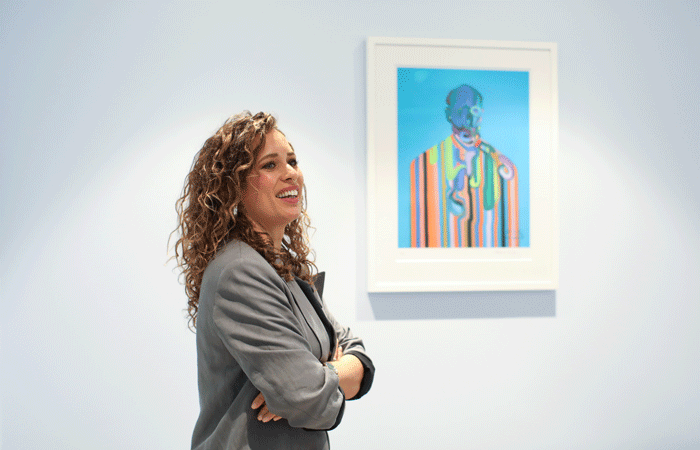
Zoë Allen of Artistic Statements with artwork Matisse in Blue” by Maxim Fomenko
That led naturally to a question about what a client needs to let go of in order to allow something more authentic to emerge.
“You can begin with a brief and a set of boxes to tick, but part of my role is to challenge the assumption that there is only one way to meet them. Often, a different direction answers the brief more fully.”
On our tour, Zoë explained that this trust played out in very practical ways. Fleur’s pieces, for example, were developed in dialogue with the interior palette, with fabric samples shared so the work would sit precisely within the room. Elsewhere, restraint mattered just as much. In reception, rather than forcing in another artwork, the team allowed a temporary lighting idea to evolve into a final light sculpture and Vic Wright’s sculptures were a perfect scale to adorn the surfaces within the meeting rooms, Zoë explained that:
“They’re made of sustainable casting cement and a lovely addition to have 3D elements as well as the prints, paintings, light sculpture and acoustic art”
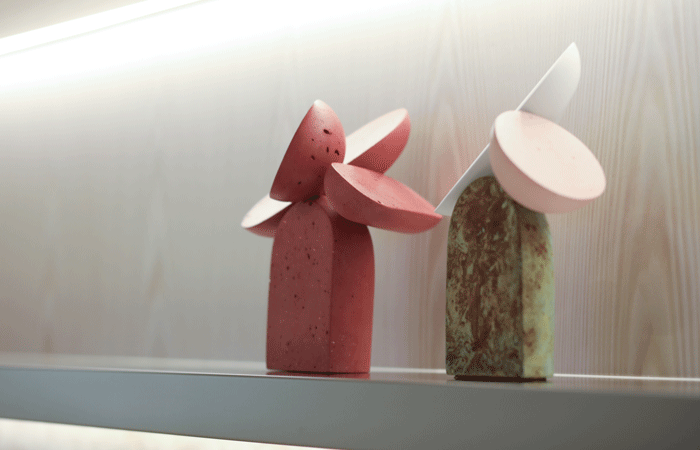
Artwork by Vic Wright
Have Workplaces Become Too Visually Cautious?
Finally, I asked Zoë to reflect more broadly on whether workplaces have become too visually cautious, and what role art can play in helping organisations express something more distinctive, human and memorable.
She began with the shift she has seen over the last decade, with a much better understanding of the value art can bring in terms of wellbeing, productivity and pride. But she also acknowledged the commercial pressures currently working against that progress.
“We’re at a crunch point. With budgets under pressure and the market as it has been over the last eighteen months, art is often the first thing to be value engineered out. I’d rather say, let’s have fewer artworks, but make them really good quality.”
For Zoë, curation is not simply about adding work to every available surface.
“I believe that a really great space sometimes doesn’t even need the art… It’s about using your curation skills to put the artwork in the right place when they’re needed.”
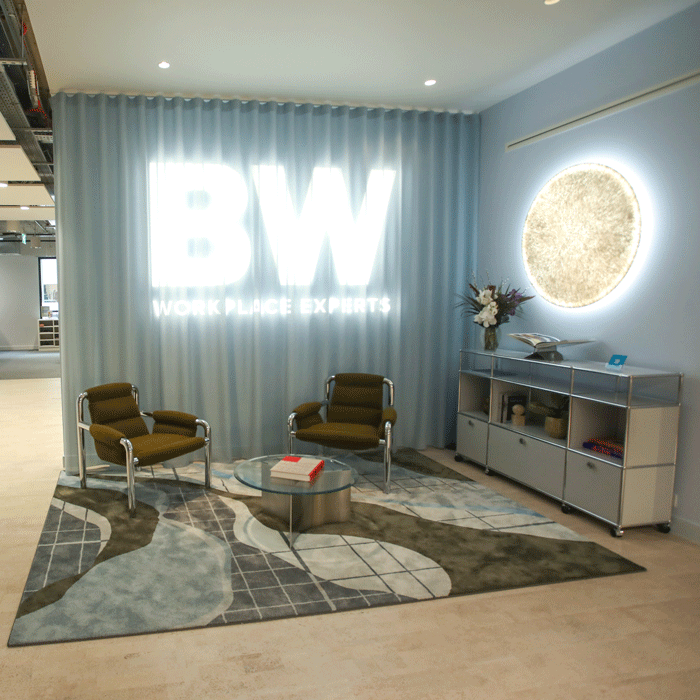
Artwork by Dagmar Zvonickova, crafted from 100% recycled plastic
On our tour, that judgement felt central to the success of the scheme. In the arrival spaces, the architecture, lighting and materiality already make a strong statement, so the art is used with restraint. In the meeting rooms, however, it takes on a more active role. Fleur’s piece, seamlessly incorporated into the wallcovering of one room, is a strong example of how art has been used to bring warmth, movement and a distinct sense of identity to the space.
Translating the Concept into Space
I then turned to Hayley Marcroft of Siren Design Group, the lead designer behind the project. With ‘celebrating construction’ forming such a clear conceptual thread through the scheme, I wanted to understand how that idea had been translated into a workplace that feels resolved from an architectural and interior design point of view.
Hayley spoke first about the breadth the concept made possible.
“I think ‘celebrating construction’ felt like a very natural starting point. It was an obvious concept for BW, but one that also offered huge variety in how we could showcase the best of design and commercial interiors. Aesthetically it opened us up to explore many expressions of construction through varied design language and material application.”
She explained that the idea extended beyond aesthetics and into shaping the layout and maximising the tricky floorplate, from the range of meeting room typologies to the distribution of pods, social space and collaboration opportunities.
“From an aesthetic point of view, it gave us scope to explore different expressions of construction through the detailing, finishes and colour palette.”
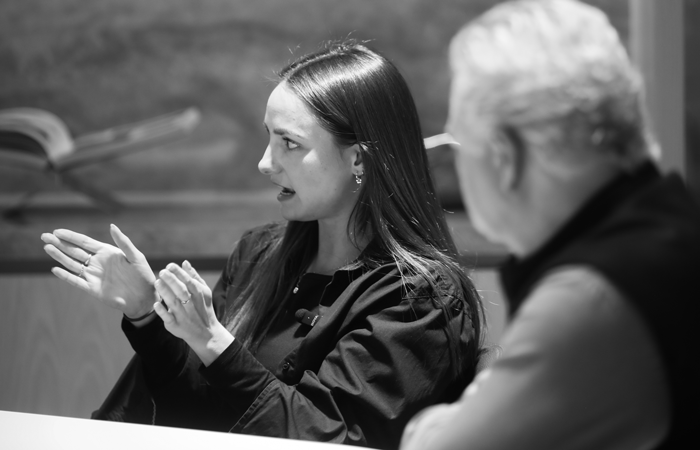
Hayley pointed out how thoroughly that idea had been carried into the detailing. The project repeatedly references section cuts, exposed edges, grids, structural rhythm and construction logic, but always in a way that feels carefully resolved rather than deliberately raw.
Working with the Existing Floorplate
The Carter floorplate comes with strong existing architectural features, including imposing columns and areas of reduced natural light, so I asked Hayley how those constraints and opportunities shaped the planning and atmosphere of the finished space.
She explained that the early layouts revealed just how much the columns would determine the feel of the project. An initial test fit placed the café and social hub further inboard, but that arrangement meant facing the columns rather than absorbing them seamlessly into the design.
The breakthrough came when the team pushed the social hub towards the strongest daylight and the arrival experience inbound.
“We had this ‘aha’ moment that the awkward space between the columns could become a series of mini environments, hosting layered, hospitality-led settings that feel welcoming, charismatic and rooted in wellbeing.”
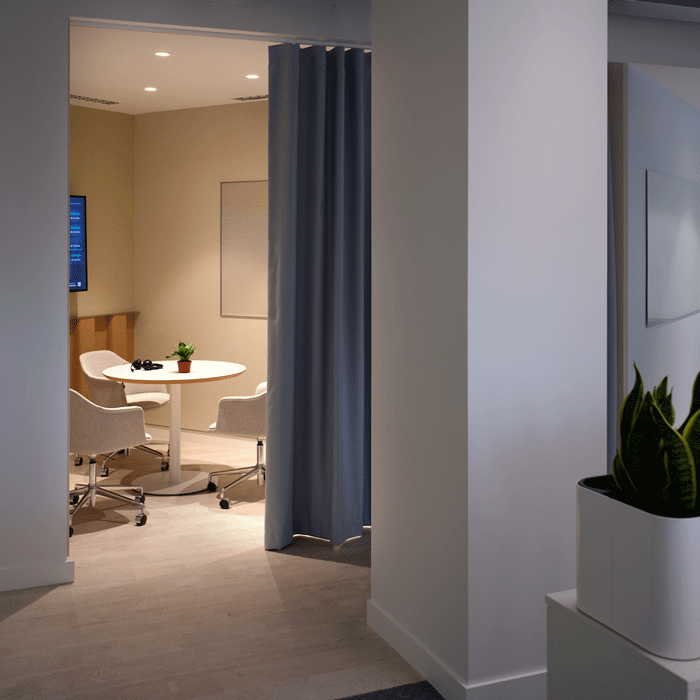
On our tour, the scale of that challenge was easy to understand. The columns are frequent and dominating, but rather than trying to disguise them, the design uses them to organise the floorplate and structure the experience of moving through it.
The Arrival Experience
My next question for Hayley focused on the arrival experience, with its curated environments, gallery-like quality and suspended steel ribbon weaving through the space.
She described the ribbon as the device that holds the sequence together.
“The architectural ribbon spanning between the columns created a continuous sense of movement through the space. True to the concept, we exposed its fixings and introduced deliberate breaks to disrupt and direct the flow through the joinery below to adjacent spaces, such as connecting the waiting lounge to the boardroom.”
From there, the arrival route unfolds into a series of connected settings, including a coffee bar, banquette seating with a library backdrop and touchdown area, each designed to support a different mode of arrival, waiting, gathering or informal work.
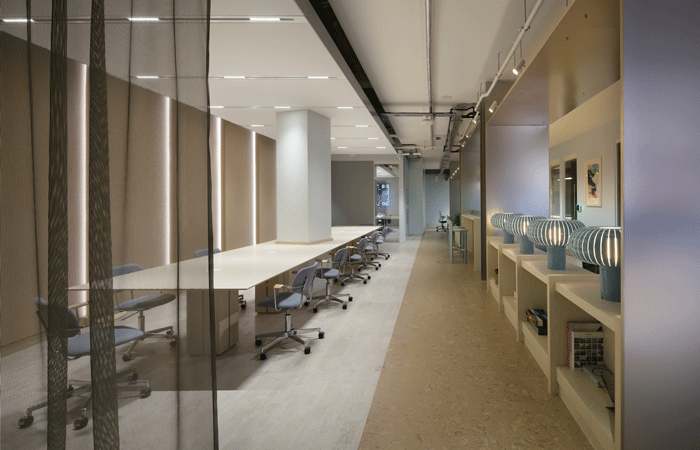
On our tour, the ribbon became one of the clearest expressions of the project’s conceptual discipline. Rather than acting as a decorative flourish, it guides movement, connects functions and reinforces the long gallery-like sequence from the lift through to the more social parts of the floor.
Technical Expression and Human Comfort
There is a careful balance within the project between openness, technical expression and human comfort, so I asked Hayley how she approached that tension.
She described a neutral architectural base palette through the circulation spaces, with colour and texture introduced through layered materials and softer finishes.
“We balanced a neutral foundation with warm cork floors and walls in an ice blue so that the decorative elements of the project could be built up in layers. It was important for the arrival and transitional spaces to be calm but still have edge.”
The more expressive moments, she said, are then allowed to emerge deeper within the scheme.
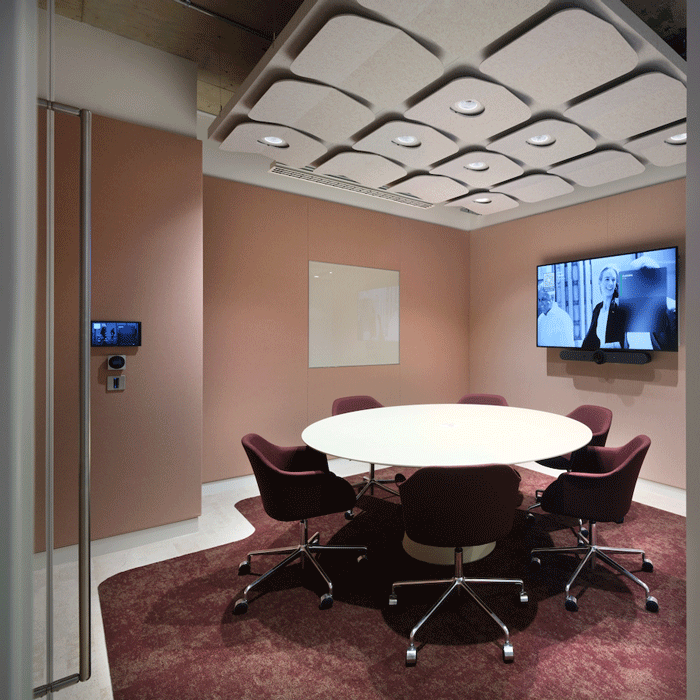
“Having five different designs grouped across the 17 meeting and focus rooms are where we were able to introduce more diversity and have a bit more fun. That variation brings personality to the scheme, but in a way that never feels overwhelming or likely to date.”
Materiality, Experimentation and Longevity
Materiality feels central to the project, from exposed and honest finishes through to low-impact and renewable elements, so I asked Hayley more broadly how she approaches the balance between tried and tested materials and newer options.
“Sometimes the cleverest approach is to take tried and tested materials and apply them in a different way so they feel new. I think that’s really important.”
That balance, she said, is often shaped by the need to make innovation feel reassuring to clients.
“However much we may want to use something new, clients often want it to feel fresh while still feeling safe. You have to find the right balance.”
A Workplace That Reflects the Business
BW’s new workspace responds clearly to the scale of the company’s growth while expressing the business it has become and the one it is still building. Through art that is fully embedded in the design, a confident response to a complex structure, and detailing that rewards close attention, the project brings BW’s culture into spatial form. The result is a workplace shaped around how people work now, and how they might work, meet and connect more meaningfully in the future.