




Shida Salehi on Cinematic Hospitality, Cultural Memory and Designing for Feeling
Design Insider’s Editorial Director, Alys Bryan, met Shida Salehi, Founding Principal at Customs Bureau, for an exclusive interview at The Londoner, where the pair sat down in the hotel’s private bar. Plush, atmospheric and quietly welcoming, it was the kind of room you could imagine brimming with life in the evening, although on this occasion they had it entirely to themselves.
The conversation explored Shida’s work, approach, passions and heritage in detail, bringing together the influences and ideas that feel especially unique to her and to Customs Bureau. What follows is an insight into a designer and studio shaping exciting new approaches to world-leading hospitality settings, from cinematic storytelling and cultural memory to global perspective and the future role of AI.
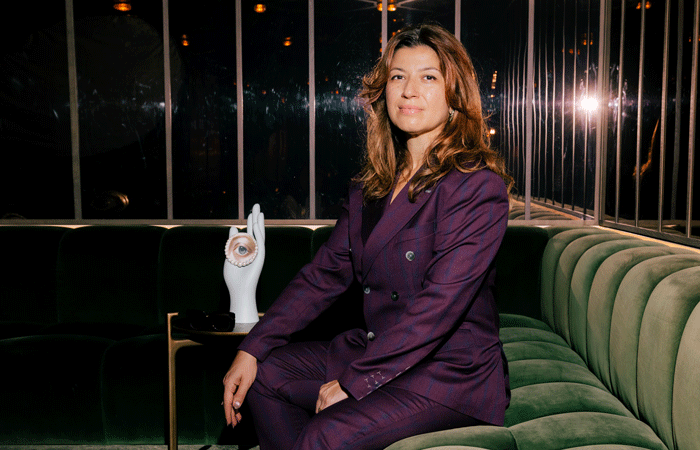
Shida Salehi, Founding Principal at Customs Bureau. ©Jonathan Clifford Photography
Hospitality as Cultural Memory
For Shida, hospitality begins long before a guest reaches a reception desk. It begins with anticipation, instinct and the subtle understanding that welcome is not a single gesture, but an experience that unfolds over time.
Her Persian heritage has shaped that view deeply, although she is clear that it forms part of her story rather than the whole of it. “I believe the Persian culture is inherently ingrained into us, in terms of hospitality,” she says. “As you’re raised, all of these things are really important. How you welcome a guest, that arrival experience, that attention to detail, this anticipation of your guest’s needs. It’s something that’s embedded in us growing up in the culture.”
When Alys asked Shida what luxury means to her, she explained that her understanding of it is far removed from more traditional interpretations.
“It’s not about just beautiful materials and expensive finishes,” she explains. “It’s that feeling that the space is considered, that you’re not just being accommodated but you’re being welcomed. That sense of anticipation, that’s true luxury, where somebody’s thinking about the next thing that you may be wanting or desiring or wanting to experience, or even curating that for you.”
Shida’s view of hospitality is generous, layered and resistant to the obvious. She is not interested in translating culture through motifs or themes. Instead, she talks about “layering”, “ritual” and “trying to evoke a feeling like a beautiful piece of music or a film.”
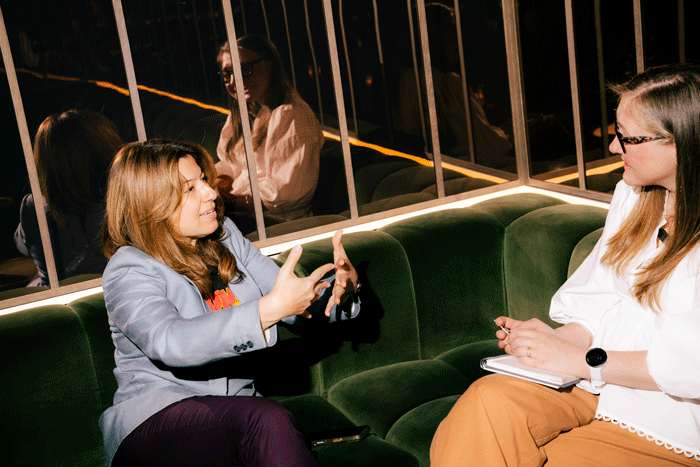
Shida Salehi, Founding Principal at Customs Bureau met with Design Insider’s Editorial Director, Alys Bryan for an exclusive interview at The Londoner. ©Jonathan Clifford Photography
Designing Through a Cinematic Lens
That filmic reference is central to the way Shida thinks about interiors. Across our conversation, she returns to cinema again and again, using it as a way to understand rhythm, feeling, movement and memory within designed spaces. For Customs Bureau, the studio she leads from its London design hub within the wider Woods Bagot and 7C Network, a cinematic approach considers how each individual space is viewed, experienced and remembered by the guest.
“It’s thinking beyond rooms and finishes, we’re actually creating worlds,” she says. “It’s looking into the sequence of space, the emotion, the character, the memory, the framing of how we want to tell a story. It’s about tapping into all the senses.”
Shida points out that a hotel is never experienced all at once. It unfolds through a series of encounters, decisions and sensory impressions. “You arrive, your first touch point, someone introduces themselves to you, you check in. Do I go to a reception desk? Do I not? All of these are moments that can be captured cinematically.”
This idea of hospitality as an unveiling becomes particularly compelling when Shida reflects on the intimacy of being welcomed into someone’s home. The experience is gradual and personal, shaped by how far the guest is invited in, both physically and emotionally. “If you were invited by someone to their home that is gracious and hospitable, it’s also about having this intimate moment,” she says. “It depends how far you get into the home. And even when you’re talking about hospitality, it’s the same thing. Your host is providing that experience, that unveiling or revealing of experience.”
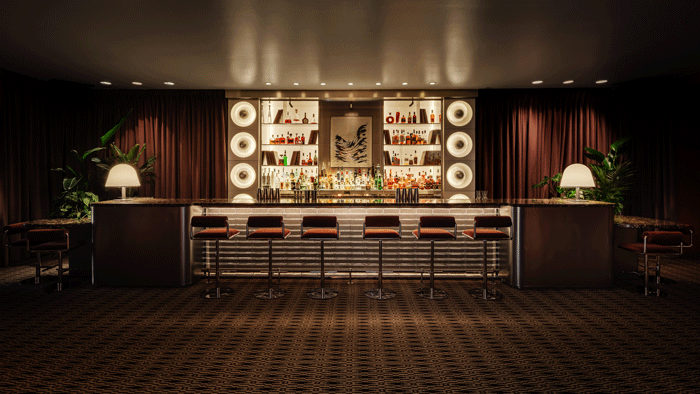
Séptimo cocktail bar at Four Seasons Hotel Brickell Miami, designed by Customs Bureau as an intimate, cinematic retreat within the energy of the city.
Rhythm, Framing and Reveal
For Shida, the cinematic quality of a space depends on control, rhythm and care. She talks about compression before expansion, darkness before view and pause before drama. One of her most vivid examples comes from the Park Hyatt Tokyo, whose elevator journey had been described to her for years before she experienced it herself.
“You’re in this tight elevator,” she recalls. “Throughout the day, the lights get dimmer and dimmer. So in the evening, when you take the elevator up to the jazz bar, your eyes are adjusting to the lighting conditions. As soon as the elevator doors open, it opens up to a view of Tokyo. It’s double height glazing and you just have this amazing view. Your eyes are already prepared to take it all in.”
For Shida, this is anticipation made physical. “All of a sudden I’m moving from a very small, tight quarter and then the frame expands to something more landscape and breathtaking. It creates a moment of, ah.”
In her own work, these ideas become practical design tools. Rhythm, light, framing, tension, pause and reveal all shape the way she thinks about arrival routes, restaurant entrances, bedrooms, corridors, bars and lobbies.
“Sometimes we’ll be designing a restaurant, but we’ll design the entry, the arrival experience first, because that is the first touch point the guest is going to feel,” she says. “It’s almost setting the tone and the experience up. Sometimes it’s more important than the actual meal because your environment impacts your senses.”
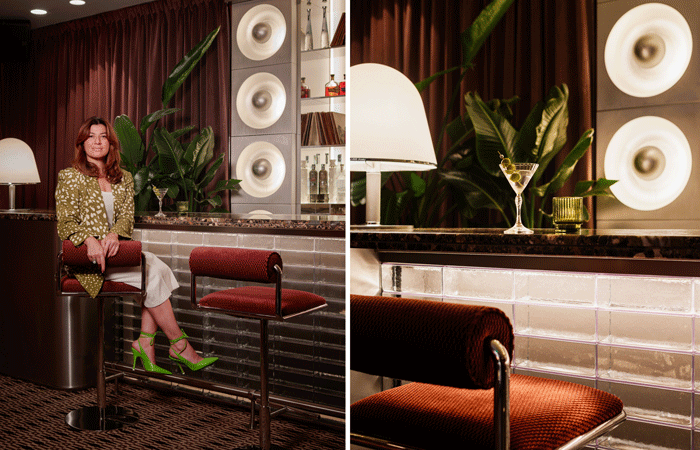
Backlit glass block, satin chrome surfaces and sculptural custom furnishings give Séptimo a refined edge, supporting Customs Bureau’s vision for a bar experience shaped through atmosphere, music and conversation.
From Arrival Sequence to Guest Experience
Shida describes an ultra luxury hotel project in the Middle East where the arrival sequence became heroic and monumental. The hotel brand’s doorman and door were central to the experience, but rather than designing a conventional oversized swing door, the studio imagined a more enveloping moment.
“We designed this really interesting revolving door where you step into it and the door, which is in a concave position, wraps around you and all of a sudden you’re thrust into the space.”
From there, the guest moves through a vaulted corridor where the stone floor wraps into the wall, creating a homogeneous, guiding surface. “It’s guiding you to your central framed viewpoint, the centre of this circular lobby entry,” she says. Around that circle sit a tea lounge, living room, patisserie, concierge, check-in and glass elevators. “That heroic central axis of framing the view becomes part of that cinematic experience.”
Storytelling as a Design Tool
This way of thinking also changes how Customs Bureau communicates with clients. Shida’s references come from film, contemporary art, culture, travel and memory as much as from hospitality design. She is interested in how stories help clients understand a space before it exists.
For a cocktail bar at the Four Seasons Hotel Brickell Miami, the studio needed to link the essence of a jazz bar with a Miami atmosphere. Rather than presenting the idea as a flat aesthetic proposition, they built a fictional story around a Japanese jazz musician.
“We told the story through a jazz musician named Sadao Watanabe,” she says. “We made it fictional by saying his music was found, that he was performing in listening rooms, and his music gets relayed to a friend in the military base, which gets transported to Miami.”
That story then began to shape the physical language of the space, Soft drapery, tactile fabrics, low lighting, and diffuse glows wrap the bar in warmth and intimacy. “We wanted the bar experience to feel like discovering a hidden corner within the hotel where guests can slow down, decompress, and disappear into atmosphere, music, and conversation,” Shida says.
Inside the studio, this cinematic curiosity is deliberately cultivated. Customs Bureau has a practice called Room Service, where the team watches films and discusses them through interiors and narration.
“We watch movies and then we get together and talk about them through the lens of interiors and through the lens of narration,” she says. “Depending on what kind of project we’re working on, we’ll reference different kinds of work. We get to talk about characters, colours, patterns, how we want spaces to be felt and seen, how we bring in that feeling of expansion and compression when we want to create a heightened sense of excitement in a space.”
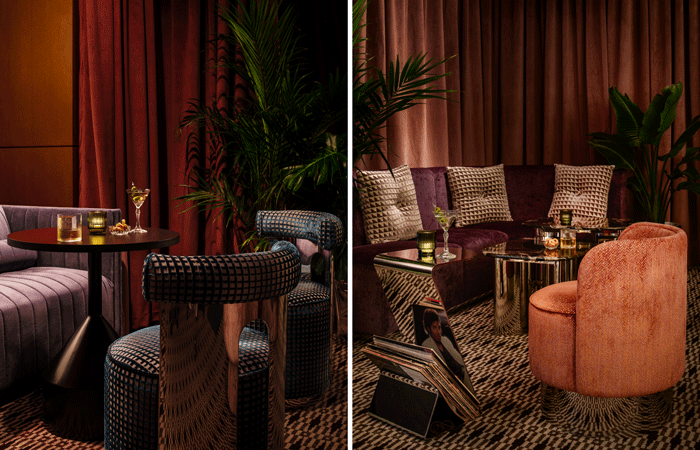
The design of Séptimo at Four Seasons Hotel Brickell Miami layers nostalgic references to 1970s cocktail lounges with a contemporary Miami sensibility.
A Boutique Studio with Global Reach
That process matters because Customs Bureau does not operate with a fixed house style. Shida is firm on this point.
“Our identity is found through our method more than the aesthetic,” she says. “I go back to the cinematic approach. How do we want people to feel? What is the brand looking for? How do they want to be perceived? How do we make this more innovative?”
That method is supported by Customs Bureau’s position within a wider international network. The studio’s design hub is in London, with global reach through Woods Bagot and the 7C Network, giving it access to market intelligence, resources and delivery capability across regions.
“We’re a boutique studio on the scale of a global company,” Shida explains. “A client gets the attention and level of detail of a small boutique studio, but the ability to tap into a delivery organisation that other studios just simply don’t have.”
Global Hospitality in Motion
That agility is important because luxury hospitality is evolving differently across markets. In the Middle East, Shida sees ambition, speed and an appetite for new typologies. “They’re trying to develop the next innovative approach to hospitality,” she says. “There’s an appetite for a new kind of hospitality in terms of typology, bringing people together, almost like third spaces, but really about bringing large groups or communities together.”
In China, she sees a highly design literate market with strong expectations, particularly in residential design. “They’re always looking for designers with strong points of view,” she says. “They’re not looking for a cookie cutter bathroom. In terms of luxury, they’re looking for a point of view.”
In the US, she sees lifestyle, membership and personalisation continuing to shape hospitality. “Luxury really is about that one-on-one experience,” she says. “People always talk about what kind of water. Instead of asking you, they’re just going to bring you the sparkling water that you always order. But it’s going to be even more than that.”
For all the global variation in hospitality, Shida’s approach consistently returns to feeling. The strongest hospitality experiences are designed to be sensed, remembered and retold.
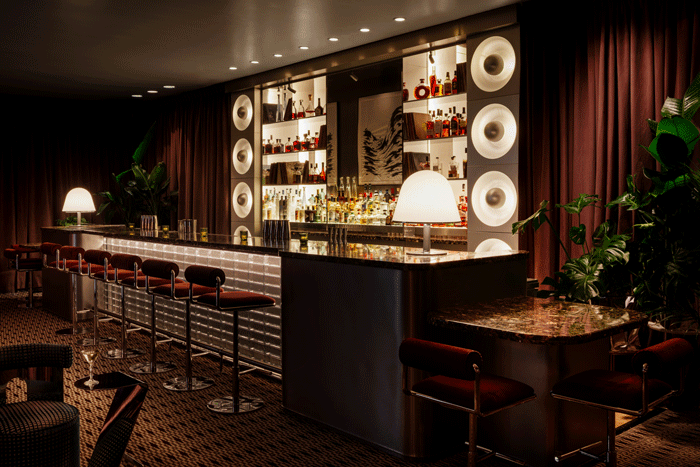
At Séptimo, Customs Bureau used low lighting, tactile fabrics and diffuse glows to create the sense of warmth, atmosphere and gradual reveal explored in Shida Salehi’s cinematic approach to hospitality design.
AI, Originality and the Future of Design
This is also where Shida’s view of AI becomes interesting. She is pragmatic, curious and direct about its role in design. “AI is super exciting,” she says. “It’s here to stay and it’s changing things.”
For Customs Bureau, AI sharpens parts of the process without replacing the studio’s thinking. “It’s accelerating research. We get to test narratives. We get to capture things that maybe we’re all trying to express but we can’t. It allows us a communication tool that we didn’t have before.”
Crucially, she says the studio’s conceptual thinking and design principles come first. AI is used to support narrative, visualisation and storytelling, while the direction still comes from the designer.
“We use it in the beginning in terms of concept and storytelling, not renders,” she explains. “I’m not designing the bar with it. I’m telling you the story of what that experience is going to be like.”
She also sees value in AI’s unpredictability. Midjourney, she says, can feel like “designing on acid”, producing strange, melting, exaggerated images. Yet that strangeness can be useful. “I’m not going to build that,” she says, “but I was like, oh, I never thought of this being mesh glass, or maybe it could be a screen.”
AI can provoke, but it cannot replace judgement. “You have to have an eye for what you’re seeing,” she says. The human designer remains essential because design still depends on critical thinking, creativity, innovation and emotional intelligence.
“If you have a vision, if you have clarity in your work, if you have a framework that’s based on something bigger than what the aesthetic is, then you shouldn’t have that problem,” she says of the anxiety that AI may accelerate sameness. “But it is a problem. We see it already.”
Shida’s answer is to use the tools while deepening the thinking around them. Context matters, process matters and the journey matters.
“It’s all about the emotional impact and the journey that we’re creating,” Shida says. “Like a beautiful piece of music. Like a piece of cinema. What is it that we’re trying to convey and make people feel?”
The Art of Being Expected
That question sits at the heart of her work. Whether she is speaking about Persian hospitality, a Tokyo elevator, a Miami jazz bar, an arrival corridor in the Middle East or AI’s role in future design, Shida keeps returning to feeling. For her, feeling becomes structure, a design tool, a memory maker and a way of turning space into story.
For Customs Bureau, cinematic hospitality is not about making interiors look like film sets. It is about understanding that every guest is moving through a sequence of frames, scenes and emotional shifts. Some moments are quiet, some are theatrical, some are intimate and some expand into spectacle. The art is knowing when to pause, when to reveal, and how to make the guest feel they were expected all along.
Shida’s viewpoint is that each story begins from a unique lens, and whether inspired through culture, film, art or technology, always revolves through experience. This approach is what moves and influences her designs and inspires the next space she is trusted to create and craft.
All project photography copyright © 2026 Kris Tamburello.