


Beyond Compliance: How Inclusive Design Drives Employee Retention and Productivity
Ben Channon, Head of Inclusive Environments at Buro Happold, has spent years exploring the relationship between people, wellbeing and the built environment. A healthy buildings specialist, architect and author, he believes the workplace has a far greater influence on employee experience than many organisations realise.
In this opinion piece, Ben shares his perspective on why inclusive design may be one of the most overlooked drivers of retention & workplace performance.

Why do some workplaces struggle to keep great employees, even when, on paper, they’re doing everything right?
In the contemporary workplace, recruitment, retention and engagement are no longer simply ‘HR issues’ – they are core business risks, especially in the post-pandemic, hybrid-working world we now find ourselves in. Finding and keeping the best talent is becoming an increasingly competitive arms race, and organisations are scrapping it out using perks, benefits and wellbeing strategies.
But there is one powerful lever that many companies are still overlooking: the physical workplace.
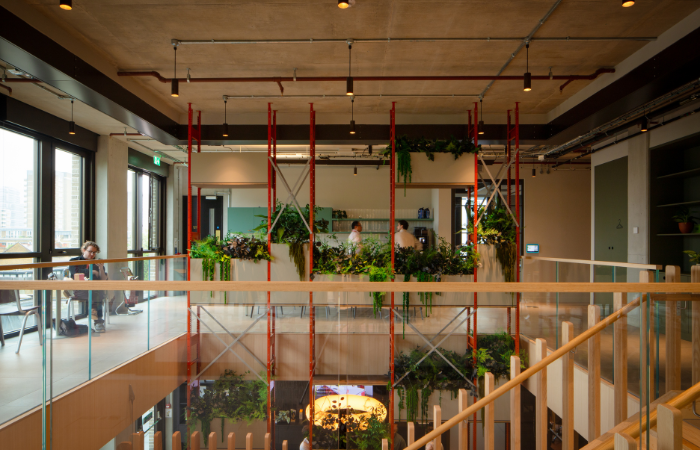
The Featherstone Building, Buro Happold’s New London Office
I am fortunate to speak to an incredibly wide range of people and businesses in my role here at Buro Happold, from architects and interior designers to clients or end users across what feels like almost every sector of the construction industry. And while many are incredibly knowledgeable about inclusive design, to some inclusive design still simply means ramps, lifts, and compliance with minimum standards.
The reality could not be more different. Inclusive design is not really about space – although that is often how it manifests itself – it is about people. In a workplace context, inclusive design is about creating places that recognise and respond to the full range of human difference, both visible and invisible.
To be clear upfront, this is not about making changes to benefit a small subset of the workforce. All of us can experience temporary or situational exclusion at different points in our lives – from permanent, progressive or intermittent impairments, to the temporary changes in circumstances, (such as having a broken leg when step free access suddenly becomes essential). Designing inclusively means acknowledging this natural variability and change in circumstances as a normal part of everyday life.
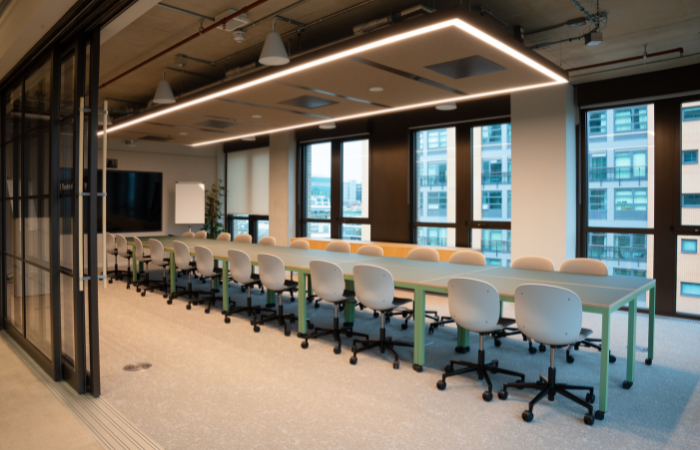
The Featherstone Building, Buro Happold’s New London Office
Structural measures such as gradients and lifts remain vital, but there is a significant difference between meeting the regulatory basics and reactive retrospective interventions, and the proactive, value driven ambition of genuine inclusion. Inclusive design is about how all of us experience buildings – and, fundamentally, about how we feel, perform, and belong at work.
Everything shifts when we begin to understand inclusive interior design as an issue affecting workplace performance, rather than a specialist or ‘edgecase’ consideration. At its core, decisions around layout, acoustics, lighting, materiality, furniture and spatial choice directly shape whether people can do their jobs well, day after day.
A useful way to think about this is through the lens of ‘daily frictions’: small but persistent moments that make it harder for us to do our jobs. These frictions often emerge from narrow assumptions about how people should work. Picture offices that are open plan without any refuge, spaces that are visually noisy with harsh patterns, or inflexible furniture that forces us to sit or work in ways that aren’t right for our bodies.
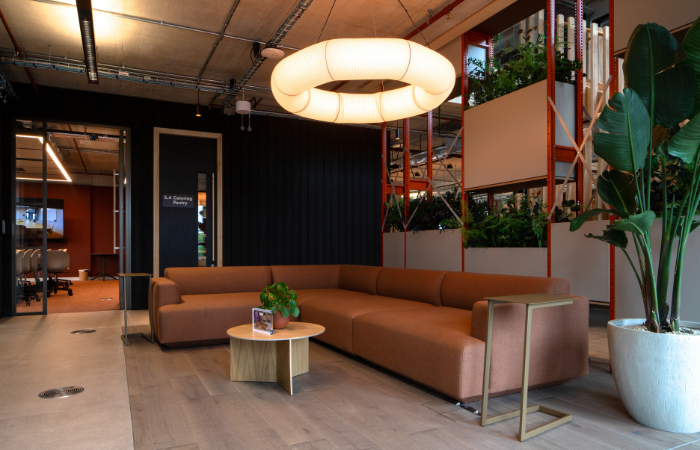
The Featherstone Building, Buro Happold’s New London Office
Over time, these frictions – caused as a direct result of design – can accumulate, quietly driving disengagement, performance loss and, ultimately, exhaustion. This is particularly true for disabled, neurodivergent or chronically stressed employees, but the impact is felt far more widely than we sometimes assume.
This helps explain one of the hidden reasons why many workplaces look successful on plan, but in reality fail to get the best out of the teams who use them. When the physical workplace makes daily work harder, louder or more draining than it needs to be, people eventually opt out – even if they like their job, their colleagues, or their organisation.
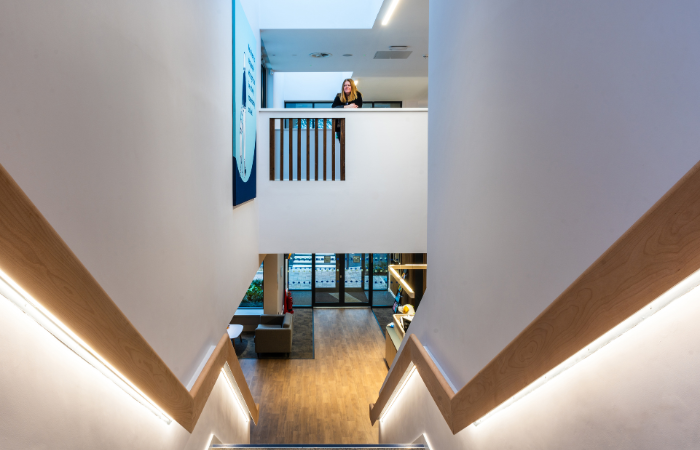
Guide Dogs Redbridge
The data backs this up. Research shows a clear link between staff retention and organisations where workplace pressures feel sustainable, rather than merely manageable in the short term. When the daily demands of work feel unsustainable, retention rates suffer even when pay remains competitive – underlining the importance of genuinely inclusive workplace environments. By contrast, inclusive workplaces actively support the people using them, enabling better work by offering choice, control and variety in how space is used.
It is therefore perhaps no surprise that studies consistently show us that staff in inclusive workplaces are more likely to look forward to coming to work, to feel pride in what they do, and to want to stay with their employer over the long term.
And crucially, this isn’t just about retaining the people you already have. The design of a workplace also plays a powerful – and often underestimated – role in determining who feels able to apply in the first place.
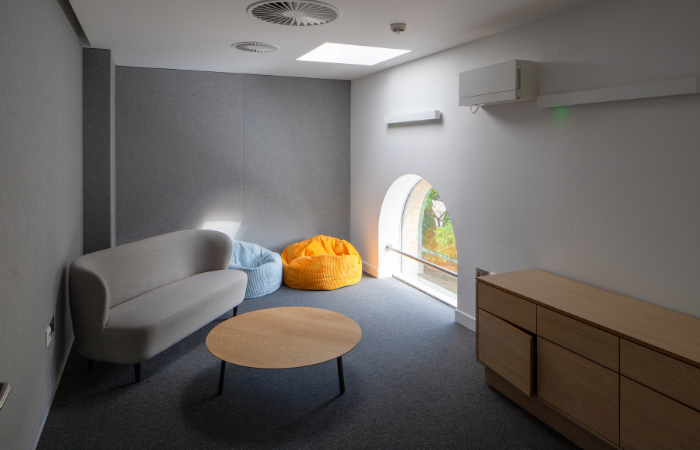
RNIB, Grimaldi Building
So what does this mean for interior designers and architects in practice?
There is, of course, no shortage of standards and guidance available around inclusive design. From PAS 6463, which focuses on neuroinclusion (part sponsored and contributed to by several colleagues here at Buro Happold), to the BS 8300 Codes of Practice on the design of accessible and inclusive built environments – such documents provide an essential reference point for designers.
They are an excellent starting place, although I would always recommend engaging experienced inclusive design specialists to ensure these principles are properly understood and meaningfully embedded within projects. That said, guidance alone is not enough. Creating truly inclusive workplaces also requires a shift in mindset around what we believe offices are for.
At a fundamental level, workplaces need to support different modes of work: focus, collaboration, social connection and recovery. Too many offices still attempt to collapse these into hybrid space types that are not particularly effective at any of them, creating unnecessary friction for users.
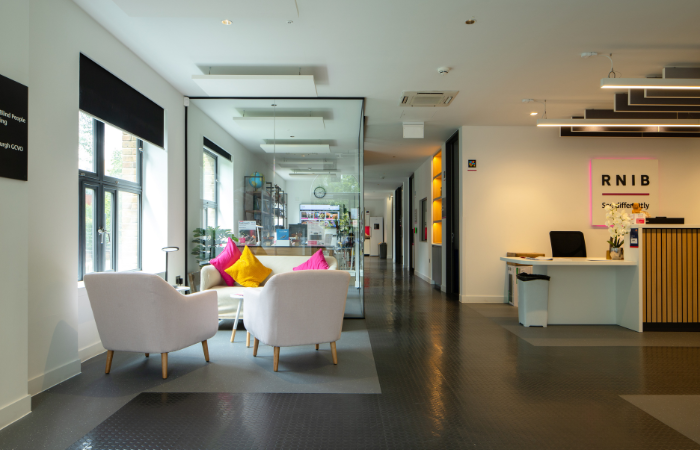
RNIB, Grimaldi Building
We also need to take psychological safety seriously as a design outcome. Legible, predictable and respectful environments can reduce anxiety and increase confidence, participation and – perhaps counterintuitively – creativity. While this is especially relevant for neurodivergent building users, it is a principle that ultimately benefits everyone. Clear layouts, intuitive wayfinding and cultural sensitivity are not aesthetic extras; they are core components of inclusive design.
The workplace also communicates powerful messages through its look and feel. A space that might appear neutral or even aspirational to some, can send very different signals to those who have experienced exclusion before. In this sense, the built environment often speaks more loudly than employer branding or value statements. This can significantly influence not only who thrives within a building, but also who feels encouraged – or discouraged – from joining an organisation at all.
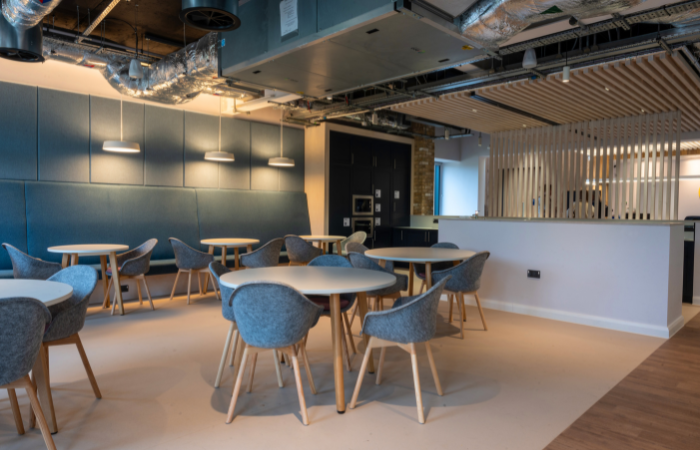
Guide Dogs Redbridge
At a time when many sectors are grappling with skills shortages, this matters. Inclusive workplaces broaden the pool of people who can realistically succeed within them, rather than forcing organisations to compete ever harder for the same narrow slice of talent.
Finally, it is vital that we move away from the idea that inclusive design can be delivered by one or two individuals working in isolation. Tokenistic consultation alone is no longer sufficient. If we are serious about reducing daily frictions for as many people as possible, we need to embrace genuine codesign and the principle of ‘nothing about us, without us’.
This also requires close collaboration with the wider consultant team – particularly acoustics and lighting specialists. At Buro Happold, we have found that when inclusion is understood and embedded by all disciplines from the outset, it is not only more effective, but often more straightforward and costefficient to deliver.
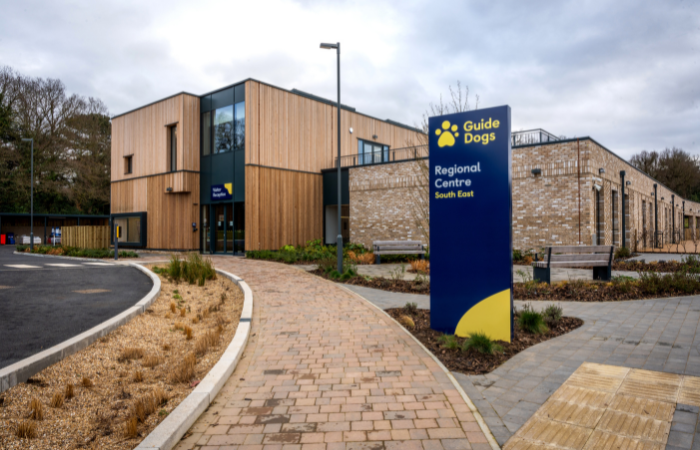
Guide Dogs Redbridge
The more I have learned about inclusive places, the clearer it has become that designers have far more influence on inclusion than we sometimes realise. The decisions we make shape how easy – or how hard – it is for people to thrive at work.
And this brings us back to the opening question. When workplaces struggle to retain great people, often it isn’t because of a lack of policy or intent. More often, it is because the environments we create quietly make work harder than it needs to be. Policy and operations teams play a vital role in creating inclusive cultures, but without supportive building fabrics and genuinely inclusive spaces, organisations will always be fighting an uphill battle against disengagement, reduced productivity and increased staff turnover.